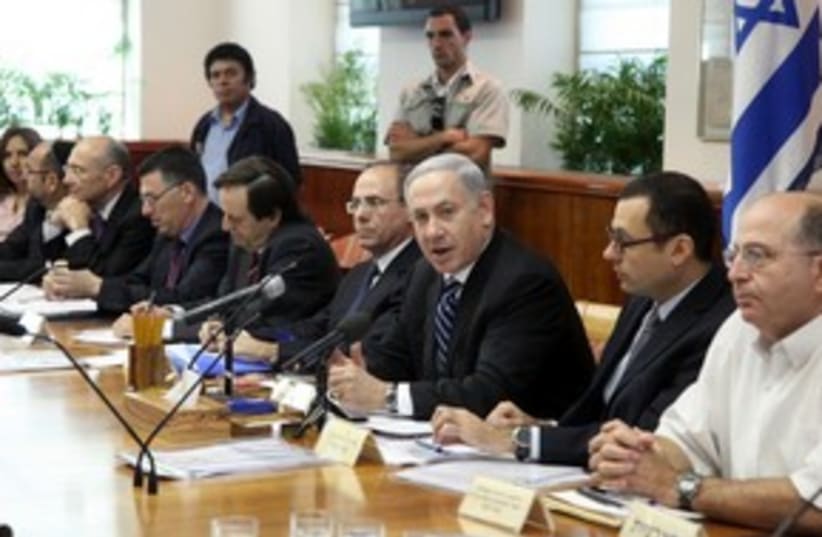
Netanyahu calls on int'l community to stop Iran from achieving nuclear weapons, which "endangers the peace of the entire world."
By TOVAH LAZAROFF, YAAKOV KATZ, JPOST STAFFNetanyahu at cabinet meeting 311.jpg(photo credit: Marc Israel Sellem)
Iran’s nuclear program is a danger to world peace, said Prime Minister Binyamin Netanyahu Sunday as he urged the international community to band together to stop it.“The international community must stop Iran’s race to arm itself with nuclear weapons – a race that endangers the peace of the entire world,” Netanyahu said at the start of the weekly cabinet meeting. In remarks to cabinet ministers, the prime minister said Tehran is closer to getting an atomic bomb than was originally thought.“Only things that could be proven were written [in the UN report], but in reality there are many other things that we see,” Netanyahu said, according to an official in the Prime Minister’s Office.The prime minister was briefed by Israel’s Atomic Energy Director Dr. Shaul Horev and Foreign Minister Avigdor Lieberman on a report on Iran’s nuclear program published last week by the International Atomic Energy Agency.RELATED:Republican candidates vow to stop Iran nuclear bombTurkish FM warns against military attack on Iran“This is a comprehensive document that strengthens the claims by leading countries in the world and Israel that Iran is systematically developing nuclear weapons,” Netanyahu said. “Any responsible government in the world needs to draw the obvious conclusions from the IAEA report.”Iran’s nuclear program will feature high on Defense Minister Ehud Barak’s agenda in talks he will hold later this week with Canadian Prime Minister Stephen Harper and Defense Minister Peter MacKay during a trip to Ontario.Barak will leave for Ontario on Tuesday and will hold talks with senior Canadian politicians.He will also attend an annual gathering of NATO defense ministers in Canada and will then travel to New York for talks with United Nations Secretary-General Ban Ki-moon.Barak plans to urge his international counterparts to impose tougher sanctions on Iran in an effort to prevent Tehran from developing a nuclear weapon.During a visit to Afghanistan over the weekend, MacKay told the Globe and Mail that he plans to ask Barak for clarifications about possible Israeli plans to attack Iran.“I think Ehud Barak... will be able to give us an insight into the thinking of the Israeli government about how they are going to respond to renewed suggestions and evidence that Iran is still aggressively pursuing nuclear capability,” the Canadian defense minister was quoted as saying.Israel’s emissaries around the globe have also been instructed to talk with their counterparts about increased sanctions.But at present, a united international front on Iran seems unlikely given that Russia and China have objected to stiffer sanctions from the United Nations Security Council.Still, US President Barack Obama lobbied both countries over the weekend during the Asia-Pacific Economic Cooperation forum that met in Honolulu.“We discussed Iran and reaffirmed our intention to work to shape a common response so that we can move Iran to follow its international obligations when its comes to its nuclear program,” Obama said after he met with Russian President Dmitry Medvedev.He also spoke about Iranian sanctions with Chinese President Hu Jintao.
Iranian Foreign Minister Ali Akbar Salehi on Sunday seemingly rejected the possibility of a diplomatic solution to ease tensions over the country’s controversial nuclear program, accusing the West of using the nuclear issue as “a pretext” to weaken Iran.“I think there is no purpose in making additional concessions,” Salehi said in an interview with the German weekly Der Spiegel.Salehi rejected the report released by the International Atomic Energy Agency last week, which said that evidence suggests Iran is working toward a nuclear weapon. The Iranian foreign minister accused the UN nuclear watchdog, and its head Yukiya Amano, of giving up “objectivity,” and bowing to pressure from “certain countries.”“We will call him and the atomic energy authority to account for these conclusions,” he told Der Spiegel.On Friday, the UN nuclear watchdog showed letters and satellite images as part of evidence pointing to military dimensions to Iran’s atomic activities, diplomats said, but Tehran’s envoy dismissed it as “lousy” intelligence work.Herman Nackaerts, head of nuclear inspections worldwide at the IAEA, made an hour-long technical presentation of the agency’s latest report on Iran’s nuclear program at a closed-door meeting for member states.Ali Asghar Soltanieh, Iran’s ambassador to the IAEA, said there were no nuclear-related activities at Parchin.“There is no proof that Iranian activities are towards military purposes,” he told reporters after the briefing.“We do have conventional activities [at Parchin] and this has nothing to do with nuclear.”Saying the report had damaged the UN agency’s credibility, Soltanieh added in English: “This kind of lousy job of intelligence created problems for all member states.”Reuters contributed to this report.Click here for full Jpost coverage of the Iranian threat
if(catID != 151){
var cont = `Take Israel home with the new Jerusalem Post Store