Netanyahu meets envoys, but Amidror's criticism not raised in meeting; PM warns Hamas could take control of the PA "any day."
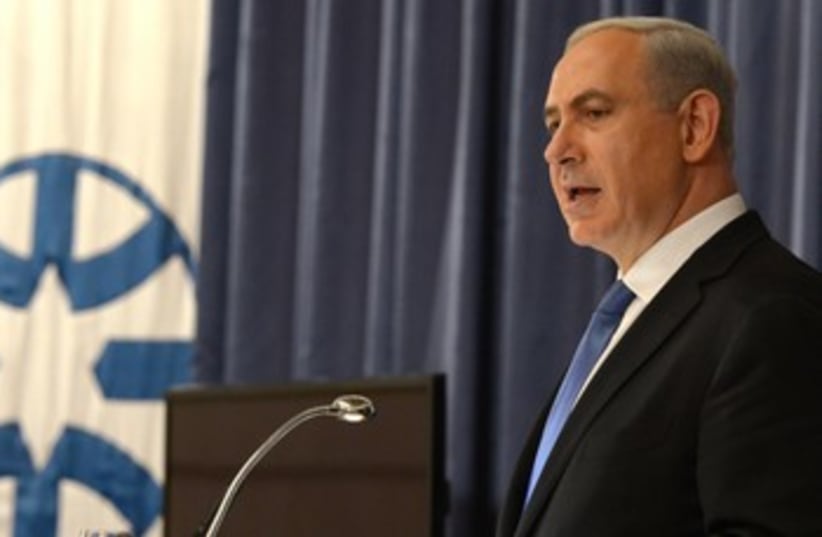
By HERB KEINONNetanyahu addresses ambassadors in Jerusalem 370(photo credit: Moshe Milner/GPO)
Iran has not yet crossed the red line that Israel set on its nuclear program, and Israel remains determined to prevent Tehran from acquiring nuclear weapons, Prime Minister Binyamin Netanyahu said on Thursday.Netanyahu was speaking at the last session of the annual year-end meeting in the Foreign Ministry for Israel’s ambassadors serving abroad.During a speech at the UN in September, Netanyahu drew a red line on a picture of a bomb signifying when Tehran would be 90% on the way to development of a bomb – meaning before it had acquired enough enriched uranium to build a nuclear detonator if it so decided. He said Iran would not likely pass that line until the spring or summer.“Iran remains the number one threat,” Netanyahu told the envoys, adding that there was a chance for positive change in the region if that country was prevented from getting a nuclear weapon. The prime minister added that in the short term he expected regional tribulations to continue.Netanyahu was accompanied to the meeting by his national security adviser, Yaakov Amidror, who earlier this week chastised the envoys for asking critical questions of Israel’s decision to announce construction plans beyond the Green Line in response to the Palestinians’ successful upgrade bid at the UN in November. When he addressed the envoys on Monday, Amidror said they could either faithfully represent the government’s decisions or resign.Ministry officials said the incident did not come up during the meeting with Netanyahu, though the prime minister did address the issue of E1, saying that what was stopping progress along the diplomatic front with the Palestinians was not an announcement of construction plans there but the Palestinian refusal to recognize Israel’s right to exist as a Jewish state within any borders.Netanyahu warned that Hamas could take control “any day” of the Palestinian Authority, and therefore “concrete security arrangements” needed to be included in any agreement, as well as a recognition of Israel as the nationstate of the Jewish people, an end to the “right of return” claim and an honest declaration of an end to the conflict.Netanyahu cited an editorial in The Washington Poston Wednesday to support his assertion that the E1 announcement was not the barrier to progress on the diplomatic front.That editorial, headlined “Overheated rhetoric on Israeli settlements,” argued that the criticism of the “flurry of announcements of new construction in Jewish settlements in Jerusalem and the West Bank” was counterproductive “because it reinforces two mistaken but widely held notions: that the settlements are the principal obstacle to a deal and that further construction will make a Palestinian state impossible.”The editorial noted that Netanyahu had limited construction in areas that both sides expect Israel to eventually annex as part of a final agreement, and that the government announcement of planning on E1 was “hardly the ‘almost fatal blow’ to a two state solution” that critics have claimed.In addition to Netanyahu, the envoys also heard on Thursday from Shin Bet (Israel Security Agency) head Yoram Cohen, who briefed them on the country’ security situation and said he did not believe Israel was on the brink of a third intifada. •Click here for full Jpost coverage of the Iranian threat
if(catID != 151){
var cont = `Take Israel home with the new Jerusalem Post Store