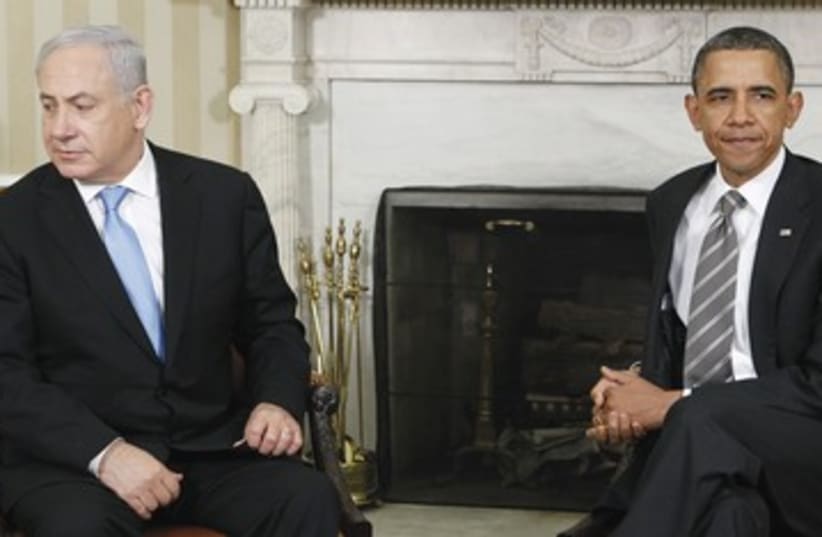
Announcement follows Netanyahu declaration that those who don't place "red lines" on Iran, have no right to give Israel a "red light."
By HERB KEINON, TOVAH LAZAROFFNetanyahuo Obama chilly awkward 390(photo credit: Jim Young/ Reuters)For the first time since taking office, Prime Minister Binyamin Netanyahu is slated to visit the United States without meeting US President Barack Obama. The lack of a meeting later this month comes in the midst of roiling tensions between Jerusalem and Washington over setting red lines for Iran’s nuclear program.Some have seen the absence of a face-to-face conversation as a further sign of strain in the relationship.A White House official said he did not have a final schedule for the president for that week. His response left open the possibility that a lastminute meeting could be added to the agenda.A request from Netanyahu’s office to meet with Obama in Washington as part of the prime minister’s trip to the United Nations in New York later this month was rejected for scheduling reasons, an Israeli official said Tuesday.Netanyahu, however, is expected to meet with other senior US officials in New York, including Secretary of State Hillary Clinton.When asked about the White House’s refusal to schedule a meeting between Netanyahu and Obama, an official there noted that the two leaders would be visiting New York at different times.News that the two might not meet came after tensions between Jerusalem and Washington over Iran burst into the open on Tuesday when Netanyahu attacked the US’s policy on Tehran at a joint press conference in Jerusalem with visiting Bulgarian Prime Minister Boyko Metodiev Borisov.Netanyahu said that those who do not place “red lines” in front of Iran have no moral right to put a “red light” in front of Israel when it comes to military action.Netanyahu’s words came in the wake of statements by Clinton on Sunday, and State Department spokeswoman Victoria Nuland on Monday, that the US had no intention of putting either red lines or deadlines in front of the Iranians.Clinton said that the US was not setting deadlines, and Nuland expanded that by saying that it was “not useful” to be “setting deadlines one way or the other, red lines.”Click here for full Jpost coverage of the Iranian threatNetanyahu, at the press conference with Borisov on Tuesday said that diplomacy and sanctions, which have hurt the Iranian economy, have not stopped the Iranian nuclear program.“The fact is that every day that passes, Iran gets closer and closer to nuclear bombs,” he said. “If Iran knows that there are no red lines, if Iran knows that there are no deadlines, what will it do? Exactly what it is doing.It is continuing without interference toward obtaining nuclear weapons capabilities and from there nuclear bombs.”The world, Netanyahu said, tells Israel to wait and that there is still time.“And I say wait for what? Wait until when? "Those in the international community who refuse to put red lines before Iran don't have a moral right to place a red light before Israel.”Iran must understand that there are red lines so it stops its nuclear program, he added.While government officials have spoken anonymously in recent days and weeks of a frustration with US policy on Iran, these were the toughest public comments yet by the prime minister on the matter.Since the beginning of the month, Netanyahu has repeatedly said that red lines needed to be established and that this was possibly one way to avoid the need for other action.Defense Minister Ehud Barak said on Tuesday night that his country had the right to act independently.“Israel reserves the right and the responsibility to make decisions, as necessary, with respect to its security and future, and the US respects this,” he said.“Despite the common purpose [between the two countries], there are certain differences between Israel and the US with regard to certain positions. But these are best dealt with behind closed doors.”He added these differences should not detract from America’s role as Israel’s primary ally and friend in the international arena.“Do not forget that the US is Israel’s main ally. We have intimate relationships in the intelligence field, and the US is Israel’s most important supporter in the security field,” Barak said. “The foundation of this relationship is a long-standing friendship and shared values between Israel and the American people.In spite of the differences, and the importance of maintaining Israel’s right to act independently, we have to remember the importance of our partnership with the US. We should do everything possible not to harm it.”US Defense Secretary Leon Panetta said Tuesday that his country was operating under a different timetable when it came to Iran. The US has more than a year to stop Iran should it decide to make a nuclear weapon, he said.“It’s roughly about a year right now, a little more than a year,” the Pentagon official said on CBS’s This Morning program. He also provided assurance that the US could stop Iran.“We think we will have the opportunity once we know that they’ve made that decision, [to] take the action necessary to stop [Iran],” he said, adding that the US had “pretty good intelligence” on Iran.“We know generally what they’re up to. And so we keep a close track on them,” he said.Furthermore, Panetta assessed that the US had the ability to keep Iran from constructing a nuclear weapon.“We have the forces in place to be able to not only defend ourselves, but to do what we have to do to try to stop them from developing nuclear weapons,” he said.Opposition leader Shaul Mofaz on Tuesday said he does not expect that Israel will take military action against Iran this year. Instead of making a decision on Iran, the opposition leader said, Netanyahu is busy subverting Obama.Mofaz went on to accuse Netanyahu of meddling in the upcoming US presidential elections, which he described as “irresponsible behavior and an error that harms the fabric of relations with [Israel’s] biggest ally.”Jerusalem’s relationship with Washington need not be sacrificed to eliminate the Iranian nuclear program, he added.As recently as Sunday, during an interview with the Canadian Broadcasting Corporation, Netanyahu said the US and Israel were discussing red lines for Iran.Netanyahu will be traveling to New York to address the Iranian issue at the UN General Assembly. He is scheduled to arrive in New York on Thursday morning, September 27, and fly back to Israel after Shabbat on September 30.Since Obama is not scheduled to be in New York during this period the Prime Minister’s Office informed the White House that he would be willing to come to Washington for a meeting.Diplomatic sources confirmed last night that there will most likely not be a meeting with Obama.According to the sources, the White House said this was the result of scheduling problems. Obama’s schedule is full, with campaign events around the country in the run-up to the November 6 election.White House spokesman Tommy Vietor said that Obama was not holding any bilateral meetings with foreign heads of state during his visit to New York on September 25 through 26.Hilary Leila Krieger and Gil Hoffman contributed to this report.
if(catID != 151){
var cont = `Take Israel home with the new Jerusalem Post Store