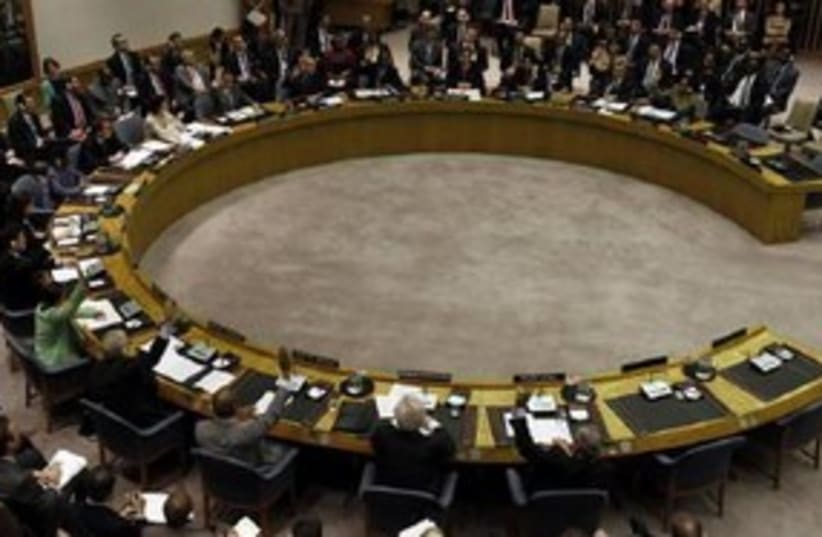
US confirms it will veto Palestinian statehood bid
"If any such resolution were put in front of the Security Council, then we would veto it,” official states.
By JPOST.COM STAFFUN Security Council_311(photo credit: Reuters)
The US will veto a Palestinian request for state recognition if it is submitted to the UN Security Council later this month, a US official said Thursday.Wendy Sherman, President Barack Obama's nominee for undersecretary of state for policy, the department's third-ranking position, told the Senate during confirmation hearings that “if any such resolution were put in front of the Security Council, then we would veto it.”RELATEDDiplomacy: How will we remember September?'PLO denies official launch of UN statehood bid'"The United States is very resolved to a veto threat in the Security Council,” Sherman said. “What we are very resolved about as well is urging the parties to enter into direct negotiations again.”The US had previously voiced its opposition to the Palestinians' unilateral move at the UN, but Wednesday's statements were the first official confirmation that the administration would veto such an appeal.While a Security Council veto would deny the Palestinians official member status, they could also seek upgraded observer status at the General Assembly as a non-member state.This could be interpreted as implicit UN recognition of Palestinian statehood because the assembly would be acknowledging that the Palestinians control an actual state. The advantage of this option is that it would require only a simple majority of the General Assembly. Since around 120 countries have already recognized the state of Palestine to date, it would most likely win such a vote.If the Palestinians were to be recognized as a non-member state, they would be able to sign certain international treaties, such as the Rome Statute of the International Criminal Court, which they cannot currently sign.George Mitchell, the former US special envoy for Middle East peace, said Thursday there was little chance US officials would be able to persuade Palestinians leaders not to seek greater recognition at the United Nations."I think there was and is little likelihood that they will succeed in that effort," Mitchell said at a conference on peacemaking at Georgetown University in Washington.Herb Keinon and Reuters contributed to this report.Click for full Jpost coverage
if(catID != 151){
var cont = `Take Israel home with the new Jerusalem Post Store