Palestinians, Jordanians join Knesset environment day
Friends of the Earth Middle East delegation, green group leaders, lawmakers discuss country’s most pressing environmental challenges.
By SHARON UDASINKnesset session 311(photo credit: Courtesy)
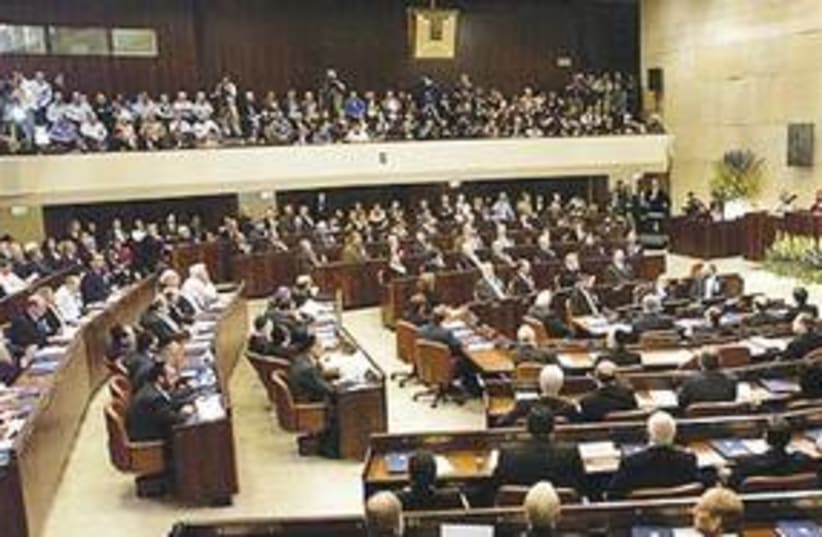
A delegation including 11 Palestinians and 11 Jordanians from Friends of the Earth Middle East took part on Tuesday in the Knesset’s environment day. They attended the afternoon environmental caucus and met individually with government officials.The Palestinians and Jordanians, accompanied by their Israeli colleagues, also attended an open environmental caucus led by MKs Dov Henin (Hadash) and Nitzan Horowitz (Meretz) and attended by Knesset Speaker Reuven Rivlin (Likud) and Environmental Protection Minister Gilad Erdan (Likud), where translators brought in by Friends of the Earth Middle East allowed the delegates to understand the discussions in simultaneous Arabic.“There’s never been a delegation like this, of Israeli, Palestinian and Jordanian residents, who are working together on environmental issues and have never before come to the Knesset. This is a first,” Friends of the Earth Middle East director Gidon Bromberg told The Jerusalem Post, just before the caucus began. “We’ve come with a very clear message: The current mechanism of how we are managing our shared water resources is shooting all of us in the foot.”The delegation, dubbed Trans-boundary Advocacy for Parliamentarians, also met in small groups separately with MKs Henin, Horowitz, Eitan Cabel (Labor), Ahmed Tibi (United Arab List-Ta’al), Yoel Hasson (Kadima), Shlomo Molla (Kadima), Afo Agbaria (Hadash) and Tzipi Livni (Kadima), as well as with Rivlin and Erdan. At these meetings, two Palestinians, two Jordanians and two Israelis joined together in presenting the group’s 55- page proposal for water sharing among Israel, Jordan and the Palestinian Authority.The current approach to water distribution, according to Bromberg, has “failed Israelis because it hasn’t given an incentive for the Palestinians to truly deal with sanitation issues, which means polluting their groundwater and our groundwater.” It has also “failed Palestinians because it hasn’t provided them with enough water. All of the residents speak of a terrible water shortage,” he said.“Our Bethlehem staff, for instance, doesn’t have water; they haven’t had water for three weeks,” Bromberg continued, noting that Bethlehem residents now rely on buying water from tankers. “That means they’re paying 10 times what they would pay from the municipality.”The mutual water crisis is currently at a stalemate, however, because the idea of water cooperation is “being held hostage by the failure to move forward in the peace process,” according to Bromberg. The report presented to MKs was on what a shared agreement might look like in reality. Bromberg expressed hopes that the politicians would see that water should no longer be used as a “playing card” and should be entirely separate from political issues.“We need the leadership, the government of Israel and the PA, to agree to allow the two water authorities to change the structure of their cooperative regime, which is the Joint Water Committee, and we’re presenting today in the Knesset what that change in structure could look like,” Bromberg told the Post. “It cannot be that in the shared mountain aquifer Israel takes 80 percent and leaves the Palestinians 20%. It cannot be that the Palestinians get no access to the Jordan River when the West Bank borders the Jordan River.”Palestinian and Jordanian representatives from the group told the Post they were unable to speak with the media about their involvement due to the sensitive nature of their participation.Throughout the rest of the Knesset’s environment day events, special discussions were also held on a variety of subjects, including solar licenses and quotas; water pollution and regulations; the dangers of cellphone radiation; sewage systems; and environmental economics, led by parties that included the Internal Affairs and Environment Committee; the Environment and Health Committee; the Science and Technology Committee; the Labor, Social Affairs and Health Committee; the Economics Committee; and environmental NGO leaders.MK Robert Ilatov (Israel Beiteinu) led an Economic Committee discussion about a potential cabinet decision to reimpose a freeze on solar installations, an idea that he said “contradicts the previous decisions and is unacceptable.”In agreement with Ilatov, Henin said that “there is no doubt that the quota program is a mistake that is disabling the sector from developing.”In an open forum on biodiversity led by Science and Technology Committee chairman Meir Sheetrit (Kadima), Sheetrit expressed dissatisfaction with the government’s treatment of animals and of open spaces.“Every animal has a role even if we don’t always understand this role,” he said.During the larger environmental lobby attended by the Palestinian and Jordanian delegates, Green Movement cochairman Prof. Alon Tal of Ben- Gurion University presented Rivlin with a new report about the status of Israel’s environmental organizations, which highlighted the economic struggle of the country’s green groups, among other issues.At the same meeting, Amit Bracha, executive director of the Israel Union for Environmental Defense (Adam Teva V’din), introduced a report about the privatization of natural resources, specifically looking at the risks involved with privatizing beaches, open spaces, the Samar sand dunes and portions of the Dead Sea.“Production of natural resources, gas and minerals of Israel is executed today by large private companies, and begs the question as to whether the state is capable of enforcing its policies on these companies, for whom the bottom line as far as they are concerned is achieving a profit,” said Nir Papay, director of environmental protection for the Society for the Protection of Nature in Israel. “Without a clear policy and firm regulation from the government, everyone’s natural resources are in danger.”While the country’s – and the region’s – environmental issues clearly were not going to be solved in one day, Bromberg was pleased with the progression of events and marveled that he was able to bring his delegation to the day’s events.“When we were consulting as to how we could go about this, Knesset lobbyists were saying, ‘Oh it’s impossible, you’re not going to succeed to bring Palestinians and Jordanians to the Knesset,’” Bromberg told the Post. “We’re seeing that all members of Knesset that we’re meeting are flabbergasted, to say the least, about such a delegation.However, as for those members of Knesset from the Right, we are having really serious discussions – we’re particularly telling the members of the coalition that they must show the leadership that we desperately need to stop holding the water issue hostage.”
if(catID != 151){
var cont = `Take Israel home with the new Jerusalem Post Store