New efforts to standardize liturgy for Holocaust Remembrance Day may help heal religious-secular rift.
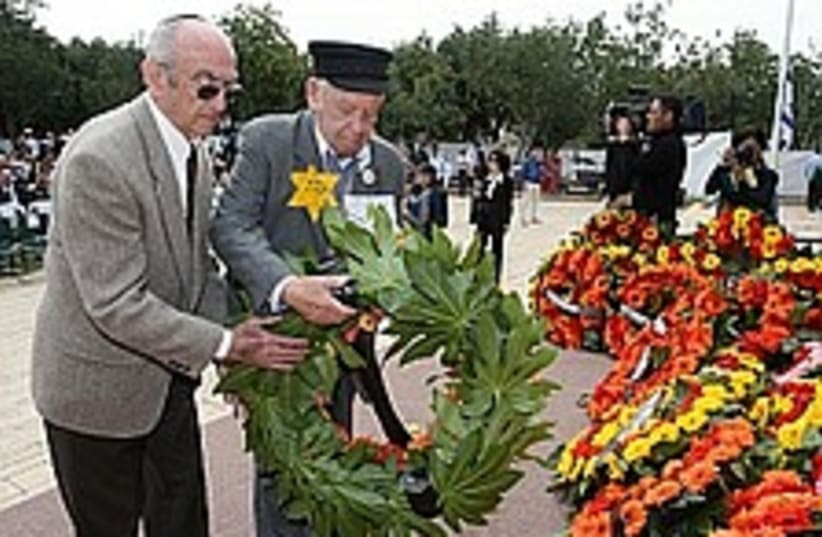
By MATTHEW WAGNERholocaust 224(photo credit: Ariel Jerozolimski)
In the winter of 1949 the Chief Rabbinate's Governing Council decided to designate the 10th of Tevet, a fast day commemorating the siege of Jerusalem that led to the destruction of the First Temple, as the official Holocaust Remembrance Day.
In its decision, the council detailed a number of memorial rituals including the lighting of a yahrzeit candle, learning relevant texts and the reciting of psalms and a Kaddish for those whose date of death is unknown.
The council also stated that "in the future, until the coming of the messiah, special atonement and lamentation prayers will be composed." But nothing ever was.
In 1986 the Chief Rabbinate reiterated its call to draft a special lamentation liturgy. This one was to be recited on Tisha Be'av, another public fast day that commemorates the destruction of both the First and Second Temples. Once again the rabbinate failed to follow through.
In 1992, Alex Eisen, a Holocaust survivor and Conservative Jew from Toronto, approached the Chief Rabbinate and requested the composition of special liturgical text, preferably in the form of a Shoah Scroll to be read publicly, that would memorialize those murdered in the Holocaust. He was turned down.
True, leading Orthodox rabbis, such as Shmuel Halevi Vauzner, Michael Weismandel and Yohanan Sofer, have penned special prayers in memory of those murdered in the Holocaust, which are recited primarily on Tisha Be'av along with many others commemorating the mass of Jewish martyrdom and victimization from various periods in history.
But not all synagogues recite these elegies to Holocaust victims. And in the meantime, the days set aside by the Chief Rabbinate for Holocaust memorializing have been almost totally eclipsed by Holocaust Remembrance Day.
ON APRIL 21, 1951, the Knesset, ignoring the decision by the Chief Rabbinate two years before to designate the 10th of Tevet as Holocaust Remembrance Day, decided that the 27th of Nisan would be the day that the State of Israel would remember Shoah victims. The Chief Rabbinate opted not to adopt the day designated by the Knesset. In part this was because opinions were split on whether it was permissible according to Jewish law to create a new day of remembrance. Some rabbis such Avraham Yeshayahu Karelitz (1878-1953), known as the Hazon Ish, argued that modern Jewry lacked the power to create new days of mourning or remembrance.
"Creating a new fast day for generations is a rabbinic commandment," wrote Karelitz, the most important spiritual leader of haredi Judaism in his generation. "All of our rabbinic commandments were instituted at a time when there was still prophesy. But how can we dare to do such a thing in a generation in which the best policy is to simply remain silent."
The rabbis also opposed the secular trappings of the state-endorsed Holocaust memorial culture. For instance, Rabbi Isaac Herzog, who served as Ashkenazi chief rabbi of the Jewish community in Israel after World War II, wrote a long halachic responsum on whether or not it is permissible according to Jewish law to build a monument to the deceased. His conclusion was that it would be preferable to build a synagogue or study hall that would be dedicated to the memory of Holocaust victims.
A dichotomy was created. The use of religious rituals such as liturgy, the learning of sacred texts and fasting to memorialize those murdered in the Shoah was allocated to the 10th of Tevet and Tisha Be'av.
In contrast, secular ceremonies such as torch-lighting and standing at attention during a memorial siren were allocated to Holocaust Remembrance Day with the religious aspects of memorializing, such as the reciting the Kaddish, kept to a minimum.
Still, the Chief Rabbinate is not the only one to be blamed for this dichotomy. As controversial historian Tom Segev pointed out in his book The Seventh Million, "From the very start, Holocaust memorial culture was meant to be an integral part of the secular national symbolism of the Zionist movement and the State of Israel."
Immediately after the war, writes Segev, "the Jewish Agency Executive realized that the rabbinate was gaining control over the memorialization [sic] of the Holocaust and had to be prevented from giving this important function a religious cast."
The Chief Rabbinate's failure to compose a significant liturgy commemorating the memory of the victims combined with the fear among early state leaders that the rabbinate would monopolize Holocaust memorializing have created a cultural chasm.
However, a liturgical composition called the Shoah Scroll (Megilat Hashoah) might just be the means of bridging this chasm. Eisen, the Holocaust survivor whose request to create such a scroll was turned down by the Chief Rabbinate in 1992, was answered in the affirmative by the Conservative Movement. Read for the first time in public on Holocaust Remembrance Day in 2003, the scroll, written by Avigdor Shinan, a professor of Hebrew literature at the Hebrew University of Jerusalem, with the help of an academic committee, was created as an attempt to ritualize the memory of the Holocaust.
"The kindling of six torches by survivors in the courtyard of Yad Vashem is a meaningful ritual, but will it last when there are no living survivors?" said Rabbi David Golinkin, president of the Schechter Institute, the seminary and educational center of the Israeli branch of the Conservative Movement, who helped edit the Shoah Scroll. "The survivors are disappearing and with them their first-hand accounts. We have an obligation to make the transition from private memories to a national memory now while there is a still a living connection with the survivors."
The six chapter scroll - symbolic of the six million killed - is meant to be read in the synagogue immediately following the evening prayer, like the scroll of Lamentations, which is read on the evening of Tisha Be'av.
It is built largely around first-person testimonies. After an opening chapter that gives an overview of the horrors of the Holocaust, the scroll goes on to tell the story of a Christian journalist observing life in the Warsaw Ghetto, a Jewish woman in a work camp and a Jewish youth who was forced to pull the teeth from his brother's corpse and shove other dead bodies into ovens. The fifth chapter contains a eulogy for those who died in the Holocaust; the final chapter recounts the efforts to rebuild Jewish life after the war.
Parts of the new scroll are supposed to be chanted in the same melody used on Tisha Be'av to recite the biblical Book of Lamentations.
Over recent years the popularity of the scroll, which has been translated into English, French, Russian and Spanish, and will be soon be translated it into Portuguese, has grown steadily. Synagogues around the world use it in public readings.
In Israel the reading of the scroll has not been limited to the small Conservative (Masorti) Movement. Last year the Israel Community Center Association (ICCA) printed the scroll as the centerpiece of a booklet which included excerpts from diaries, eyewitness accounts and modern Hebrew poetry.
The booklet, called "Let it not end forever" (shelo yigamer le'olam), a quote from a poem by Hanna Szenes, the secular Zionist hero caught and executed while on an undercover mission to save victims of the Holocaust, was used in ceremonies at 50 community centers around the nation.
Ya'acov Maoz, head of the Jewish Renewal Division in the ICCA and editor of the booklet, said that this year another 5,000 booklets were printed and more than 50 community centers are expected to use it.
"The booklet stresses the Israeli aspects of the Shoah," said Maoz. "The sources included with the scroll deal with the Holocaust less as an historical event than as something relevant to what is going on today."
He said that the reading of the scroll is not presented in the community centers as a religious act. "We are neither religious nor secular. We try to balance between Right and Left, secular and religious and we are happy about that."
In addition to being distributed in community centers, the scrolls will also be used by the Foreign Ministry in embassies around the world as a teaching tool.
IN HIS INTRODUCTION to the Shoah Scroll, Golinkin illustrates the importance of religious ritual as a means of preserving national memory by quoting from David Ben-Gurion's speech before the United Nations in 1947, on the eve of its decision to create a national home for the Jewish people.
Ben-Gurion pointed out that while Americans recall the sailing of the Mayflower, they cannot say when precisely the ship reached the shore of America, how many people were on it or what those people ate.
"And behold, more than 3,300 years ago the Jewish people went out of Egypt," he said. "Every Jew in the world knows the day they left - the 15th of Nisan. Every Jew knows what they ate - matzot. To this day Jews throughout the world eat matza on this day... and they tell the Exodus story... that is the nature of the Jews."
However, the strength of liturgical texts such as the Haggada is in their universality among all segments of the Jewish people: A Jew in Yemen and a Jew in Hungary recited virtually the exact same Haggada for hundreds of years.
Or as Golinkin says, "Historic events are remembered in Judaism only if they are anchored in religious rituals."
if(catID != 151){
var cont = `Take Israel home with the new Jerusalem Post Store