Security and Defense: IDF seeks to improve ability to coordinate, reduce time it takes to strike enemy target.
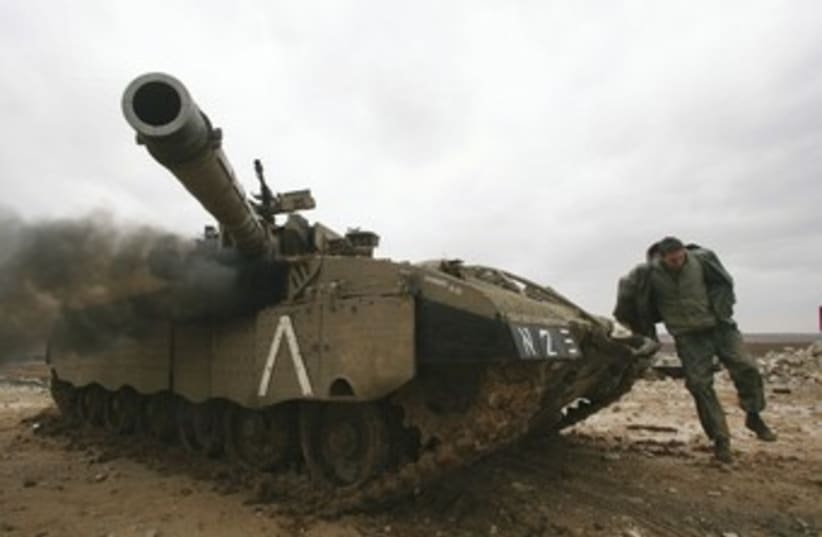
By YAAKOV KATZIDF soldier, tank outside northern Gaza 370(photo credit: Reuters)
Lt.-Col. Hanan Iserovich remembers it like it was yesterday. It was the beginning of August 2006 and Iserovich – commander at the time of the Nachal Brigade’s 50th Battalion – was deployed with his troops in a village in southern Lebanon. Suddenly, his radio crackled and on the line was an intelligence officer from the Northern Command.“There is a Hezbollah anti-tank missile squad in a home nearby,” the officer said. “Get ready.”Such intelligence was rare to come by during the war, leading to a comprehensive review of the role Military Intelligence is supposed to play in such scenarios. But this time it was dead-on accurate and within a few minutes. Iserovich had located the cell with his night vision goggles in a home a few kilometers away.As it turned out, an Israel Air Force Apache attack helicopter was flying nearby and Iserovich raised the pilot on the radio to request that he bomb the home where the Hezbollah cell was hiding.“It took me 15 minutes to explain to the pilot where the Hezbollah cell was and where my forces were” before he finally dropped the home, Iserovich recalled in an interview this week. “The pilot kept on going back and forth, asking me again and again to explain where my troops were located since he wanted to make sure that he would not hit them accidentally. Even though I was confident that we were nowhere nearby, it seemed to me that ultimately the pilot simply did not trust me.”Today, nearly six years since that fateful war, Iserovich is now an officer in the IDF’s C4I Directorate and is in charge of a number of communications projects aimed at ensuring that such miscommunications do not repeat themselves in the future.Immediately after the war in 2006, the IDF understood that it was lacking in “interoperability,” the ability to get all of its various branches – land, air and sea – to work together. The main challenge has been how to shorten what is known as the sensor-to-shooter cycle – the amount of time it takes from when an enemy target is detected by a sensor – either human or electronic – and when it is attacked.One change that occurred after the war was getting the officers from the various branches to become acquainted with one another. Homogeneous courses once strictly for ground forces officers became mixed with officers from the IAF and the Navy with the objective of getting each to understand the others’ language and culture. The next stage was improving the technical side of things.In order to deal with this challenge, the C4I Directorate – a technical branch consisting mostly of engineers and computer experts – understood that it needed a number officers with extensive combat experience in its ranks to help present the needs of the forces in the field in order to know what systems it needed to develop.This is how Iserovich found his way to the directorate, together with another officer, Lt.-Col. Ofer Rotberg who came from the Artillery Corps.Both assisted in developing new systems and improving some of the existing ones. Rotberg, for example, came to the C4I Directorate as it was developing the Tzayad Digital Army Program, which allows units to share information on the location of friendly and hostile forces as well as imagery collected from ground and aerial sensors.“One issue I helped with was understanding how much information a company commander needs and how much of the tactical data needs to be pushed back to the top of the chain of command,” he says.Iserovich has worked on a program called Tirat Agam – loosely translated as “operations castle” – which is the command and control system used by the IDF General Staff at a time of war.When Iserovich took up his post two years ago, though, the generals sitting in the command center – known as the Bor (“pit”) and located deep underneath the Kirya Military Headquarters in Tel Aviv – could only see the final numbers pertaining to a certain battlefield – the number of IDF soldiers, enemy forces, ammunition levels and aircraft.Iserovich recommended that Tirat Agam also enable the generals to see the non-processed information that comes from the tactical level.His recommendation was accepted and, today, Chief of Staff Lt.-Gen. Benny Gantz can see down to the individual platoon or tank, including its fuel levels, the number of shells it has fired and its location.“This gives decision-makers the ability to see on the one hand the larger strategic picture of how the war is progressing but at the same time to see, for example, where exactly the commander of the Paratroopers Brigade is on his way to conquer a target in the Gaza Strip,” he explains.Currently, Iserovich and Rotberg are working on a new project that will revolutionize the way the IDF works today. Called “Tactical Connectivity,” the program is aimed at enabling ground forces to transfer targets directly to aircraft or navy vessels and vice versa through their own individual communications systems.This might sound simple but is realistically complicated since currently each IDF branch has its own independent communications system.Since the war, the C4I Directorate, together with the Ground Forces Command, the IAF and the Navy, has succeeded in establishing a system that enables a tank commander, for example, to designate a target on the plasma screen in his tank and transfer it back to headquarters. From there it can be transferred to the IAF headquarters and then to a specific aircraft.“The problem is that such a process takes time,” Rotberg explains, “and we also need to think about what happens if a tank is out of range of headquarters but an aircraft is nearby. He needs to be able to independently transfer targets to the aircraft.”This will take a few more years but the direction is clear – to improve the interoperability and connectivity between forces from various branches.“It all seems technical, but in the end this will make us more effective and lethal on the battlefield,” explains Col. Boaz Kavina, head of the C4I Directorate’s Weapons Development Division.Kavina works closely with his counterparts from the various IDF branches and is currently working on a revolutionary system aptly called “Crystal Ball” that would improve coordination between units.The Ground Forces Command is also thinking of how to improve its use of UAVs. Currently, under the Sky Rider Program, all IDF infantry and armored battalions have been supplied with Skylark shortrange UAVs.Now the IDF is looking to equip its battalions with compact radars which would be deployed ahead of the main force and search for enemy forces. The data the radar provides would then be transferred back to the battalion’s command post, where commanders could automatically dispatch UAVs to provide live footage of the suspected enemy force.Col. Nir Halamish, head of the Ground Forces Command’s Weapons Development Division, explains that the shortening of the sensor-to-shooter cycle is imperative when confronting the challenges currently facing the IDF.“The enemy today – whether Hezbollah or Hamas – has a low signature, is slippery and operates inside an urban setting,” Halamish explains. “We need to know how to detect, identify and engage such targets quickly and accurately.”
if(catID != 151){
var cont = `Take Israel home with the new Jerusalem Post Store