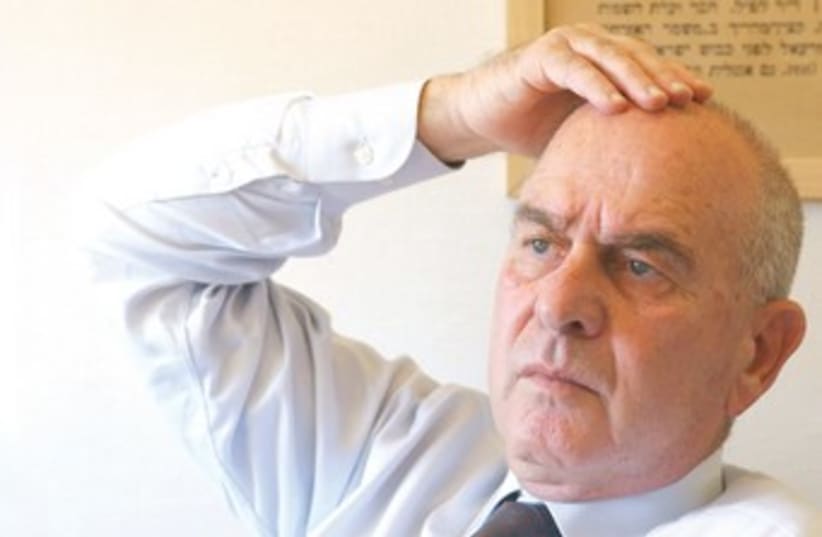
In 'Post' interview. outgoing minister says Israel will only strike Iran "if the sword was clearly at our throats."
By GIL STERN STERN HOFFMANMATAN VILNA’I 370(photo credit: Ariel Jerozolimski)
Outgoing home front defense minister Matan Vilna’i nearly gave people who care about Israel around the world a heart attack this week, even though he really intended to ease their fears.Vilna’i gave a parting interview to Ma’ariv’s veteran Knesset correspondent, Arik Bender, headlined “Vilna’i: There is no reason for hysteria, the home front is ready.” Just as he did in other interviews, he downplayed threats and boasted about the work he had done to prepare Israel for any eventuality.But the Reuters news agency took a quote from Vilna’i out of context and headlined its reports, which were published around the world, “Israeli minister: Possible war with Iran could be month-long affair with 500 dead.”Coming from the ultimate expert on Israel’s readiness for war, who happens to be moving 7,130 kilometers away next Wednesday to Beijing, it is no wonder such a headline set off alarm bells. But those familiar with Vilna’i know he did not intend to scare anyone.Vilnai’s deep voice and calm demeanor could act as a sedative for even the most stressed. He is not running away from Israel to China.Click here for full Jpost coverage of the Iranian threatHe accepted a plum posting as ambassador to Beijing that will cap off 50 years of public service in which he rose through the army’s ranks to deputy chief of staff and then toiled for 13 years in politics.For the past five years, he has been in charge of the home front, first as deputy defense minister and then as a minister.And for the record, a month-long war with 500 dead is the worst-case scenario that Israel is preparing for – it’s not something expected. Whether you are a worry-wart or happy-go-lucky, the fact that such preparations are being made is undoubtedly a good thing.Vilna’i had something to say to both worriers and warmongers in an interview this week with The Jerusalem Post:Matan Vilna’i, should we be worrying? Whenever there is a possibility of war, you have to worry. And everyone who lives in Israel needs to know that at any point there can be a war. The right thing to do is to make sure we are doing everything possible to avoid war until there is no choice. That is correct whether the war is on the home front or in enemy territory. We would only go to war if the sword was clearly at our throats.Are we prepared to endure attacks on multiple fronts? Over the past three years, Israel has prepared in a way we never have before. There is no reason to enter hysteria. We can feel very good about what we have done. It won’t be like the Second Lebanon War in 2006, when we were not ready.What did you mean when you talked about 500 dead in a month-long war? That people who spoke about thousands were exaggerating. The numbers “500” and “one month” are the Defense Ministry’s assessment for the worst-case scenario that we need to prepare for based on the strength of the enemy. I agree with that assessment, so that is what we are getting ready for. But it could be more and it could be less. In the Gulf War, two Israelis were killed from direct hits of Scud missiles from Iraq while 28 marines in Saudi Arabia were killed from one missile. In the Second Lebanon War, 40 citizens were killed by 4,000 missiles. Now there are are 10 times as many missiles in Lebanon. There should not be panic as though there will be thousands of casualties. Do you think Israel will attack Iran? I won’t get into predictions. What I did was not necessarily connected to Iran. I had to get the country ready for earthquakes and for every eventuality. We prepare for the worst-case scenario. I don’t deal with scaring people.What is the greatest challenge you are leaving for your successor, Avi Dichter? I left him my outlook and my framework for getting the job done. There is work that will never be done. People have forgotten that at the beginning they said there was no need for a ministry. Now no one is saying that. The home front has changed dramatically. What about reports that one-third of the population has no shelter of any kind?Building shelters for the entire population is important, but it is a project of dozens of millions of shekels that I don’t think we should invest in. If people listen to our warning systems and get to the most protected place possible, that is what should be done. Educational commercials will start airing soon about choosing the best place to go in an emergency.Can you understand why the public would think you are escaping a troubled ministry on the eve of a potential conflict? The press may say we are on the eve of a conflict but I am not so sure. I built a whole system to deal with any scenario. I have been dealing with security for 50 years and now I have a right to go do something else. The prime minister and foreign minister asked me to go to China. I have learned a lot about China over the past few months, I am excited about the opportunity and I intend to do that job well.Can you persuade China to cooperate with efforts to prevent the nuclearization of Iran through non-military means?I will do everything I can. I don’t think I can persuade them. They have their considerations. I will do what I can to represent Israel’s interests.What is your greatest accomplishment and your biggest regret? I took the home front, an issue that politicians didn’t want to touch for 60 years. There were 20 years of un-implemented decisions, and I took care of it.I have no regrets.
Related TagsSecond Lebanon WarAvi Dichter
if(catID != 151){
var cont = `Take Israel home with the new Jerusalem Post Store