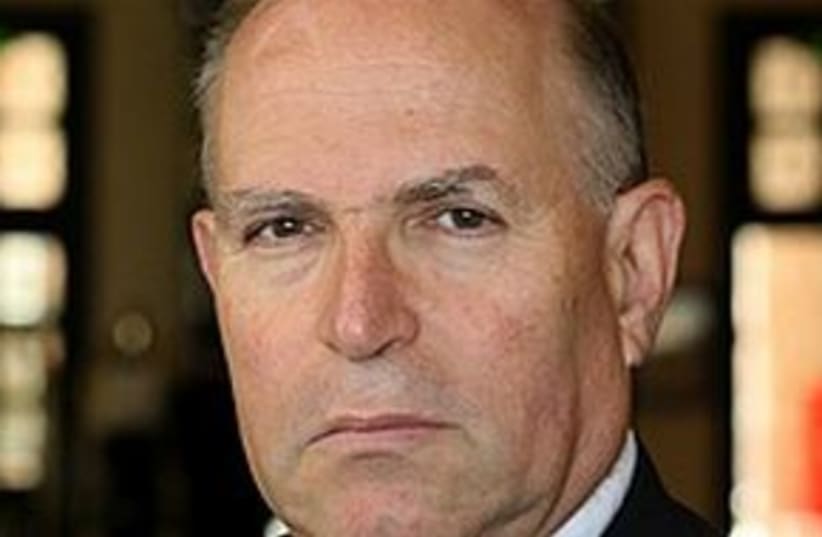
Uzi Arad: It behooves allies to listen to each other
Ahead of Obama’s visit, Netanyahu’s former national security adviser says it is important to get the US president on Israel’s turf.
By HERB KEINONArad 311(photo credit: Ariel Jerozolimski/The Jerusalem Post))
One of the main storylines in US President Barack Obama’s visit to Israel next week is his relationship with Prime Minister Binyamin Netanyahu.Those who are charitable describe that relationship as “rocky” or say the two leaders never developed “good chemistry.”The less charitable – meaning much of the mainstream media in both Israel and the US – say the two men don’t much like each other and that Netanyahu is largely to blame, especially since conventional wisdom has it that he backed Republican candidate Mitt Romney in the last US election.Or, as American political satirist Stephen Colbert said in an interview last week with Israel’s Ambassador to the US Michael Oren, “Netanyahu wanted the other guy, that’s clear. It’s absolutely clear to anybody who has eyes in their skull. He wanted the other guy. It must be incredibly awkward for him, because Obama is going to go over there and say, ‘You rolled the dice the wrong way, Bibi.’” Uzi Arad, who sat in on Obama-Netanyahu meetings as Netanyahu’s national security adviser for the first two years of the prime minister’s second term, disagrees with Colbert’s assumption of “incredible awkwardness.” What makes a leader a leader, he said during an interview on the sidelines of the Herzliya Conference this week, is the ability to put personal baggage to the side.Arad is not a kiss-and-tell kind of guy. In addition to serving as Netanyahu’s national security adviser from 2009 to 2011, he also was Netanyahu’s chief foreign policy adviser during his first term in office in the 1990s.One might assume that having worked for five years for Netanyahu at the very top of the pyramid, in addition to 25 years in the Mossad culminating as head of its Intelligence Division, Arad would have a truck full of succulent anecdotes. But he doesn’t readily share them. Though he has just finished a book manuscript, it is a professional book about Israeli government decision-making and his role in setting up and strengthening the National Security Council – not a revealing memoir. He is not one to dish on the personal details of previous Obama-Netanyahu interactions.Yet, Arad said, chances are that people will be “pleasantly surprised” by how the two men will be able to work together next week in Jerusalem.“They know how to work with people and other world leaders,” he said. “Look at Bibi’s ability to form a coalition with people who rubbed him the wrong way. Politics takes over, and the need to work together wins out.”And not only for Netanyahu. Arad recalled that Obama and Hillary Clinton waged a bitter presidential primary campaign against each other in 2008. Yet, afterward, their perception of national interest called upon them to work together, so they worked together. Arad’s message: That same dynamic will be displayed between Obama and Netanyahu.No political leader can get to where Obama and Netanyahu have gotten by being overly sensitive or easily offended, he noted. "Democratic societies put their leaders through hardball politics. They can take anything if they decide to take it." At the end of the day, according to Arad, "each has qualities that he can admire, if not respect, in the other." Not the least is political success: both just won another term, something that was not necessarily a given. "Political success is a currency that elected politicians respect in one another" Arad pointed out.TODAY ARAD IS A lecturer and researcher in the Lauder School of Government, Diplomacy and Strategy at the IDC Herzliya. In addition, he was recently selected to replace Shlomo Gazit as chairman of a small, boutique think tank called the Institute for Defense Studies, an association for the historical study of Israel's national security.He was also recently selected to replace Uzi Dayan as head of a "discussion group" called Israel's Security Council, which brings together scholars, politicians and business people to discuss security matters.And finally, Arad -- who has shown an adeptness throughout his career at setting up institutions such as the National Security Council and the Herzliya Conference, which he founded-- has undertaken a new project at IDC called Israel's National Security and Grand Strategy which is aimed at involving what Arad said are "some of the most prominent and worthwhile thinkers in the country" to produce fresh thinking on new issues.This effort, he said, is to get the country's "best and brightest" on an ad hoc basis to "look creatively at the new agenda – to look at principles of the past, and project relevance onto the future."This endeavor reflects Arad's belief in the importance of grand strategies, something in short supply in a country focused often on dousing short term crisis. Indeed, Arad said one of the important aspects of next week's Obama-Netanyahu talks is that they will provide an opportunity for each to understand the other's regional strategies."America is far away but has many diverse interests in a Middle East in turmoil; it is probing what to do. Israel is stuck in the Middle East, with the same concerns, but exposed," he explained.Arad said that across a range of issues – Iran, Syria, the Palestinians, Egypt, Lebanon, the Gulf, Turkey, Jordan – a common policy needed to be forged and action decided upon."They need to consult and decide about what will be done in concert and in coordination," he said. At the end of the day, they need to understand each other's regional strategy."We have a very complicated template of points of concern to discuss," he said, adding that this included not simply an exchange of views, but also a division of labor in certain theaters: who should do what, where should there be more active action, where should one side act, where should one side not act.Arad said that as much as the two men have met in the past – eight times in the US over the last four years – and as many phone conversations as they have held, next week's meeting is different because it is on Netanyahu's turf."Netanyahu going to Washington is the routine thing, and it takes place as Obama goes along with his daily routine," Arad said. "One day he is meeting Bibi, the next the Bulgarian prime minister. Here he is not in his office, he is our guest, he doesn't have to rush to other meetings – for a day or two this is all that is on his mind."ARAD IS NOT AMONG THOSE WHO BELIEVE THAT foremost on the president's mind will be pressing Israel on the Palestinian issue."There is nothing much to push hard on," he said. "It is clear that the realities allow for only so much maneuvering space." According to Arad, the US Administration has largely abandoned the sentiment that a final status agreement is lurching just around the corner, with Hamas' consolidation of power in Gaza and the resulting "hardening" of the Palestinian camp major reasons for the jettisoning of this assumption.For instance, the new Palestinian reality – Fatah in the West Bank, Hamas in Gaza -- has altered the viability of such features along the diplomatic process as the 2001 Clinton parameters.When Clinton presented his parameters for a Mideast solution in 2001 calling for an Israeli withdrawal from some 95% of the West bank and Gaza, and the division of Jerusalem, no one -- Arad said -- imagined Hamas would rule Gaza and "be armed to the teeth. That would have been considered a nightmare at the time," That this nightmare is now reality makes things look significantly different."Now we are stuck," he said. Nevertheless, Arad advised Obama and Netanyahu to "craft a strategy of what can be done, because the status quo and passivity is dangerous."We have to navigate within the spaces of feasibility," he added, recommending limited, partial steps forward, and adding that "one cannot put pressure on Israel, but not the Palestinians." Arad said that reciprocal steps are needed for any process to work."No one can expect Israel to take steps, but that the Palestinians do not," he said. "Unilateral steps will not fly, people are wiser and older. This should be two way street."REGARDING IRAN, ARAD SOUNDED confident that Obama would not let the country obtain nuclear weapons."We have a common strategic vision," he said. Obama has been "very explicit in declaring that the US is determined to prevent Iran from acquiring nuclear capabilities He also clarified that he is not excluding any means to accomplishing this goal."Arad stressed that Obama has clarified that the Washington strategic mindset was not acceptance of the possibility of a nuclear Iran, and then falling back on a strategy of containment and deterrence, but rather one of "preventing that eventuality.""If you take the president and his spokesmen seriously when they say he is not bluffing on Iran, and that he means what he says, and if you assume that the great American nation is determined to keep Iran from going nuclear, then Iran will not become nuclear," he said.Asked whether he trusts the American intention and resolve on this matter, Arad said, "I trust them as much as they trust themselves." Obama, he said, has not indicated there has been any change in his policy, and has pleaded for people to take him seriously on this."If he means what he says, we have no reason to doubt, because it [preventing a nuclear bomb] is clearly within his capabilities." And, he added, when Obama "feels strongly about something, he has shown that he sticks to his guns.If that is the case, then why all the tension between Washington and Jerusalem over the issue? "Even in America you don't have uniformity and conformity on this matter," he said. "There are other voices, and there may be some debate. But this has not altered the president's course."Arad acknowledged tactical differences on the matter between Israel and the US, but downplayed their importance, saying such differences were natural between allies. He nevertheless advised Israel to listen carefully to what Washington has to say on the mater."It behooves any partner in an alliance to listen to the other side," he said, "just as we are free to express our concerns and have them taken into account. If the US has a different take on something we should be very attentive of it, while still making our reservations heard. " Asked how he expected the Iranian issue to play out, Arad said he has "not given up hope that one way or another Iran will be prevented from nuclear weapons." He said he did not believe it was a foregone conclusion that a negated solution to slow or retard the program would fail.If that track succeeds, "all the better," he said. But if it fails, and all efforts to convince the Iranians to give up their program are for naught "there is a significant likelihood military means will be applied and Iran will not have a nuclear weapon … I have not given up hope that one way or another Iran will be prevented from nuclear weapons."
if(catID != 151){
var cont = `Take Israel home with the new Jerusalem Post Store