People who don’t follow the issues, understand the debate or know the country want to play with our lives.
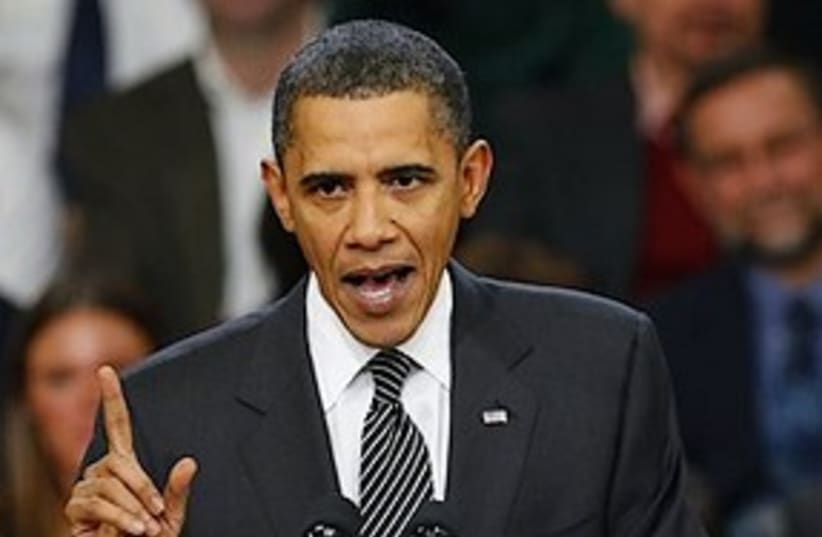
By BARRY RUBINobama pointing 311(photo credit: AP)
The arguments used by many in the West to avoid thinking and talking seriously about the Middle East generally feature a refusal to discuss the substance of issues and usually involve a barrage of insults, characterizations, and nonlogical or nonfactual claims.1. The right-wing argument. This says: You’re basically a right-wing person who opposes a two-state solution and wants to do mean things to Arabs or Muslims. Therefore, we can ignore anything you say.I won’t take the space to present my Democratic Party (US) and Labor Party (Israel) credentials. Let’s just point out that there are many Democrats unhappy with Barack Obama’s foreign policy (even if only in private) and that the Labor Party is part of the current Israeli government.Calling people who aren’t right-wing right-wing is merely a tactic by radicals to convince liberals to ignore critics and to mistake a relatively extremist approach as a moderate left-of-center one.There is a parallel attempt to label anyone who favors Israel as a right-winger unfit for civilized discourse and thus an enemy of enlightened people. Yet it should be a liberal cause to support a country that is not only democratic and with an open, liberal society, but which is also a US ally, a bulwark against aggressive and repressive forces and a country which has made considerable sacrifices and taken great risks for peace.It should be a liberal cause to oppose the establishment of radical Islamist regimes that destroy individual rights, create ruthless dictatorships and oppress women and Christians. Moreover, it is very much in the national interest of the US and of the West – including any liberal interpretation of that interest – to oppose a region dominated by Iran and its allies, the overthrow of relatively moderate Arab regimes, the destruction of Israel and a situation of increased violence and crisis that would result.2. The “They don’t love Obama” argument.For many people Obama has become an icon above criticism. Thus, if one criticizes Obama or his administration, one is an evil person (hints of racism and xenophobia might be inserted) and should be ignored.It is no mystery that the Obama administration is failing badly in foreign policy. This is common in private discussions among officials in many countries, and is also shown in both Middle East and American public opinion polls.Obama must face the same criterion and analysis, and be judged by the same standards, as his predecessors.Many lives and the freedom of whole countries depend on this.3. The abandonment of logic: What we see lately is a much higher level of non-rational argument. Some attribute it to people being told to give feelings, rather than logic, the higher priority.Obama said Israelis were distrustful of him because of his middle name, that is a Muslim name, but to many people there is also an implication of racism.How to disprove this? Simple. The original Israeli reaction to Obama, as shown by polls, was very favorable.He still had the same name back then, before his policies changed people’s minds.4. Israelis are stupid. When people say they are going to save Israel for its own good, it makes me mad. Aside from the ignorance generally displayed by those who are so arrogant, a key problem is that many in the West have forgotten the events of 1993-2000, though Israelis haven’t.We tried a process in which money was poured into the Palestinian Authority, many concessions (mostly unilateral) were made by Israel, territory was handed over and the result was massive violence by the other side and a refusal to make peace.As a result of experience – not ideology – the debate in Israel has changed.There is no serious discussion about annexing large amounts of territory or holding onto the West Bank forever.Nobody is proposing taking back the Gaza Strip. Israelis overwhelmingly want a two-state solution that provides long-term peace and security.They are right in being suspicious of steps that endanger their lives and correct in reading the Palestinian side skeptically, while accurately understanding the Islamists’ intentions.We are not in the 1990s now, much less the 1970s. Today, Israel’s options are narrower: There is a partner for talks and shorter-term cooperation (the Palestinian Authority) but no partner for full peace.Iran, Syria, Hamas and Hizbullah are not amenable to diplomacy.Israeli leaders are very much aware that this country has parallel interests with most Arab governments and try to figure out how to make use of that fact. Yet the actual cooperation possible is limited.Revolutionary Islamism is advancing and the US, given its current policy, isn’t exactly a bulwark battling against it. People here know we are in 2010; those outside may not fully understand what this means.So people who don’t follow the issues, understand the debate or know the country want to play with our lives.And not only our lives but the lives of many others who, even if ostensible enemies, are in the same boat.Consider, for example, the need to get a proper system for containing Iran when (yes, I did not say if) it gets nuclear weapons. It is clear that the White House does not understand what is going to be required.Isn’t it rather important for them to rethink their strategy? The same applies to the acceptance of a repressive revolutionary Islamist dictatorship in the Gaza Strip, a client of Iran and an advocate of genocide on the Mediterranean Sea.The lives of millions of people and the world’s future hang in the balance.That deserves a rather clearheaded discussion on the issues.The writer is director of the Global Research in International Affairs Center and editor of Middle East Review of International Affairs and Turkish Studies. He blogs at www.rubinreports.blogspot.com.
if(catID != 151){
var cont = `Take Israel home with the new Jerusalem Post Store