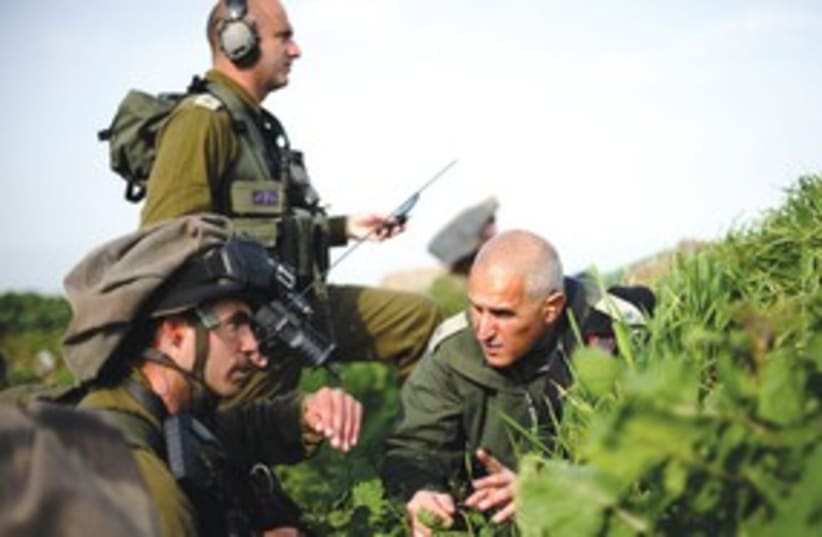
OC Ground Forces Command Maj.-Gen. Sami Turjeman is preparing IDF for war on multiple fronts, possibility of conflict with Hizbullah, Syria.
By YAAKOV KATZTurjeman 311(photo credit: IDF Spokesperson)
A group of gazelles runs alongside the jeep as it hops over another mound of dirt in the northern Golan Heights. Suddenly, the Toyota Land Cruiser comes to a halt as a massive Merkava Mk 2 battle tank takes the place of the gazelles, raises its cannon and lets loose a thunder of shells at a target somewhere off in the distance.A few seconds later, two Cobra attack helicopters emerge from a cloud and begin spraying the ground with gunfire to provide cover for the maneuvering tanks, as well as a battalion of paratroopers stationed a few kilometers to the north. Artillery shells pound the earth just a few hundred meters away as the tanks line up along a small ravine ready to plow forward into the mock battlefield.“You have the order to fire,” the brigade commander says into the radio. A minute later, an old Syrian Soviet-made tank – left over from the Yom Kippur War – is attacked from multiple tanks and directions.Like most months on the Golan Heights, September has also been marked by increased training. Last week, the 7th Armored Brigade carried out an exercise during which it trained for future conflicts – from all-out conventional war with Syria to small counter-terror operations in the Gaza Strip.There to watch the exercise was OC Ground Forces Command Maj.-Gen. Sami Turjeman, who between the tank fire and artillery shelling gave an exclusive interview to The Jerusalem Post, his first to the Israeli press since taking up his post last September.A veteran tank commander, Turjeman watches with pride as the Merkavas ride past us, swirling up a cloud of thick dust. “This is power,” he says.A quiet and serious officer, Turjeman is a strange bird in today’s highly politicized IDF, marred by the recent scandal surrounding the appointment of the next chief of General Staff. He remains mostly out of the spotlight and prefers to spend his time out in the field with the troops. When scheduling this interview, the IDF Spokesman’s Office said that Turjeman specifically asked to hold the meeting on the sidelines of a military exercise on the Golan. Only this way, it explained, will you be able to understand what the general will speak about.At 46, Turjeman is the youngest member of the General Staff. He is also the only general born outside the country, in Marrakech, Morocco, which he left at the age of six months. He enlisted into the Armored Corps in 1982 and slowly climbed the ranks, serving as a battalion commander, a brigade commander and finally in 2004 as commander of the Armored Corps.In 2007, Turjeman was appointed commander of Division 36, responsible for the Golan Heights, a job he served in until last September when he was promoted to major-general and put in charge of the IDF’s largest resource – its ground forces.IT IS TURJEMAN’S JOB to ensure that the military is prepared for future conflicts and that the mistakes of the Second Lebanon War are not repeated.The exercise we are at is proof of the change. Before the war four years ago, a brigade-level exercise was a rarity.Today, each brigade holds one at least once a year.“This is the same army with the same people,” Turjeman says when asked about the change. “The difference is that we are more focused today and understand what our mission is and what is expected from us.”Sitting down to talk in the shade under an old olive tree, Turjeman lowers his Tavor rifle and explains the primary challenges the IDF is facing.“On a tactical level we will see an attempt to wear us down with urban warfare, which is a characteristic of all the fronts we face today, with missile attacks of various ranges and sizes on the home front as well as a close battle between ground forces,” he says.On a more strategic level, he is preparing the IDF for war on multiple fronts and for the possibility that a future conflict with Hizbullah in Lebanon will also lead to a war with Syria.“The axis of evil and the connection between the players is tight and demonstrated by their practical daily cooperation and the strategic understandings they have reached between one another,” he explains.Turjeman took over the Ground Forces Command about six months after Operation Cast Lead in the Gaza Strip, following which the IDF came under unprecedented criticism for the way it operated, culminating in the Goldstone report in which it was accused of war crimes and crimes against humanity.One of his first decisions was to write for the first time an operational doctrine which sets the rules of engagement for forces operating inside a civilian- populated area. One order in the doctrine is for IDF commanders to make every effort to evacuate civilians from an area where combat is expected.In addition, commanders are told to select empty structures when entering an urban or heavily populated area and fire a number of shells to scare away the civilians who remain in the area. The new order also sets guidelines regarding which type of weaponry to use during operations inside urban centers.Turjeman recently held a seminar to teach officers about the new doctrine but ultimately, he says, the Goldstone Report is not just about Israel but a threat to every democratic nation which seeks to defend itself.“America and European nations have the same problems when fighting against terrorists in a population center,” he says. “It is true that we need to match the force we will use to the challenge we will face, but the IDF has always operated in a moral way – before Cast Lead, during Cast Lead and after Cast Lead.”Looking around at the impressive military platforms participating in the exercise, it is clear that the IDF has come a long way since the Second Lebanon War and Cast Lead.Today, tanks are fitted with the new digital army program called Tzayad – Hebrew for “hunter” – which enables all platforms on a battlefield to see one another on a digital map as well as targets that each one has punched in to the system.They have also recently received new shells – called Kalanit – which enable precision strikes against anti-tank cells that could not be targeted by normal tank shells. The Artillery Corps is looking into the possibility of purchasing new advanced accurate rockets, and the infantry battalions have started using unmanned aerial vehicles, with plans to equip each brigade with a larger UAV as well.Tanks are also in the process of being equipped with active protection systems against anti-tank missiles and the IDF is scheduled to shortly choose an American company to manufacture the Namer, said to be the most protected armored personnel carrier in the world with the highest level of survivability.“Nothing is the same, from the boots the soldiers walk in to the helmets they wear on their heads and the weapons and missiles they carry,” he says.“Ground forces are more lethal and independent today. When you can maneuver with better protection and have better intelligence, you can direct your forces in the right direction to the right mission.”In addition to upgrading the equipment and developing new technology, the Ground Forces Command under Turjeman has also put an emphasis on educating commanders to be what he calls “military professionals.” To maintain this standard, Turjeman has instituted quarterly tests for officers from brigadier-generals who serve as division commanders to lieutenants who serve as squad commanders. He then receives a list with the names, ranks, positions and grades of the officers who take the tests.“Serving in the military is a profession, and officers need to be educated,” Turjeman says. “These tests provide us with an indication of where the gaps are in a commander’s knowledge. If, for example, a bunch of junior officers fail a test in urban warfare, then their commander will know that he needs to hold a seminar for them in urban warfare.”TURJEMAN’S OVERALL prognosis foresees the possibility of war on a number of fronts. He says that a conflict in Lebanon could easily develop into a simultaneous conflict with Syria as well as in the Gaza Strip. For this reason, when the 7th Brigade holds its exercises, it does so on the Golan on terrain that matches what it could face in Syria or Lebanon.The war will have conventional and non-conventional characteristics, he says.A war with Syria could involve tanks and artillery, but would also involve commandos riding motorcycles and firing anti-tank missiles. As shown by the recent explosion of an arms cache in a home in southern Lebanon, Hizbullah has deployed its rockets inside civilian structures, meaning that soldiers will have to go door-to-door to stop the expected attack on the home front.“We need to have the basic skills from which we can derive the capabilities we will require in a war against Hizbullah, Syria or whoever it might be,” he explains. “There are techniques that a soldier needs to know no matter whom he is fighting against.”
if(catID != 151){
var cont = `Take Israel home with the new Jerusalem Post Store