Exclusive: Worries over the direction of the country in the aftermath of the Arab Spring persist among Jewish community.
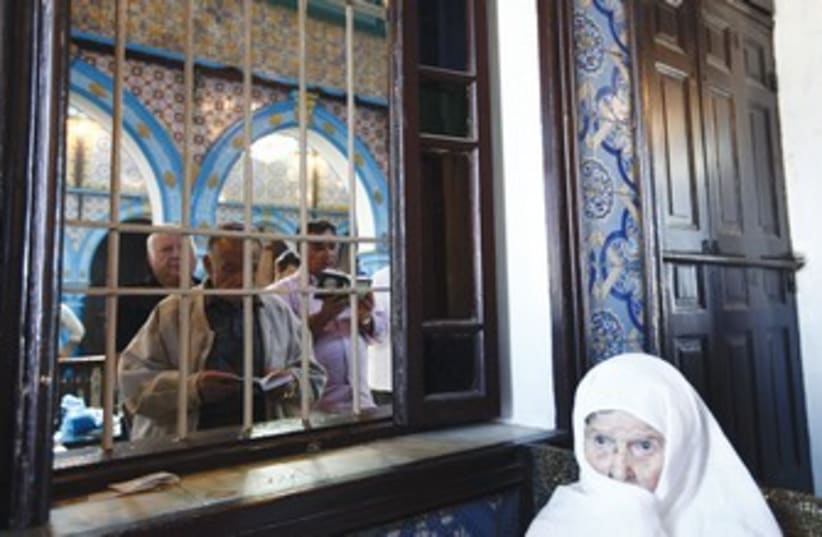
By GIL STERN STERN SHEFLERGhriba synagogue(photo credit: Anis Mili/Reuters)
LA GOULETTE, Tunisia – Over a dozen men meet on a Saturday evening at a house of worship tucked away in a quiet alley in this seaside suburb of Tunis. They pray and sing songs and break bread together in a building that most locals do not even know exists.And while the entrance to the sanctuary is diminutive and the service respectful of the Muslim- majority surroundings, they do so freely, merrily and without fear. This is Beit Mordechai Synagogue and its congregants are members of the country’s 1,500 Jews, the second-largest such community in the Arab world after Morocco. They are what remains of a group that numbered over 100,000 people at its peak in the 1940s and dates back to antiquity. They live good lives, working in commerce and development or providing religious services, but their prosperity, not to mention their continued existence as a community, has been called into serious question over the past year and a half.Since the uprising that ousted longtime autocrat Zine el-Abidine Ben Ali in January 2011, most Jews in Tunisia have been vacillating between hope and fear. Hope because the demise of a corrupt dictatorship – even if it protected them from physical harm – and the advent of democracy might help create a better, more just society. Fear because the subsequent rise in popularity of Islamists and of Salafists, who adhere to an even more radical form of Islam, might create an atmosphere hostile to Jews.The sweeping victory in the country’s first-ever democratic elections last October by Ennahda, an Islamist party formerly banned by the regime, had people talking at the synagogue in La Goulette.“I still feel safer here right now than I do in Paris where I often feel threatened by French Arabs,” says Maxime Journo, a Tunisian-born concert promoter who divides his time between Tunis and Paris.“Perhaps, but there’s no denying the situation is less certain for us than it was under Ben Ali even though he was what he was,” responds another congregant. “We must wait for further developments and see.”A big test of the Islamist-led government’s attitude toward religious minorities took place several days earlier in Djerba, the picturesque Mediterranean island where the majority – 900 – of the country’s Jews live. Last year the annual Lag Ba’omer pilgrimage to El Ghriba, the island’s ancient synagogue, was canceled due to security fears. The question this year is whether the new government will be willing or able to ensure the rite continues.“Celebrated for hundreds of years, this religious rite is an achievement that should not change, because it illustrates the openness of Tunisia to the world,” AP quoted Tourism Minister Elyes Fakhfakh as saying last month. “It is an achievement of the revolution, which established freedom of worship.”Still, an overbooking almost ruined the government’s painstaking efforts to prove they would protect the Jewish community.Youssef Qaradawi, a Qatari-based Egyptian radical preacher barred from the US, the UK and France, planned to hold a gathering in Djerba on May 5, just four days before the Jewish event.“We had to do something,” Roger Bismuth, a leader of the Jewish community in Tunis, says after the fact. “If [Qaradawi] had said anything wrong it would have gone badly for the pilgrimage, and they listened to us.”The cleric’s gathering was relocated to the mainland, the crisis was narrowly averted and the pilgrimage went ahead as planned.AT THE El Ghriba synagogue on Lag Ba’omer, a set of unique Tunisian traditions and superstitions are on display. Women who want to bear children write prayers on boiled eggs that are then placed in a small cavern in the center of the sanctuary. Men sprinkle boukha, a fig-based alcohol, on their faces, hands and inside their pockets.“It brings good luck,” says one.A few hundred worshipers dance with the Torah outside the ancient synagogue during the day and pray and feast within its sacred confines at night.“To me, there is something magical about Jews and Arabs living together like they do here,” says Guy Tzinmann, a French Jew who has come from Paris to participate.” If you don’t come with an Israeli passport they don’t give you any trouble and, unlike Algeria, where my mother is from, I can come here to visit.”The police presence, aimed at preventing attacks like the one carried out here by al-Qaida in 2002 that left 21 dead, is considerable. There are probably more security officers than there are worshipers.Like most religious pilgrimages, there is a strong commercial aspect here. For the Trabelsi family, which runs the synagogue and organizes the gathering, it is an important source of income.“We would have liked many more to come,” says Renee Trabelsi. “In the past thousands did, but we’re happy with the turnout.”It is telling that the most important guest this year is not Jewish. When the tourism minister, Fakhfakh, shows up on the second day, he is greeted by participants singing the national anthem.JACOB LELLOUCHE, the Jewish owner of the popular restaurant Mami Lily in La Goulette, looks like a musketeer. Porthos, the fat one, to be precise. And it’s not just because of his thick mane of hair, his carefully trimmed French beard or his big – not overweight – build, but because of the joviality, affability and joie de vivre he radiates. When he laughs the earth shakes a little, and when he does the rounds, speaking to almost every client who sits down for dinner at the old Italian villa he made into a restaurant, he moves with surprising agility for a man of his size.“When I opened this restaurant 15 years ago, I wanted to remind people of what was once here when many Jews lived in Tunisia,” he says, sinking down deep into his chair. “Almost everyone here has his own memory of living with Jews.”Lellouche specializes in the distinctive cuisine of Jewish Tunisians. Appetizers include homemade matbouha, piquant carrot salad and, of course, the ubiquitous baguette, part of the enduring French influence on this country. Main dishes include thin, spicy merguez sausages, whole grilled fish freshly plucked from the nearby sea and a thick, green stew whose name I do not catch.Rim Temimi sits at a table in the back of the restaurant, typing away furiously on her laptop. The co-founder of Dar el- Dekhra, a society documenting the Jewish heritage of Tunisia, has had a busy week.Its first-ever exhibition opened at an arts venue in the medina, Tunis’s old quarter, earlier in the week.“So far between 300 and 400 people came, and tomorrow is the last day,” she says. “Yesterday a black woman, someone from the lower class, came to the exhibition and cried. I asked her why and she said her parents used to listen to a song we were playing sung by a Jewish singer.”Starting a group documenting Jewish heritage in Arab-Muslim Tunisia is no simple matter. Tamimi’s project might be likened to Zochrot, the organization in Israel that commemorates Arab villages whose inhabitants fled in 1948. One may well wonder why a Muslim photographer would invest herself in such an endeavor, but to Tamimi the answer is as clear as a cup of boukha.“If you do not know your past, you know nothing about your present or future,” she explains. “My great-greatgreat- grandfather was Jewish, but I have been Muslim for seven generations.Knowledge of history and particularly Jewish history in Tunisia helps all Tunisian, regardless of their religion.”Tamimi’s sister-in-arms is Sonia Fellous, a Tunisian-born Jew living in Paris who researches religions. She is one of four Jewish core members of the society. The other 11 are Muslim.“This is the only organization promoting Jewish history that has more Muslim members than Jews,” she says proudly.Indeed, a short conversation with the two women reveals the extent of contributions by Jews to the country. The first filmmaker in Tunisia was Jewish. He also happened to introduce the bicycle to the country. Several important singers, such as the Semama sisters and Habiba Masika, were Jews. Members of the community were part of the country’s social and business elite.“It was easier for them to go between the East and the West,” Fellous explains.The Jewish community of Tunisia has a fabled past, but what of its future? Fellous sighs. It is clear she thinks that sooner or later her co-religionists will follow the path that led her out of the country, but it is Tamimi who gives a resolute and surprising answer to the question.“Yes, certainly there is a future,” she says. “Otherwise, what am I fighting for?”THE THORN in the side of Jewish-Arab relations in Tunisia is the same as it is throughout the Arab world: Israel.Conversations with Tunisians, rich and poor, religious and secular, educated and uneducated, seem to point toward a pretty uniform opinion: The Jewish state has no right to exist.At an upscale fish restaurant in La Marsa, a well-heeled coastal town near the capital, I meet a group of four friendly, educated and worldly Tunisians for dinner where they explain why Israel as we know it will sooner or later disappear.“Israel is a theocracy like Saudi Arabia and Iran,” explains Youssef, a former Fulbright scholar with an Ivy League education.“There will eventually be a one-state solution the same way it happened in South Africa. It is inevitable.”The group, consisting of human rights activists and policy wonks, is curious to learn about public opinion in Israel. They ask what will happen with Iran and what Israelis think about the possibility of the creation of a binational Jewish-Arab state.But they seem bitterly disappointed, even hurt, to hear that that kind of discourse takes place only on the fringe of Jewish society and is considered by the vast majority to be both impractical and undesirable.Nadia, one of the dinner guests, who has lived in Jerusalem where she worked with an international aid agency, has Israeli friends. “Many of them would support such a solution,” she says.It is hard to reconcile just how differently things are seen in the East and the West.Western military intervention in Libya against the tyrant Muammar Gaddafi, for instance, was harmful and unnecessary, they say. They reject the notion that Gaddafi would have crushed the insurgency had France and the US not launched strikes against his forces. Such action did more harm than good, as it did in Iraq and almost everywhere else the West has intervened in the Middle East, they argue. For those reasons they oppose any kind of military intervention in Syria’s civil war.While the group feels animosity toward Israel, they say their attitudes toward Jews in general are warm.“I would love all the Jews who left Tunisia to return,” declared Nadia.I ask her why she feels that way about Tunisian Jews whereas the roughly two million non-Jewish emigres leave her indifferent. She says it is because Jews contributed to a prosperous, vibrant and progressive society. Their return would help make the country a better place.The dinner ends somewhat sourly. Not even a shot of boukha manages to get rid of the bitter taste that the tense debate leaves.Half an hour later we are at a party at a bar by the beach where a band is playing the timeless hit, “La Bamba.” The partygoers are a good mix of young men and woman, straight and gay, locals and expats. It is an integral part of Tunisia, but at the same time it has nothing to do with the narrow alleys in the old medina of Tunis where veiled women shop for halal meat and bearded men leisurely walk to the mosque. The scene is yet another reminder that the Middle East has no problem containing countless paradoxes, and it makes me think of another country in the region that I know is similar in this sense.THE JEWISH community in Tunisia is roughly divided into three groups: Rich and secular Jews in Tunis, religious Jews of modest means in Djerba and a group of old people who remain here by virtue of having nowhere else to go. The Jewish oldage home is located in a stately residence around the corner from the synagogue in La Goulette.Roger Krief, 87, is one of the 40 or so residents at the home. The former jeweler says he has family in many places, including in France and Israel, but does not elaborate on his life story. The past can be a sore subject.Like most institutions for the sick and elderly it is not a happy place to visit, but it provides a very vital service to the community that could not exist without the help of their brethren overseas.“Our cooperation with the Tunis community is good,” says Yechiel Bar Chaim, an official with the American Jewish Joint Distribution Committee. “We don’t work independently there, but we work with them to help provide them with means.”Just around the corner at the tiny synagogue in La Goulette, the sounds of Hebrew echo loudly between the walls.The congregants sing: Shabechi Yerushalaim et adonai Haleli elohaich tzion Rabbi Daniel Cohen opens the synagogue’s door, letting the Mosaic melody spill into the empty alley outside, but cantor Eliyahu Sa’adon closes it instinctively.“Let them hear a little,” the young rabbi politely asks Sa’adon, his elder.They reach a Talmudic compromise without exchanging a word. The door is left half open – or half closed, depending on your point of view.The dilemma of the door at the synagogue is a good metaphor for the state of Tunisian Jewry. How openly can its members live in the country and how sure can they be that someone or something might not come through the door tomorrow, bringing their singing to an end The singing reaches a crescendo and then comes to an abrupt stop.“Everyone is talking about Islamists and Salafists all the time,” one of the congregants declares in French. “But let the world know that in Tunisia, the Jews are singing.”
if(catID != 151){
var cont = `Take Israel home with the new Jerusalem Post Store