After Cast Lead, IDF recognized that Islamists would regroup, rearm for future conflict. Two years later, is this next round looming?
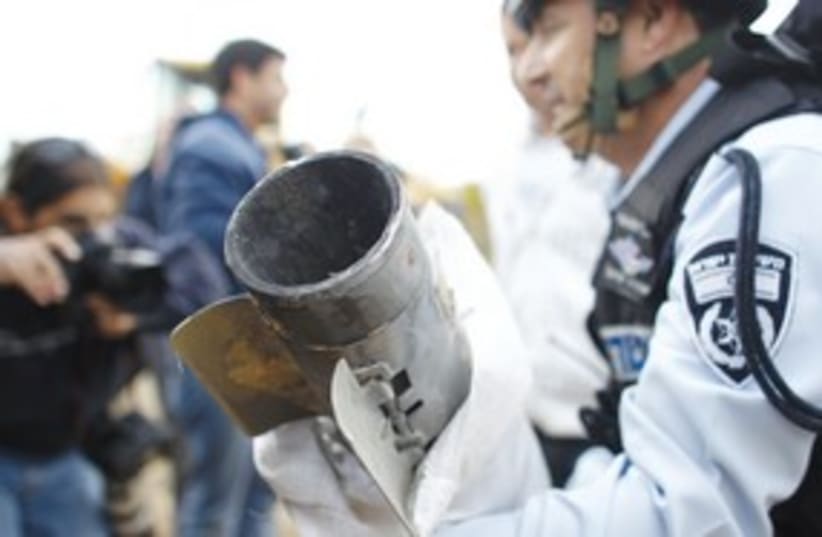
By YAAKOV KATZPolice sapper carries Grad rocket 311(photo credit: Reuters)
In March 2009, two months after Operation Cast Lead in the Gaza Strip ended, Maj.- Gen. Tal Russo, head of the IDF Operations Directorate, claimed that Israel had defeated Palestinian terrorism. For a while.“We are in a state of victory today against Palestinian terrorism, although this type of victory is always temporary,” Russo said according to the book Let the IDF Win, published in 2010, on the second intifada. “This does not mean that the current situation will last for another two years, since such victories need to be achieved all the time.”It is two years later and Russo was right. The only change is that he is no longer head of the Operations Directorate. Today, he is head of Southern Command, in charge of maintaining the temporary victory against terrorism, in order to prevent, for as long as possible, another largescale operation in the Gaza Strip.Russo stands out among his colleagues on the General Staff. He is the only bachelor and the only general in IDF history to become an officer without going to Bahad 1, Officer’s Training School.Russo grew up in Kibbutz Haluta in the North and remembers as a teenager during the Yom Kippur War watching four Syrian MiGs get shot down by the air force. In 1978, he was drafted and served in the special forces. He left the army, traveled around South America and the US for about two years working as a mover and a truck driver and then returned to the IDF, this time for good.Russo is a no-nonsense general who tends to analyze situations in what appear to be black-and-white terms. During his years as head of the Operations Directorate, he was a lone, ignored voice within the top IDF command who believed that more needed to be done to stop Hezbollah’s military buildup, possibly to the point of taking preemptive action.SINCE THE escalation in the Gaza Strip, Russo has used the term “cannon talk” to describe the type of dialogue Israel has with Hamas and to explain the Ping-Pong type of attacks between terror groups in the Strip and the IDF.This recent round of hostilities has had several triggers which lead Hamas to claim that Israel is actually the one escalating the situation. First, were the reports that Israel had abducted Gaza engineer and alleged Hamas member Dirar Abu Sisi from Ukraine and that he is in Israel undergoing interrogations.Next, was Israel’s decision last Wednesday – in a rare move – to strike a manned Hamas position in the middle of the day in retaliation for an earlier rocket strike. Two Hamas operatives were killed.While Israel has struck at Hamas targets in Gaza since Operation Cast Lead, it has rarely done so against manned positions. The idea was to send a message to Hamas that Israel viewed it responsible even though its operatives were not the ones firing the rockets, but not to kill its men so it would not have a pretext to join the fighting.Yet that is exactly what the Wednesday strike did and on Saturday the Hamas response came swiftly with a downpour of 50 mortar shells – about a quarter of the entire amount fired last year – on bases and towns along the Gaza border.The IDF responded to the attack by bombing additional targets in Gaza, including a tunnel being dug under the border, killing several more operatives.From this point, the path was paved to an all-out confrontation, with daily rocket attacks from the Gaza Strip. Wednesday’s bombing in Jerusalem – while not yet clear if directly connected to Gaza – was a demonstration this war is being fought on multiple fronts simultaneously.The situation, though, is far more complex.While Hamas did fire mortar shells on Saturday, it has refrained from firing rockets deep into the country. The Katyusha rockets that slammed into Beersheba, Ashdod and Ashkelon this week were fired by Islamic Jihad.While to some, there might not be a difference between mortar attacks near the border and Katyusha attacks on cities, Hamas has reason to make a distinction.Today it is a three-headed monster, with its leadership split between the political echelon in the Gaza Strip led by Ismail Haniyeh, the diplomatic echelon in Damascus led by Khaled Mashaal and the military forces in the Gaza Strip led by Ahmed Jabari.Hamas fighters are frustrated at not being able to fight for two years, during which they have obtained new weaponry – longrange rockets, antiaircraft missiles and antitank weapons. They are not allowed to use them.By allowing mortar fire, Jabari was letting his fighters vent their frustration. By preventing them from firing long-range missiles, he is sending a message that he does not yet want a full-fledged confrontation.WHILE THE investigation into the bus bombing in Jerusalem continues, the IDF is already reviewing possible mistakes that might have led to the attack. The quiet in the West Bank in recent years has led to the lifting of close to 30 manned checkpoints, the withdrawal of some IDF forces from the territories and a drop in the number of arrest operations in Palestinian towns and cities.These are all calculated risks, taken in an effort to bolster the Palestinian Authority and in recognition of its fight against Hamas and terrorism.But, at the same time, fewer operations mean less intelligence. Without having boots on the ground inside the cities, the IDF and Shin Bet (Israel Security Agency) are going to have difficulty gathering information.IDF ASSESSMENTS are that it is unlikely Hamas was directly involved in the Jerusalem attack. It was more likely carried out by Islamic Jihad, possibly with the assistance of Hamas infrastructure in places like Hebron, where it is known to have a significant presence. Another possibility is that the attack was carried out by east Jerusalem residents who could or could not be connected to a more established terror group.According to a senior officer in the Southern Command, Hamas is not yet ready for another operation like Cast Lead and is still working on improving its offensive capabilities and command-and-control systems, a lesson from 2009 when its fighters fled in the absence of clear instructions and leadership.Israel’s claim that Hamas is responsible for everything that happens in the Gaza Strip makes for good rhetoric but is not necessarily the case.While Hamas has been using the time since Cast Lead to rehabilitate its capabilities, Islamic Jihad has used the time to gain independence and to hoard advanced weaponry that enables it to challenge Hamas’s authority.If during Cast Lead, Islamic Jihad fought mostly under Hamas command, in a future conflict it will have its own units and field commanders. It is already known to have an arsenal of long-range Grad-model Katyusha rockets and it also might have some advanced antitank missiles.The weaponry that was captured aboard the Victoria by the navy last week was destined for terrorist groups in Gaza, possibly Hamas and possibly Islamic Jihad.There is no question that Israel’s deterrence, which has effectively staved off conflict since Cast Lead, is eroding. The challenge will be for the IDF to restore it and stave off a larger-scale conflict – if that is what the government wants.
if(catID != 151){
var cont = `Take Israel home with the new Jerusalem Post Store