Syria’s Kurds are sitting out the civil war, which they see as a clash between Assad's regime and Turkish-backed Sunni Arabs.
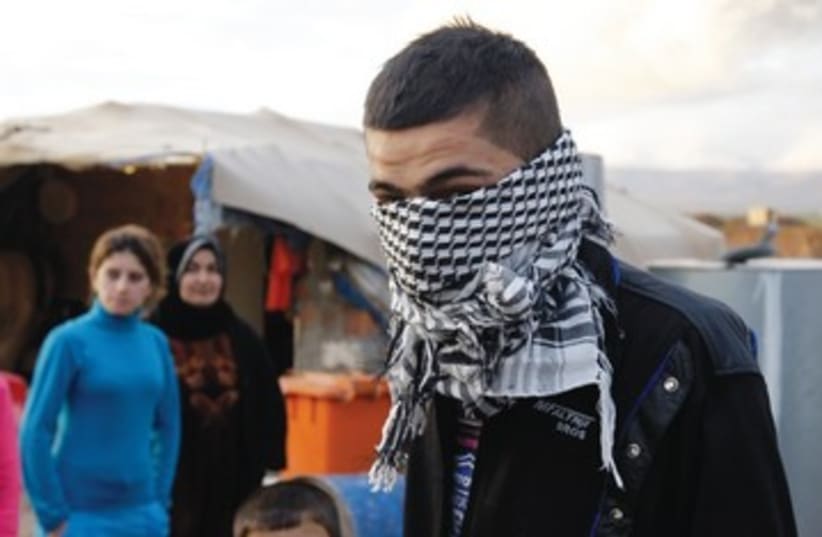
By JONATHAN SPYERA Syrian Kurd refugee in Iraq 390(photo credit: Azad Lashkari/Reuters)
At a recent meeting in London, I asked a Syrian Kurd whose affiliations are close to the nationalist Kurdistan Workers’ Party (PKK) why the Kurds of Syria remained on the sidelines in the uprising against President Bashar Assad.The Kurds of Syria, who number around 10 percent of the country’s population, have largely preferred to avoid active involvement in the civil war now taking place.His reply was enlightening. “What uprising?” he asked. “What’s going on in Syria is a fight between the Assad regime on the one hand and the Turkish government and the Muslim Brotherhood on the other. The Kurds have no part in this, and we need to protect our own areas against both the Assad regime and the possibility of Turkish intervention.”This was not idle speculation. The PKK and its Syrian affiliates are currently organizing to prevent the Syrian revolution and its armed elements from activity in Kurdish areas in the country.This is leading to tensions with the Free Syrian Army.The FSA now controls significant territorial enclaves within Syria. One of the largest of these stretches from the Turkish border in northern Aleppo province, west of Aleppo city and down to the area north of Idleb city.East of Aleppo, however, is an area of largely Kurdish population.In the large area of Syria’s northeast, stretching from the triangular border area where Syria meets Turkey and Iraq, to the town of Efrin, east of Aleppo city, the FSA has found its activities hindered by the presence of an armed Kurdish element.These armed Kurds are not merely a local initiative. According to a report by Mohammad Ballout at the respected Al Monitor website, 4,000 to 4,500 PKK fighters travelled over the last year from the Qandil Mountains in northern Iraq to northern Syria. Their presence, alongside mobilized local men, ensures the dominance in this majority Kurdish area of the Kurdish Democratic Union Party (PYD), which is the PKK’s representative movement among the Kurds of Syria.This force has no interest in allowing Kurdish areas to be used for the operations of an insurgency which they regard as Turkish-sponsored and Sunni Arab in nature.The Assad regime has been happy to take advantage of the opportunity to ensure quiet in the northeast. According to Ballout’s report, the regime released 640 PYD members from its prisons in 2011. Most of these militants made their way to the north to take part in the securing of the Kurdish region.The town of Efrin, east of Aleppo, offers a gateway into Syria’s secondlargest city. The Free Syrian Army identifies securing control of Aleppo as a strategic goal. But the presence of the PYD-controlled fighters, who maintain checkpoints along the road from Efrin to Aleppo, has prevented the FSA from achieving this objective. The Kurdish fighters also try to prevent the smuggling of Saudi, Turkish and Qatari arms for the rebels across the Turkish border into the area they control.The Kurdish-controlled area in Syria’s northwest has been acknowledged by the FSA leadership to represent a significant challenge. Gen. Mustafa al- Sheikh, FSA chief of staff, told a Turkish newspaper that “the Syrian regime is trying to use the Kurds. The PKK has been mobilized in Syria on orders of the regime. The Syrian regime is supporting the PKK now against the interests of Turkey.”Colonel Riyad Asaad of the FSA, who, like Sheikh, is based in southern Turkey, concurred that PKK fighters were present in the Efrin region. “The PKK guerrillas,” Asaad said, “are hindering the movement of our armed forces in these regions.”The PYD is not overtly pro-Assad.The party is an affiliate of the National Coordination Committee, an opposition coalition that opposes external intervention into Syria.This group is regarded by the FSA and the Syrian National Council as a stooge of the regime.PYD representatives freely acknowledge their opposition to FSA activity in the Kurdish northeast. Hussein Kocher, a local representative of the PYD, noted that “some time ago, units of the FSA wanted to enter the Efrin region but the Kurdish people did not allow them. Kurds have their own forces and do not need Arab forces or forces from other countries.”The PYD is of course not the only element active among the Kurds of Syria’s northeast.But even its rivals in the 11-party Kurdish National Council (KNC), who are close to the Kurdish Regional Government of northern Iraq, are sceptical regarding the pro-Turkish and -Arab nature of the uprising. Following recent tensions, the two groups signed an agreement sponsored by the Iraqi Kurdish leadership to prevent intra- Kurdish tensions.This agreement seals the de facto Kurdish control of a large swathe of Syria’s northeast and the placing of this area off limits to the insurgency against the Assad regime for the foreseeable future.Sentiment among the Kurds there is not pro-regime. Demonstrations calling for the downfall of Assad do take place.But the distrust of the Turkish-backed rebel forces runs broad and deep. The general consensus against allowing FSA activity is strengthened by a determination to spare the Kurdish population from the brutal regime retribution meted out elsewhere in the country.Syrian Kurdish scepticism toward the rebellion is well-based. The main strategic backer of the rebels is indeed Erdogan’s Turkey. The Turkish government remains opposed to Kurdish demands for greater autonomy. Erdogan has ensured a top-heavy representation for the Muslim Brotherhood in the Turkish-sponsored Syrian National Council.But even non-Islamist elements in the SNC and the FSA look for the most part suspiciously like Arab nationalists, from the Kurdish point of view. The appointment of a Kurd, Abd al Baset Sieda, as the nominal head of the SNC is likely to prove insufficient to dispel this sense.So the Kurdish strategy appears to be to seek to sit out the Syrian civil war. If the rebels win, the Kurds will then try to negotiate from a position of strength with the new regime, from their fastness in the northeast of the country. In the unlikely event of Assad prevailing, the Kurdish stance will mean that they will avoid the worst fury of the regime’s revenge.Minority communities have not so far done well out of the Arab uprisings.The main victor in Egypt, Libya and Tunisia has been Sunni Islamism.The Kurds of Syria differ from many other regional minorities in that they possess separatist defense structures of their own. In the context of the earthquake currently taking place in Syria and beyond it, it is not surprising that they prefer to place their trust only in themselves.
Related TagsAleppo
if(catID != 151){
var cont = `Take Israel home with the new Jerusalem Post Store