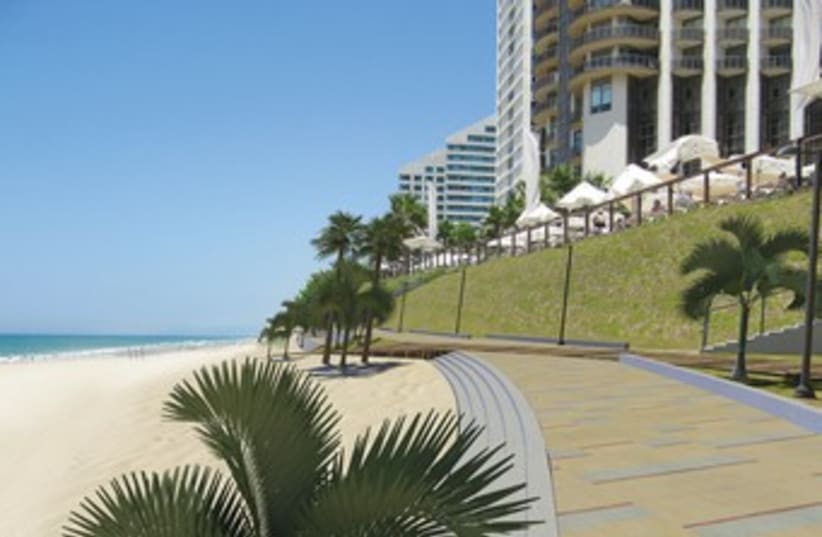
The municipality’s plans for an NIS 16 million promenade along Zevulun Beach
has kicked off a heated debate with residents.
By SHARON UDASINZevulun Beach (370)(photo credit: Courtesy)
For many Herzliya residents, the municipality’s plans to construct a promenade over Zevulun Beach both pose a threat to their narrow strip of beloved sand and raise certain legal questions.“The residents and people who regularly go to the beach woke up to a situation where one day there were tractors,” resident Avi Silberman told The Jerusalem Post on Tuesday evening. “Apparently the city has given itself the permit to build.”The Herzliya municipality is currently in the process of constructing a NIS 16 million promenade to stretch over Zevulun Beach, connecting to the already existing boardwalk that goes through Acadia Beach in the south.The promenade, the city has said, will provide beach accessibility to all people, regardless of disabilities and age, as well as provide wave-breakers for the dangerous and destructive waves that sweep sand from the narrow beach strip in the winter.Mayor Yael German, in the face of heated protests from local residents, has claimed that “under no circumstance will we allow harm to the beach” and has said that the beach will remain natural and be accessible to more people during more seasons of the year.To this effect, a survey that the city commissioned from the Dahaf Research Institute indicated that up to 75 percent of Herzliya residents were in favor of building the promenade.At a press conference presented by city on Monday, Lynette Rofe, chairwoman of Kanaf – Social Club for the Physically Disabled, stressed the importance of building such a promenade, providing her and others the opportunity to enjoy the beach and “move about freely,” no differently from other people.“I welcome the initiative and think that there is compassion and consideration of the widespread public within it,” Rofesaid.Hordes of local residents have rallied environmental activists and government officials to their cause, and about a week-and-a-half ago the city agreed to temporarily stop work on the site after environmental advocacy group Adam Teva V’Din (Israel Union for Environmental Defense) demanded a statutory clarification with the appeals commission at the District Council for Planning and Building. Amit Bracha, executive director of Adam Teva V’Din, told the Post that while the organization is not against building the boardwalk in principle, it is against the illegal manner in which the process has been occurring.In order to construct such a promenade, the city should first acquire permits from both the district council as well as the Committee to Save the Coastal Environment (the Valhof), neither of which steps it has taken at this point, Bracha explained. He criticized them for being “the ones giving themselves permission to build.”In response to the citizens, Environmental Protection Minister Gilad Erdan sent German a letter at the end of last week explaining that he, too, had found many problems with the building permit for the Zevulun boardwalk. The city should have conducted an extensive environmental assessment, involving professionals from his office and from outside the city before inflicting damage upon the beach area, according to Erdan. He also pointed out that the contractor had exceeded the zone assigned to him in the building permit, to which German responded that work had stopped as soon as the city realized this had occurred.“I will request that you ensure that all work in the coastal environmental area in general and in the coastal cliff area in particular be conducted with necessary caution, together with the joint supervision of people in your city’s environmental unit,” Erdan wrote, requesting that the city accept the help of his officials. “I am impressed that the city acted in an unreasonable manner with regards to the public and with regards to unnecessarily damaging the preservation of the coastal environment.”Following Erdan’s letter, German said she regretted that he had been exposed to a series of lies spread by the local activists, adding that Erdan should not have made a “unilateral impression” before hearing all the facts from the municipality.Silberman, who has been a resident of Herzliya for 42 years, said he has been on these beaches – including Zevulun – even before there was a marina in the area.Both he and his colleagues have attempted to meet with German, but instead she has sent other people in charge of executing the plan to speak with them, he said.“We have been declined,” said Silberman, noting that the residents were prohibited from entering this week’s press conference.“The reaction to us is so hostile, so negative.”“This is just pathetic that I can meet a minister and not my own mayor,” he added.The residents are not necessarily entirely against building a boardwalk, but they said they do oppose the process that the city is following, granting itself a permit rather than going to the district council and Valhof, as Adam Teva V’Din suggested.More specifically, city officials applied for a permit to build the boardwalk through their own licensing bureau, an action that can be taken, for example, when individual residents want to build on their lawns. This regulation, which allows for bypassing both the district council and Valhof, stems from a decision made in 1961, according to Jonathan Jacobovitz, the ringleader of the resident protest.“Basically, they came and approved the building of this boardwalk the same way they approve a porch for your house,” Jacobovitz told the Post on Wednesday.“Here we have a minister, two organizations that work closely with her and are sticking their necks out to go against her because they realize it’s a very big mistake,” Silberman said. “All we’re saying is if you want to do it, do it the right way.”Since the city is currently working on a comprehensive plan to protect all of its beaches, the municipality should have waited to implement the promenade construction until after the plan was complete, according to Silberman – an idea that Erdan also echoed in his letter.“Our people are just saying, ‘Hold on, let’s do it correctly,’” Silberman said. “The whole behavior of the municipality is puzzling at best, illegal at worst.”“We are not against any boardwalk that will be at the beach of Herzliya,” Jacobovitz said. “We understand that there may be some need for a boardwalk, the same way as Phase I.”A promenade in this area would only be worthwhile and environmentally friendly if the municipality first expanded the beach below, as it is currently too narrow to support a boardwalk, in the opinion of the residents.Some residents favored Phase I of the promenade plan – the boardwalk that has already been built up to Acadia Beach – and others did not, but this plan passed completely legally and occurred on an area with a beach 100 meters wide, Silberman explained. Zevulun Beach, on the other hand, stretches only 25 meters wide, according to the residents, although the city has guaranteed that it measures 40 meters.Equally problematic to the residents are the huge amounts of public funds required to carry out the plan.“It should go into the Guinness Book of World Records as the most expensive path in world history,” Silberman said.Jacobovitz added, “For NIS 16 million you can build ramps for that for the next 200 years.”One other element that has angered both Silberman and Jacobovitz is the idea that the city is using the promise of accessibility to the disabled as what they call an “excuse” to build the promenade.“Their excuse that its use for handicapped people is cynical and populist,” Jacobovitz said, noting that every disabled person he has spoken with has said that a small wooden path down to the beach would be completely sufficient.A better idea, he said, would be to first make the nearby park across the street handicap-accessible and then to stretch a small ramp from there to Zevulun Beach.One former surfer from the area, who has been wheelchair- bound for the past eight years, told the Post on Wednesday evening that she feels the promenade “is not a necessity.”“They can’t use the disabled population in order to justify this boardwalk,” said the woman, Reut Redansky.“I’ve been around the world since the accident and I’ve been to many beaches and they are all accessible, much more so than the beaches in Israel or in Herzliya, and none of them have huge boardwalks, especially when the conditions don’t allow for it.”If the beach was much wider then implementing such a plan would be fine, but there are thousands of other solutions that could make the beach accessible while preserving nature, according to Redansky.On a beach in Italy, for example, Redansky said she was happy to make use of a small ramp made of rubber carpets.“We can make accessibility in a million ways, but we are trying to choose the best way in order not to harm the beach and there are many ways and this boardwalk is not one of them,” she said.In response to the complaints of the residents, the municipality told the Post on Wednesday that the city is presenting all the correct information and that the coast is 40 meters wide, having been measured recently by professional surveyors.Meanwhile, according to the municipality, German sent the chairman of the Municipal Tourism Development Corporation and the project architect to talk to them so that they could get practical answers from the experts on the ground, rather than meeting with the residents herself.As far as bringing in outside experts to assess the environmental viability of the program, the city said that they have brought in the best experts in their fields – soil engineers, construction engineers and the top marine engineer and leading architect in the business.Spending so much on the project will allow for a permanent structure that serves the Herzliya population for generations to come, the municipality explained.“This is a long-term investment that requires special construction, taking into consideration sandy conditions, winter storms and of course maintaining the width of the beach,” a city statement said. “In order to maintain the level of the promenade built in Phase I, a Wi-Fi connection and a network of security cameras will be added, all this without building and while taking the general public under consideration, and providing access to the beach for all the people of Israel.”
if(catID != 151){
var cont = `Take Israel home with the new Jerusalem Post Store