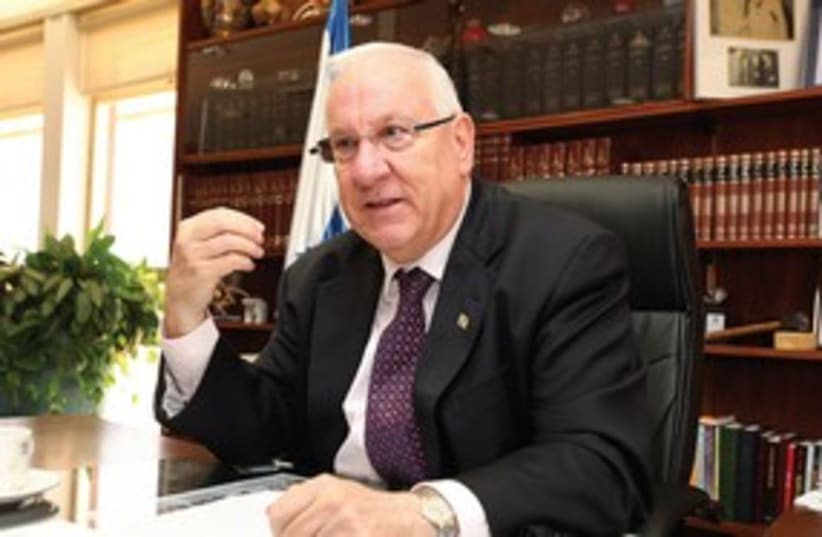
In an interview with the ‘Post’, the Knesset speaker laments a changed US perception of Israel, and the new dangers it brings.
By REBECCA ANNA STOILRivlin 311(photo credit: MARC ISRAEL SELLEM)
As the American administration feverishly works to pressure Israel and the Palestinian Authority to return to the negotiation table and to make significant advancements within 90 days toward resolving the conflict, one of the Likud’s most veteran politicians, Knesset Speaker Reuven Rivlin, warned the US this week that “there are no shortcuts to peace in the Middle East.”Since Prime Minister Binyamin Netanyahu presented the latest plan for a 90-day moratorium on new settlement construction last Saturday night, Rivlin has walked a delicate line, refusing to speak out against the freeze or join his party’s anti-freeze rebels. In an interview conducted in his Knesset office on Wednesday, however, Rivlin made plain his thinking and maintained that the current American policy represents a slippery slope for Israel.What has changed in the situation today with the Americans compared to what Israel has experienced in the past?Today we find ourselves facing an American administration that does not see as a basic point of reference the moral responsibility for the existence of Israel. It certainly supports the Zionist idea, the idea that the Jews of Israel live here, but it does not feel any moral responsibility for Israel’s existence.There is definitely a new American perception that does not see Israel as a strategic asset in the Middle East for both the United States and the free world. This is a development that even we, the veteran politicians, see as something new.I remember that in 1948, [president Harry] Truman was not so excited at the prospect of a Jewish state in the Middle East. In fact, Moscow was more excited than the United States because of various political considerations.But since then the United States demonstrated a real commitment to Israel for two reasons: a moral one and a strategic one. Today, these two factors are less dominant. Not that, God forbid, someone [the US] doesn’t want Israel to exist. Rather, they see the conflict through an American prism – not Israeli.Can Israel live with a vulnerable eastern border, without [control of] the Jordan Valley? Can Israel divide Jerusalem? Can Israel relive the [withdrawal] experience of Gush Katif [but this time] with more than 300,000 residents?Much of the focus of attention surrounding the American commitments, both in Israel and among the Palestinians, seems to revolve around Jerusalem. What’s your thinking on this, as a politician, and as someone who has spent his past 71 years as a Jerusalem resident? Jerusalem is a microcosm of the situation as a whole. I know that any artificial separation solution will not work because we all live together. We are bound together. There is no east or west Jerusalem – there is one Jerusalem.Because in east Jerusalem, there are more than a quarter of a million Jewish residents.After the 1967 war, the Israeli plan was to build all of the neighborhoods to the east of central Jerusalem, in what is now called east Jerusalem. There was a consensus on this.Jerusalem is indeed a microcosm in which we all live together. For the time being, we are doomed to live together.With God’s help, we will understand that we are destined to do so.This is an attempt by a new US president to take shortcuts in the Middle East. There are no shortcuts in the Israeli-Arab conflict. The Israeli-Arab conflict is between two peoples. Both are convinced that they are objectively correct. The Jews have no other solution because they have nowhere else to go.And they need to find a way to live in peace with the [Arabs], who live together with them in the land they themselves consider as their own homeland.Would it be significant for you if the Americans were to sign a letter saying that the freeze would not include Jerusalem?I don’t believe that they would write that, but I retain my opinion that there are no shortcuts. I have a feeling due to past experiences with [prime minister Ariel] Sharon and [attorney Dov] Weissglas that they won’t sign. They’ll say to the Palestinians, “Don’t be afraid, you know we’re behind you. Israel says that Jerusalem isn’t included, but we won’t let them build there,” or something similar to that. They will speak two languages – one for the Palestinians and one for the Israelis. A letter making promises on Jerusalem doesn’t hold water.Beyond that, a letter must clarify that Israel distinguishes between Jerusalem and the rest of the settlements, which would be a very serious step before an agreement has been reached. It would be a retreat.I understand the prime minister’s difficulties, and I understand why I don’t want to be the prime minister. The difficulty of leading a nation when there is the danger that the United Nations will decide for us, and the United States won’t stand behind us, is a risk that we must weigh. But would such a letter advance us in some way? And if after three months we don’t achieve an agreement with the Palestinians, won’t there be yet another demand? When [former prime minister] Menachem Begin went to Camp David, his friends came to him and asked, “If they were really planning on returning most of the Sinai to the Egyptians, why doesn’t Israel also ask the Americans to forgive the debt owed by Israel to the United States?” Begin said, “Are you crazy? We’re going to do a peace deal for money?” They said, “But we owe money” and Begin replied that “I know you won’t understand me at this moment, and that there will be others who say that the old Polish Jew is playing games again with national honor, but in the long run, as a norm, you will understand.”So would any American letter of commitment make a positive difference?We have learned from past experience.We were promised that Israeli reservations would be added to the Road Map, and in the end nothing was added in.Also, we in Israel increasingly see that letters given to us in the past by the American government, whether by the president or the State Department, undergo a sort of an erosion. What use are such letters if they don’t ultimately become a clear basis for understanding between the Americans and the Israelis? Every promise, every letter, is something that by its nature awakens doubt based on past experience.But beyond that, Israel needs to determine what it needs in order to maintain its security and its existence as a state in this region. Red lines are something without which we cannot hold negotiations.Until now, we discussed negotiations without preconditions. Until now, we discussed direct talks in which we will solve our problems with the Palestinians.The Palestinians rejected many offers in previous negotiations – very generous offers in terms of the Israeli consensus. Is Jerusalem in the Israeli consensus? Is the Jordan Valley? Where do the red lines run?Are you troubled that this demand for a moratorium is the inevitable consequence of Israel’s willingness to impose the first 10-month moratorium that ended in September?When the idea of the first freeze came up, I discussed it with two of my friends – Prime Minister Binyamin Netanyahu and [Minister-without-Portfolio Bennie] Begin, who is both my friend and my neighbor. I warned them against raising the idea of a freeze as an Israeli gesture, because the moment you say that there is the possibility to freeze building, it becomes a fact that you can – and then have – frozen it.And I said that beyond that, it will be hard to explain to our best friends in the world how we freeze construction in order to get the Palestinians to sit with us at the table, but then at the moment they sit with us we lift the freeze. Every child in Budapest, Vienna, Paris or London would not understand the logic.I said more than that. I told them that when you impose a moratorium and say that it is not pending on annexed areas, you automatically assume that building in Jerusalem will not be part of the freeze. I said to the prime minister 12 months ago that within three, four weeks, the topic of Jerusalem will be raised in the context of the freeze, because while we take for granted the assumption that Jerusalem is unified, even the United States doesn’t agree. So in essence, I predicted what happened with [US Vice President Joe] Biden. Not because I am especially wise, but rather because I am the boy in “The Emperor’s New Clothes” that [Hans Christian] Andersen spoke of, who understands what he sees. He doesn’t say what a nice suit the king has, he says what he sees, that the king is naked.I said to them, if we agree to a freeze in Ariel, then the US will say what is the difference between Ariel and Jerusalem? Because in the Palestinians’ eyes, and unfortunately in the eyes of the Americans, Jerusalem is part of the occupied territories.Tovah Lazaroff contributed to this report
Related TagsGush Katif
if(catID != 151){
var cont = `Take Israel home with the new Jerusalem Post Store