Will Hizbullah avenge the hit on its terror chief?
Security and Defense: Has Hizbullah let the Mughniyeh assassination slide or is it simply waiting for the right moment to retaliate?
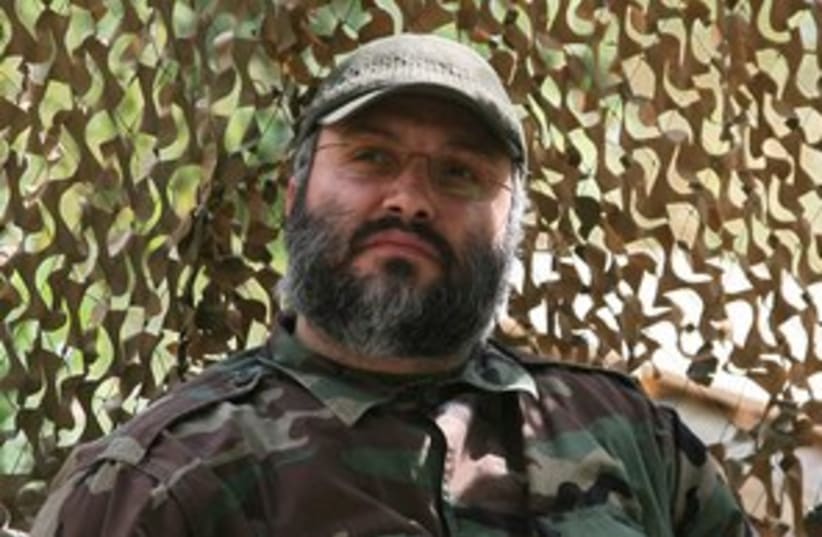
By YAAKOV KATZimad mughniyeh_311(photo credit: ASSOCIATED PRESS)
For the past three years, the defense establishment has been waited in apprehension. After that fateful night in the upscale neighborhood of Kafr Soussa in Damascus on February 12, 2008, when Imad Mughniyeh was assassinated, the country has been bracing for the expected revenge which has yet to come.The fact that Hizbullah has yet to attack is possibly the greatest proof of just how important Imad Mughniyeh was for the guerrilla organization. Without his crafty strategic and tactical skills, it apparently could not pull off an attack, even though it accused Israel of carrying out the assassination.Several known plots have been thwarted, including a plan to bomb the Israeli embassy in Baku, Azerbaijan and a plan to hit a target in Turkey with shoulder-to-air missiles.Despite the three years that have passed since Mughniyeh’s death, his position as commander of Hizbullah’s military forces has yet to be completely filled. Also unfilled, is the position he held as head of its overseas terrorist infrastructure, the likes of which carried out the 1992 and 1994 bombings in Argentina.In more recent years, he was involved in the 2000 kidnapping of three IDF soldiers and the abduction of reservists Eldad Regev and Ehud Goldwasser on July 12, 2006, an attack that sparked the Second Lebanon War. His relationship with Iran and Syria made him something like a nexus of terrorism encompassing the Middle East and possibly the entire world.BUT WHO was Mughniyeh? He was born into a Shi’ite family in 1963 in the southern Lebanese village of Tayr Dibba. His father was a poor farmer and vegetable salesman and at 16 he joined Fatah and climbed the ranks fairly quickly, eventually becoming a member of Force 17, its elite military force. One of Mughniyeh’s first missions was to protect Abu Jihad, later believed to have been assassinated by Israel in Tunis in 1988.One of the first Israeli intelligence officers to hear the name Mughniyeh was Brig.-Gen. (res.) Shimon Shapira, who served as Binyamin Netanyahu’s military aide during his first term as prime minister in the 1990s.“He was of interest to us since it was unusual for the Palestinians to give such a senior position to a Shi’ite like Mughniyeh,” said Shapira, who wrote his doctorate on Hizbullah and its rise to prominence.“This was a clear indication of Mughniyeh’s skill, talent and looming greatness.”In 1982 though, after Yasser Arafat was deported from Lebanon following Israel’s invasion, Mughniyeh decided to leave Fatah and started working for Iran, acting as the bodyguard for Sheikh Muhammad Fadlallah, the Lebanese Shi’ite community’s spiritual leader who died last July.It was during that period that he became involved with Hizbullah, which was just taking its first steps into the world of global terrorism. The next year was a big year for Hizbullah and Mughniyeh, who helped mastermind and carry out the attacks against the American embassy and Marine barracks in Beirut which killed more than 300 people. Two years later, he was involved in the hijacking of a TWA airliner.“We picked up on Mughniyeh when he started working for the Iranians and following the TWA hijacking in 1985,” recalled Shapira, who worked for more than 20 years in Military Intelligence with a special focus on Iran.A number of attempts to assassinate or capture him over the years failed and in 2000, following the withdrawal from Lebanon, Mughniyeh offered Iran to not just support Hizbullah as it had been doing, but to turn Lebanon into its frontline base against Israel.“This is when Iran decides to turn Hizbullah into their front against Israel and into a real strategic asset and begins deploying thousands of missiles in Lebanon. Mughniyeh is responsible for all of this,” Shapira said.In 2006, Mughniyeh personally joined the combat and fired Katyusha rockets into Israel. Before the war, he was spotted once or twice along the border giving tours to his Iranian patrons.“He was an old-school type of terrorist,” explained Col. (res.) Eitan Azani, a former head of Military Intelligence’s Lebanon Desk. “He had a very strong operational mind-set, and he also invested a lot in watching over himself since he knew that he was being hunted.”ACCORDING TO various foreign reports, the decision to assassinate Mughniyeh was taken before the 2006 war but turned urgent immediately after the cease-fire went into effect on August 14.After receiving a tip that Mughniyeh was planning to attend the 29th anniversary of the revolution celebrations at the Iranian embassy in Damascus, Mossad chief Meir Dagan tasked the Kidon unit, an elite group of assassins which operates under the Caesarea Branch, with the mission.According to one account in the foreign press, three operatives flew into Damascus on European passports. Using local conspirators, the three obtained explosives, loaded them into a rental car and parked it in front of the Iranian Cultural Center.The team set up down the street from the center and waited for Mughniyeh. He finally showed up, left his car and began walking toward the party, the report claimed. As he passed the rental car, the entire street shook. Mughniyeh’s body parts were later found scattered across the street.His assassination took Hizbullah completely by surprise, particularly Sheikh Hassan Nasrallah, the organization’s leader, who still delivers speeches from his bunker, fearing a similar end.But the void Mughniyeh left has been hard to fill. According to senior IDF officers, no single person was capable of replacing him and his responsibilities have been divided among a number of Iranian and Lebanese nationals.The Iranian Revolutionary Guards Corps, Mughniyeh’s patron, used his assassination to solidify its control over Hizbullah. Shortly after he was killed, Iran deployed a top IRGC officer to Lebanon to oversee its operations.The officer has been identified as Hossein Mahadavi, and his official title is “commander of Iran’s overseas division,” which, in this case, is Hizbullah. Mahadavi is believed to maintain an office in Beirut and is a senior member of the IRGC’s Al Kuds Force, which is responsible for overseas operations.Relations between Iran and Hizbullah have seen some tension lately. Mahadavi’s presence has caused friction, as has Iran’s decision to cut its annual $1 billion in support by some 40 percent.IT IS unclear if Hizbullah is still interested in avenging Mughniyeh’s assassination.The organization’s recent takeover of Lebanon with the formation of a new government essentially controlled by Hizbullah and Nasrallah is an indication of Iran’s growing regional hegemony, but will also likely restrain the group due to the potential political losses it would suffer in a future war.Looking back on Mughniyeh’s life, one better understands the transformation that Hizbullah has made from its humble beginnings as a small-time terror group. At the same time, his story suggests the threat the Western world will face if Iran is allowed to continue supporting terror and developing a nuclear weapon.
if(catID != 151){
var cont = `Take Israel home with the new Jerusalem Post Store