What Operation Pillar of Defense says about Israel’s wider strategic picture.
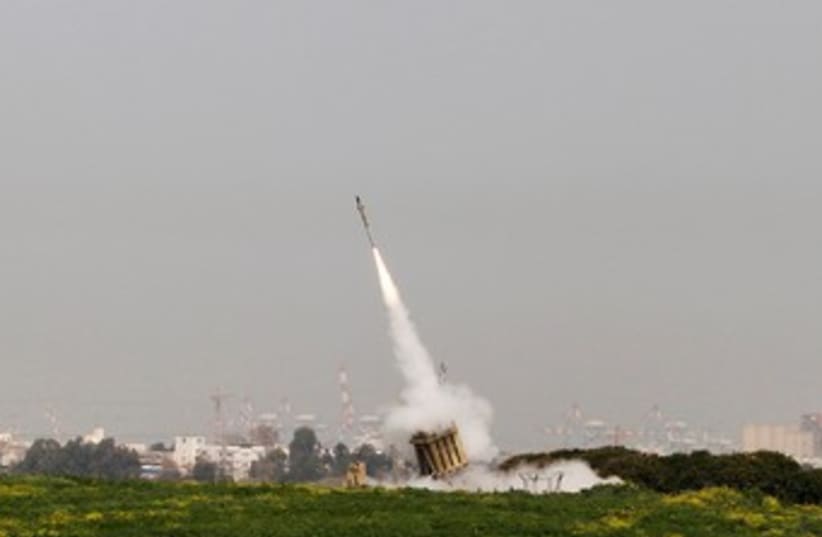
By YAAKOV LAPPINIron Dome 370(photo credit: REUTERS)
The recent conflict between Israel and Hamas offers several hints regarding Jerusalem’s wider strategic situation in the region. For many years, Iran and its proxies on Israel’s borders have worked to create rocket and missile bases, aimed at threatening its soft underbelly: the civilian home front.The Iranian project saw terror bases developed in southern Lebanon and Gaza, and represents the most serious asymmetrical threat faced by Israel to date.The Iranian plan is based on the idea of giving Hezbollah, Hamas and Islamic Jihad the ability to flood the home front with projectile fire, thereby causing casualties, widespread damage and a paralysis of ordinary life. This capability has multiple purposes in the hands of Israel’s enemies.It allows Gaza terror factions to realize their ideology of eternal jihad, buffered only by tactical cease-fires between rounds of fighting. Even more significantly, it enables enemies of the state to try and deter Israel from striking at the threats that surround it. When Iran’s Revolutionary Guard Corps oversaw the creation of the rocket bases, they had hoped that the threat they were developing would deter Israel from carrying out targeted assassinations of terrorists in Gaza on the local front, while on the regional front, Israel might be deterred from striking Iranian nuclear sites.Hamas had wrongly assumed that the rise of its fellow Islamists in Egypt would contribute to that deterrence.As Operation Pillar of Defense proved in November, the attempt to deter Israel from defensive strikes in local arenas failed. An Israeli air strike killed Hamas military commander Ahmed Jabari, a development that shocked both Hamas and Iran.Iran was startled by the blow, despite its ongoing crisis with Hamas (relations between the two have cooled over Hamas’s backing of the Syrian rebels).One of the major factors that allowed Israel to operate freely last month is, of course, the Iron Dome rocket defense system.The five Iron Dome batteries deployed in southern and central Israel intercepted 87 percent of projectiles heading toward populated areas, allowing the IDF to stick to its plan of a limited weeklong air campaign to damage Hamas. The plan was centered on the modest goal of reinstating Israeli deterrence, as a necessary condition for ending the daily rocket menace terrorizing the South.The problem is that this successful model – of an active defense in the service of offensive Israeli capabilities – is in place only for Gaza for the time being, and not against the main Iranian rocket base in our region, which is Hezbollah in Lebanon.The Shi’ite terror organization has amassed over 50,000 rockets in Lebanon, and all of Israel is within range.In timing that cannot be coincidental, the Defense Ministry held a successful test of the David’s Sling rocket defense system soon after the end of the recent Gaza conflict. David’s Sling, with its ability to intercept medium and long-range rockets and cruise missiles, is the active defense answer to Hezbollah’s threat.But it will only be operational in 2014. That creates a serious “scheduling problem,” as Israel may find itself having to make a fateful decision on the Iranian nuclear question as early as this spring, if Tehran continues its enrichment of uranium at the current pace.“The problem is Hezbollah’s rocket arsenal. They have Katyushas, M600s, Scud missiles from Syria, and Fajr 3 and 5 rockets. This is an immediate threat, which we might face in the spring, when there will be a need to decide on Iran,” said Dr. Ely Karmon, a senior research scholar at the Institute for Counter-Terrorism at the Interdisciplinary Center Herzliya.“The Iranians armed Hezbollah with 50,000 rockets for a reason. They are reserving this option. The threat from Hezbollah is more serious. Perhaps they [the IDF] will have to conquer Beirut,” he added.Air defense systems were never meant to provide a full answer to the threat, but the more efficient they become, the more flexibility the IDF has in planning its air and ground attacks.It remains unclear whether the IDF is planning on a return to the Lebanese capital, but there can be no doubt that in the absence of an active defense system, a wide-ranging ground offensive involving large numbers of infantry and armored vehicles crossing deep into Lebanon, backed by an aggressive air campaign, will form Israel’s response to the rocket threat from Hezbollah. The faster ground forces get to Hezbollah positions, the sooner rocket attacks on Israel would cease in a future war.In Gaza itself, there are few signs that the Iranian rocket strategy suffered a blow to its prestige, Karmon argued.“Iran has already scored points from this confrontation.The heads of Islamic Jihad and [Hamas Prime Minister] Ismail Haniyeh have said that it was Iranian weapons which allowed them to attack Israel. Islamic Jihad was the first to fire on Tel Aviv.That’s significant, as this organization is Iran’s auxiliary,” Karmon added.Musa Abu Marzouk, deputy chairman of Hamas’s political bureau, declared in recent weeks that Hamas would continue to receive shipments of Iranian weapons to refill stocks of long-range Fajr rockets and medium-range Grads.“I see this as a message from Hamas to Egypt, in which they are demanding freedom to import weapons to Gaza,” Karmon said.According to various publications, Iran sent out one shipment already and they are determined to send more.Thus, Hamas managed to join the new Sunni axis while maintaining its access to Iranian weaponry.In addition to the threats from Lebanon and Gaza, Iran possesses hundreds of ballistic missiles, such as the Shihab 3 (based on a North Korean missile) and the BM25 (purchased from North Korea in 2008), all of which can strike Israeli territory.Jerusalem has already developed a response to this threat in the form of the Arrow 2 ballistic missile defense system, which intercepts incoming threats in the upper atmosphere, and the Arrow 3 system, which will intercept missiles in space after becoming operational.“The question is what is the state of the radars within the Arrow system,” said Maj.-Gen. (res.) Giora Eiland, former head of the National Security Council. “Can these systems preempt the Iranian missiles?” Eiland said there was no clear connection between Iron Dome’s performance and a possible strike on Iran in the spring. He also cast doubt on the term “multi-layered missile defense,” often used by Defense Minister Ehud Barak.“To think that Arrow 2 [and] 3, David’s Sling and Iron Dome give us the chance to shoot down the same missile is wrong,” Eiland said. “Although there is some overlap between them, each system deals with a different threat.”Nevertheless, Iron Dome is capable of providing a partial answer to some of Hezbollah’s rockets.Yet, as of now, Israel has no defensive answer in place to deal with Hezbollah projectiles with a range of 200 kilometers, Eiland stated.“The other side is improving. It has more rockets, larger warheads and the ranges are growing,” he said. “Even in Iron Dome, which provided a good but limited response, we saw that it wasn’t perfect.”Brig.-Gen. (res.) Shlomo Brom, a senior researcher at the Institute for National Security Studies in Tel Aviv, agreed. Although Israel challenged the Iranian rocket program, it is far from neutralizing the threat, he said.In the November conflict, rockets still managed to strike the home front, and terror organizations began overwhelming Iron Dome with massive volleys toward the end of the escalation, Brom noted.“I’d bet that the trend will feature a rise, not a drop in rockets. In the future, they’ll try to fire many more rockets than what we’ve seen,” he said.But Lt.-Col. (res.) Michael Segall, a strategic analyst for the Jerusalem Center for Public Affairs, takes a more optimistic view on the repercussions of the conflict. In an analysis he recently published, Segall viewed the conflict through a wide regional lense, placing it within the context of a growing rift between the Shi’ite and Sunni camps.He said the Shi’ite camp – made up of Iran, President Bashar Assad’s regime in Syria and Hezbollah – is on a collision course with the emerging Sunni camp – composed of Egypt, Saudi Arabia, Qatar and Turkey.The tensions are “evident in the conflict arenas in the Middle East – Syria, the Palestinian arena, Bahrain, Jordan,” Segall said, and stand to greatly influence the landscape of the region.“Egypt, playing a central role in determining the new regional order, will likely find itself in confrontation with Iran. Turkey is already confronting Iran over regional hegemony and influence, with Syria as a front line,” Segall said.In this context, Israel’s ability to deflect Iranian rockets, as exhibited last month, helped “put Iran in a problematic position of growing isolation,” he argued.Segall views Iron Dome’s success as one of a number of blows to Iran’s standing in the region.Whether the Gaza war damaged or benefited Iran, Tehran’s nuclear clock continues to tick.
if(catID != 151){
var cont = `Take Israel home with the new Jerusalem Post Store