If you want to know what the Palestinians are going to do tomorrow, just listen to what US President Barack Obama says today
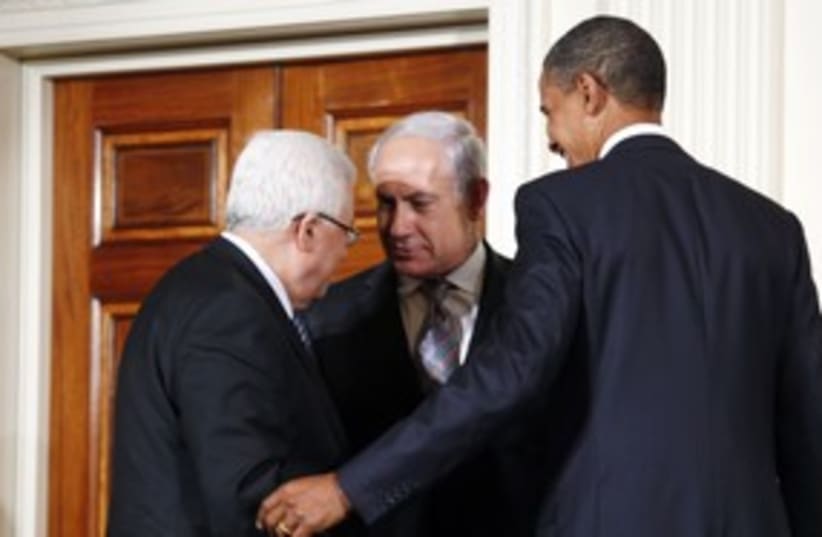
By HERB KEINONObama, Netanyahu, Abbas at White House 311 (R)(photo credit: Jason Reed / Reuters)
If you want to know what the Palestinians are going to do tomorrow, just listen to what US President Barack Obama says today. In May 2009, after the first meeting in the White House between Obama and Prime Minister Binyamin Netanyahu, the US leader made a comment that set the tone for the next couple of years and pretty much killed any chance of negotiations: Settlements must stop.“Settlements have to be stopped in order for us to move forward,” he declared.The Palestinians, who until that point had never made a total settlement freeze – including in areas beyond the Green Line in Jerusalem – a condition for negotiations, heard Obama and pounced. If this was what the American president was saying, how could they ask for anything less?Or, as Palestinian Authority President Mahmoud Abbas said himself in a Newsweek interview in April, “It was Obama who suggested a full settlement freeze. I said OK, I accept. We both went up the tree. After that, he came down with a ladder and he removed the ladder and said to me, jump.”And then again in September 2010, at the UN General Assembly, Obama addressed the Israeli- Palestinian issue just as the 10-month Netanyahumandated settlement freeze was about to come to an end. “We have travelled a winding road over the last 12 months, with few peaks and many valleys,” he said.With his distinctive soaring rhetoric, Obama declared, “The conflict between Israelis and Arabs is as old as this institution. And we can come back here next year, as we have for the last 60 years, and make long speeches about it. We can read familiar lists of grievances. We can table the same resolutions. We can further empower the forces of rejectionism and hate. And we can waste more time by carrying forward an argument that will not help a single Israeli or Palestinian child achieve a better life.“Or,” he went on, “we can say that this time will be different – that this time we will not let terror, or turbulence, or posturing, or petty politics stand in the way. This time, we will think not of ourselves, but of the young girl in Gaza who wants to have no ceiling on her dreams, or the young boy in Sderot who wants to sleep without the nightmare of rocket fire.“This time, we should draw upon the teachings of tolerance that lie at the heart of three great religions that see Jerusalem’s soil as sacred. This time we should reach for what’s best within ourselves. If we do, when we come back here next year, we can have an agreement that will lead to a new member of the United Nations – an independent, sovereign state of Palestine, living in peace with Israel.”And that was it – all of a sudden September 2011 became a magic deadline for declaring a Palestinian state.True, Netanyahu had said after meeting Abbas in Washington a few weeks before Obama’s UN address that he believed “we should make every effort to reach an historic compromise for peace over the coming year.” But it wasn’t until Obama spoke of Palestine as a new member of the UN by 2011 that this date suddenly became a benchmark.For instance, since that speech, the EU has consistently set September as a deadline of sorts, including referring to a “framework agreement by September 2011” in a statement released as recently as May 23 by the heads of the EU countries – a statement notable for the degree to which it seemed completely divorced from reality.Does anyone really think a framework agreement is going to be reached by that date, what with the sides not even directly speaking to each other at this point? Still Obama said September 2011, and neither the Europeans nor the Palestinians are going to appear less Catholic than the Pope.The Europeans put this deadline in their statements, and the Palestinians have expressed their determination to fulfill Obama’s prophecy in September by asking for UN recognition of a Palestinian state – whether that recognition means anything or not, and regardless of the consequences. Obama set the bar, and the Palestinians are not going to lower it; rather, they will do whatever they can to jump over – even if there is no landing pit on the other side.And then the pattern of Obama making declarations and the Palestinians adopting those declarations as their tactics repeated itself again last month.In his State Department speech on the Middle East on May 19, a day before Netanyahu was due in town, Obama said that “while the core issues of the conflict must be negotiated, the basis of those negotiations is clear: a viable Palestine, and a secure Israel.“The United States believes that negotiations should result in two states, with permanent Palestinian borders with Israel, Jordan, and Egypt, and permanent Israeli borders with Palestine.“The borders of Israel and Palestine should be based on the 1967 lines with mutually agreed swaps, so that secure and recognized borders are established for both states.” Obama also laid out his policy toward the sequencing of negotiations, essentially adopting the Palestinian position by saying that the “two wrenching and emotional issues” of the future of Jerusalem and the fate of Palestinian refugees should be deferred and discussed after questions of territory and security were addressed.With that speech, Obama struck a third time. If Obama said that the basis of negotiations should be the 1967 lines, and that Jerusalem and refugees should be deferred to a later date, then who were the Palestinians to quibble? And, indeed, they did not quibble. In fact, clutching those parameters to his breast is exactly what Palestinian senior official Saeb Erekat did Tuesday during a speech at the Saban Center of the Brookings Institution in Washington.According to The Washington Post’s Jackson Diehl, Erekat “staked out a new position” in his speech, saying that talks would only commence if Netanyahu formally accepted Obama’s 1967-lines parameters, something Netanyahu has made abundantly clear he has no intention of doing.If Netanyahu “wants to be a partner he has to say it: Two states on the 1967 lines with mutually agreed swaps,” Erekat said. “He has a choice.” Erekat said that without that declaration, there would be no talks, and the PA would go ahead with its UN push.“I have no quarrel with the United States,” Erekat stated. “If Mr. Netanyahu says he accepts the two-state solution on the 1967 lines with agreed swaps, he’s on.”There’s the pattern: Obama makes a declaration – one Israel cannot accept – and it becomes the newest Palestinian prenegotiating position. But when the Palestinians take up this position – knowing full well it is a source of US-Israeli friction – it seems meant not to promote a solution, butto chip away at Israeli-US government ties.Erekat, Diehl said, “left little doubt that he was staking out a position in response to the Obama administration’s efforts to restart negotiations – a position that appears aimed less at advancing the process than at deepening the discord between the Israeli and US governments.”Erekat’s comments, moreover, come at a time when the operative assumption in Jerusalem is, and has been for months, that Abbas has no desire in the world to negotiate with Netanyahu.Indicative of this assumption is a diplomatic cable that arrived in the Foreign Ministry this week from a senior diplomatic official in Washington who met with a senior Palestinian official stationed there. The cable made clear that the Palestinian official believed Abbas was intent on going to the UN in September, and that he had decided to “abandon the process,” and had “no intention of returning to negotiations.” The cable also said that at this point in time Abbas was primarily concerned about his historical legacy.What Obama does with his various declarations is give Abbas the cover to stay away from negotiations, while blaming Israel for his own rejectionist stance.Just as Netanyahu could not, for a variety of reasons – political and ideological – declare another settlement moratorium, forcing Obama to have to backtrack on that demand, it is also unlikely he will now accept a return to negotiations based on the 1967 lines, with mutually agreed upon swaps, unless some very significant “sweeteners” are thrown into the mix: such as Palestinian recognition of Israel as the nation-state of the Jewish people, a formula that would imply an abandonment of the Palestinian dream of a “right of return.”But the chances of that happening are slim indeed. Concerned with his legacy, Abbas is not eager to go down in the Palestinian history books as the one who closed the door to the descendents of Palestinian refugees “returning” to Haifa, Jaffa and Safed.The negotiations, therefore, remain stymied, and Obama has uncovered an uncanny ability – with his declarations – to handcuff the very diplomatic process he is trying to push forward.
if(catID != 151){
var cont = `Take Israel home with the new Jerusalem Post Store