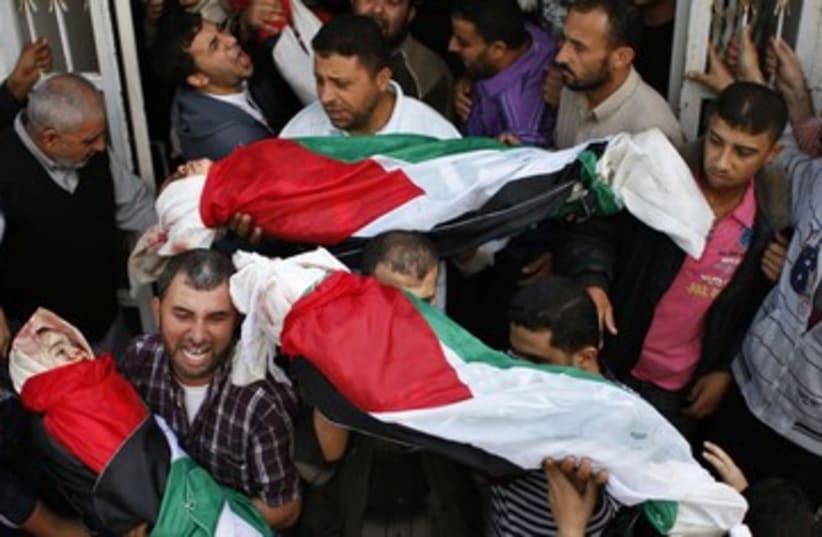
Israel’s air strike on Sunday of the Dalu family is a public relations disaster.
By YONAH JEREMY BOBAl-Dalu family 390(photo credit: REUTERS/Mohammed Salem)
Israel’s air strike on Sunday of the Dalu family is a public relations disaster.An Israeli bomb turned an apartment building mostly into a crater, killing 11 people across several generations, including most of Jamal al- Dalu’s family.Initially, media reports indicated that IDF Spokesman Yoav Mordechai had claimed that a major terrorist commander was killed. But Palestinian reports surfaced that the sought-after terrorist was still alive and had not been there.Later reports had Mordechai saying the incident was being examined and it was unclear if the terrorist had been killed, injured or not there at all.Under the law of armed conflict, if the terrorist had been on the premises, the IDF might have been able to justify the attack legally (there can be no possible positive public relations spin) if it could show that al-Dalu had a high value and that the expected damage to civilians had been low.This argument in itself may be problematic in light of the extent of the damage to the building and the number of civilians killed.Click for full JPost coverageIn other words, it appears from the results that the weapon used was not particularly light.So unless there was incorrect intelligence about how many civilians were in the building or where they were situated, which is quite possible in an evolving war zone, Israel’s argument is already not simple.What if a terrorist was present or the IDF believed there was a terrorist present and did not expect the extent of the harm to civilians, essentially eliminating a three-generation family, but it was just wrong about one of those critical details? This scenario makes the situation all the more tragic, as the IDF may not even have killed the family, had its information had been accurate.In such a situation, it would be almost impossible to prove any war crimes allegations against those who fired the missile or their commanders either because they hit a military target or because they genuinely thought they were hitting a military target.Also, those who fired the missile and their commanders may have had intelligence that said, incorrectly, that there were fewer civilians nearby.Lawyers call this a “mistake of fact.” An honest mistake of fact essentially bars any attempt to prove there was criminal intent, a prerequisite to prove any war crime.Is that the end of the story? Probably not. There is a wideranging debate about whether in such “mistake” situations, there is a legal obligation to pay compensation to the surviving family members.Some say there is an obligation, while others say mistakes, if not negligent and in the “heat of battle,” are just part of war and states do not need to compensate victims.The arguments can be much more complex, but essentially the idea would be that the IDF did not ask for this war. It views all of its actions as self-defense against rocket attacks.From this perspective, Hamas should pay the family since they were the cause of the war and the need for air strikes in self-defense.The response would be that these civilians had nothing to do with Hamas.Then they would argue that Israel was the one who killed the family, making only Israel responsible for compensating the family.The pro-compensation side of the argument could point out that even if a terrorist had been there, the practice of many states is to compensate civilians in these circumstances even if the harm caused to them might be justified as “collateral damage” under the law of armed conflict.The fact is that in some cases from Operation Cast Lead and other famous instances of hitting civilians by accident in the past, Israel has side-stepped the legal question by paying compensation “ex gratia,” or voluntarily above and beyond the law’s requirements (similar to the Jewish legal term “lifnim mishurat hadin”) This is a way of showing compassion without admitting fault. Another possibility is a public statement of regret that still falls short from admitting fault.Much of the above is speculative, until hard facts are collected.Now, there will likely be a long process to check and confirm all of the facts and probably a military investigation, but there is a decent chance that Israel will eventually decide to compensate or express regret to al-Dalu.
if(catID != 151){
var cont = `Take Israel home with the new Jerusalem Post Store