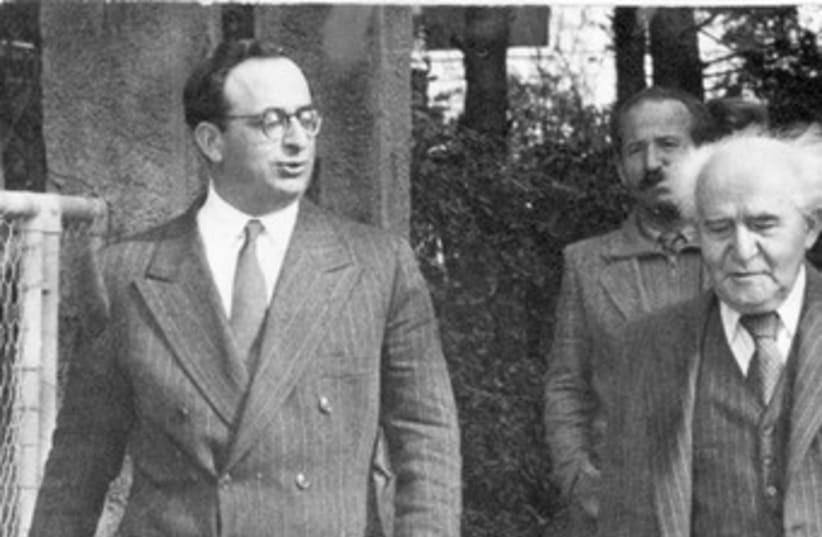
By GREER FAY CASHMANYitzhak Navon and Ben Gurion 370(photo credit: P. Schlesinger)
Israel’s fifth president Yitzhak Navon has had a varied career as a teacher, diplomat, politician, government minister and writer.More than anything else he is an educator – a born teacher whose natural inclinations in that direction often rode in tandem with his other careers.His favorite pupil was without doubt Israel’s founding prime minister David Ben-Gurion. Navon, whose family has been in Jerusalem for many generations, speaks several languages in addition to Hebrew. One of them is Spanish.Soon after the establishment of the state he was sent as second secretary in Israel’s diplomatic missions to Uruguay and Argentina.Following his return to Israel, he went to work as personal secretary to then foreign minister Moshe Sharett.During this period someone sent Ben-Gurion a book about Spinoza, whose intellect he greatly admired, though he disapproved of Spinoza’s heresy.Ben-Gurion was eager to read the book, but there was a snag. The book was in Spanish, a language which Ben-Gurion did not have at his disposal.The avid reader and scholar that he was, Ben-Gurion refused to entertain the possibility that someone fluent in Spanish would read the book and then present him with a summary in Hebrew. He wanted to read it himself, and asked people in his orbit to recommend a good Spanish teacher.The task fell to Navon, who met with Ben-Gurion regularly, taught him vocabulary and grammar and read passages of the book together with him.Having mastered Spanish to the extent that he could read a book and understand it, Ben-Gurion became more ambitious and decided to read Cervantes’ Don Quixote in the original. Navon again came to his assistance and they read Cervantes together.Ben-Gurion was a most assiduous pupil, Navon recalled last month in an interview with The Jerusalem Post in his book-lined office in which an abstract portrait of Ben-Gurion dominates the wall behind Navon’s desk.Navon and Ben-Gurion might well have gone their separate ways but for the fact that Ephraim Evron, who was Ben-Gurion’s secretary, had been given an ultimatum by his wife. She wanted him to be home more often to be a full-time father to their children and not some nebulous being whom they occasionally saw when he was not otherwise occupied with affairs of state. She made it clear that if he did not resign she would leave him. As devoted as he was to Ben-Gurion, in Evron’s list of priorities, his family came first and he duly resigned and returned to the Foreign Ministry where he had previously been political secretary to the foreign minister. Years that followed carved out a distinguished diplomatic career.Ben-Gurion spent little time looking for a replacement. He had already developed a good working relationship with Navon, and the post of secretary to the prime minister was one of several positions that Navon subsequently held in the Prime Minister’s Office.The two worked together for 11 years, during which time they built up a strong and lasting friendship, confidence in each other and mutual respect.FROM A historic perspective, it seems incredible that Navon, a Sephardi on both sides of his family, should rise to such a high position. It was a period when Sephardim, particularly those of Moroccan background, often complained of discrimination. In Navon’s case it just didn’t happen. He has no recollection of being the victim of negative bias based on his Sephardi or Moroccan roots.It was not until he was president that he became acutely aware of the multitude of prejudices that existed among the different sectors of Israeli society.Supreme Court justice Haim Cohn, who had previously been state attorney, attorney general and justice minister, asked him to do something in his presidential capacity to pay tribute to the German immigrants who by and large had come to the country in the 1930s in the immediate aftermath of the rise of Nazism in Germany. Most were well educated and in the country of their birth had been members of white-collar professions. In the Holy Land many found themselves doing manual and menial work to eke out a living. They did not merge into the local lifestyle, and despite the climate, continued to wear their jackets to work, which was the reason they were known by the derogatory term of yekke. A jacket in German is jacke.Cohn, who had been born in Lübeck, Germany and had lived most of his life in Israel, was nonetheless regarded as a yekke. Pained by an attitude that continued to prevail, he asked Navon to give all those Israelis of German origin a better sense of self-image. Navon complied, but as a result became alert to how other ethnic, national and religious groups perceived themselves and each other. He reached the conclusion that every sector of society sees itself as a victim of negative bias both in relation to the media and the mainstream.He set himself a task of finding a common denominator that would unify all these groups as part of one nation while preserving the cultural heritage of their forebears.The common denominator was the Bible and a shared history of persecution and survival, he concluded.OTHER ISSUES that bothered him as president were youth at risk and finding ways to reduce the gap between Israel’s Arab and Jewish populations.As an educator, Navon thought it important to pay a visit to the slums of the Hatikva neighborhood in Tel Aviv.Going to Hatikva for only a day would not accomplish anything, Navon reasoned. If he was to gain the trust and confidence of the young people who were largely school dropouts living in a corrupt and crime-ridden environment, he had to spend at least three days with them listening to their problems and their complaints – and not from the lofty heights of the presidency but on eye-to-eye level. Navon listened, offered advice here and there, asked questions and demonstrated his keen interest in the well-being of these young people.Navon, whose fluency in languages includes Arabic, could not help but be aware that Israel’s Arab population was getting a raw deal in relation to its Jewish counterparts.It was customary in those days for representatives of the Arab sector to come as a delegation to the president to receive his blessing for Id el Fitr at the end of Ramadan. Navon decided that because dignity is so important in Arab culture that rather than have them come to him, he would go to them.Festivals notwithstanding, he frequently visited Arab towns and Beduin villages. Arabic poetry, he says, is very beautiful, and so when he addressed the Arabs on their holidays and on other occasions, he included some of the classic works by renowned Arab poets by way of paying respect to their culture – and of course his speech was delivered in Arabic.This was another language that he had taught Ben-Gurion, who was insistent on reading works in the languages in which they had originally been written. Maimonides’s Guide for the Perplexed, though written in the Hebrew alphabet, was in fact a transliteration of Arabic, which made it easier for Ben-Gurion to read, but Navon still had to teach him the vocabulary, and this was yet another classic work that they read together.In his visits to Arab and Beduin communities, Navon could see the lack of educational facilities, but under Israeli law, a president does not have the authority to deal with such issues, and it was not until he returned to the political arena and became education minister that he could order the construction of additional schools in the Arab sector.NAVON WAS among the most popular of all Israeli presidents, and when he threw his cap back into the political ring, there were many who urged him to take on the chairmanship of the Labor Party because of his extreme popularity with the voting public of North African background who had voted Menachem Begin into office. Navon declined.When asked why in the course of this interview he replied that there were two reasons. One was that while he knew that he could be a good president, he was not sure that he could be a good prime minister.They are two distinctly different roles. When he accepted the presidency, he knew exactly what it entailed. The burden of responsibility that a prime minister carries on his shoulders was not for a person of his disposition, he decided. But no less important was the fact that he did not want to alienate himself from Shimon Peres, who was then the leader of the Labor Party. Theirs is a close and long camaraderie which has endured for more than six decades.Each of them, Navon at 91 and Peres at 89, remains as devoted as ever to Ben- Gurion who died almost 39 years ago, and each is so committed to the preservation and promotion of his legacy that it is rare for either of them to address the public without making a direct or indirect reference to Ben-Gurion.ALTHOUGH HE is less in the public eye than he used to be, Navon is still very much in demand as a guest of honor and a keynote speaker, especially at bilateral events because he can switch so easily between languages, and he can speak effortlessly without notes.Age has not dulled his brain. His memory, both short term and long term, is remarkable, as is his attention to detail, which is yet another hallmark of an educator.When he speaks about Cervantes, for instance, he rises and walks to his bookcase to remove a thick Spanish volume, flips to Ben-Gurion’s favorite passage about nobility and humanity, and translates it into Hebrew.Later, when discussing Ben-Gurion’s meetings with world leaders and quoting Churchill, Navon knew exactly which file contained the records of that meeting and buzzed his secretary to bring it in.Several things that he quoted by heart, he checked in the file to be absolutely sure that he was correct.Among the many leaders visited by Ben-Gurion were prime minister U Nu of Burma, president Charles de Gaulle of France, British prime minister Winston Churchill, German chancellor Konrad Adenauer and US presidents Dwight D. Eisenhower and John F. Kennedy.Navon accompanied Ben-Gurion on all these and other visits, and has vivid recall of conversations that Ben-Gurion had with these men, whose names are indelibly engraved not only in the histories of their respective countries, but of the world.Just as Holland has used the sea to its advantage, Ben-Gurion told De Gaulle, Israel would use the desert. “We’ll cultivate it and there will be plenty of room for everyone,” he said, adding “We must conquer the desert or it will conquer us.”In later life, when no longer in office, Ben-Gurion, by way of example, went to live in the Negev and settled in Sde Boker, where his grave has become a place of pilgrimage.In a booklet, David Ben-Gurion, Builder and Warrior, that Navon authored, he wrote that Ben-Gurion never told anyone to do anything unless he tried it himself.Referring to the period when Ben-Gurion was prime minister, Navon wrote: “Ben-Gurion delivered his speeches only after detailed investigation, meticulous examination of the evidence and profound thought; but his words underwent an extraordinary process of absorption in all his senses and emotions. His addresses were built summing up current events and analyzing the outlook for the future – but they always came from the heart. No one ever wrote Ben-Gurion’s speeches for him, as witness the thousands of pages in his own hand preserved in the archives.”ON A TRIP to the US, Ben-Gurion and Adenauer were to have their first face-toface meeting at the Waldorf Astoria Hotel in New York. Both men were staying at the hotel and in the train en route from Washington to New York, reporters asked Ben-Gurion whether he was going to meet Adenauer or Adenauer would come to meet him. Ben-Gurion replied that he was going to meet Adenauer, because Adenauer was older.Privately he told Navon that he was going to Adenauer “because I need him, he doesn’t need me.” Ben-Gurion was going to ask Adenauer for a loan of $250 million in addition to German reparations already received. He was also going to ask Adenauer to ratify an agreement between Shimon Peres and German defense minister Franz Josef Strauss for more than $70 million worth of military equipment.Navon was profoundly disturbed by what Ben-Gurion had told him. As he prepared for sleep he kept thinking to himself that it was Adenauer who needed Ben-Gurion and not the other way around. Germany needed to atone for what it had done to the Jews, and Adenauer, though an anti-Nazi who had been imprisoned for his views, was in a position where he had to demonstrate goodwill, especially as anti-Semitism was still pronounced in Germany and many graves in Jewish cemeteries had been desecrated after the war.When Navon met with Ben-Gurion in the morning, the latter was shaving.Navon told him that $250 million was not enough, and he should ask for $1b. Ben-Gurion disagreed, saying it was far too high a sum, aside from which the Germans had already been notified of what he wanted. He couldn’t suddenly ask for more. Navon thought otherwise, pointing out that it was a loan, not a grant. “You are the prime minister,” he told Ben-Gurion. “It will be a fatal mistake if you don’t ask for more. “How much do you suggest?” asked Ben-Gurion, who balked when Navon by way of compromise proposed $750m.This was still too high for Ben-Gurion.They argued and Navon said he would not accompany Ben-Gurion to his meeting with Adenauer. Ben-Gurion relented, slapped Navon on the shoulder and said: “All right, I’ll ask for $500m.” Navon was not convinced that Ben-Gurion would adhere to their bargain and cautioned the translator to say $500m. regardless of what Ben-Gurion might ask for. And indeed in the course of a two-hour meeting Adenauer agreed to the sum as well as the request for military equipment. With hindsight Navon believes that if Ben-Gurion had asked for $1b. as Navon had urged him to, Adenauer would have acceded to this too.On a subsequent visit to the United States, Ben-Gurion met with president John F. Kennedy, who drew him aside and told him, “I know I was elected by the Jewish vote and I will never forget it.”
Related TagsMoshe Sharett
if(catID != 151){
var cont = `Take Israel home with the new Jerusalem Post Store