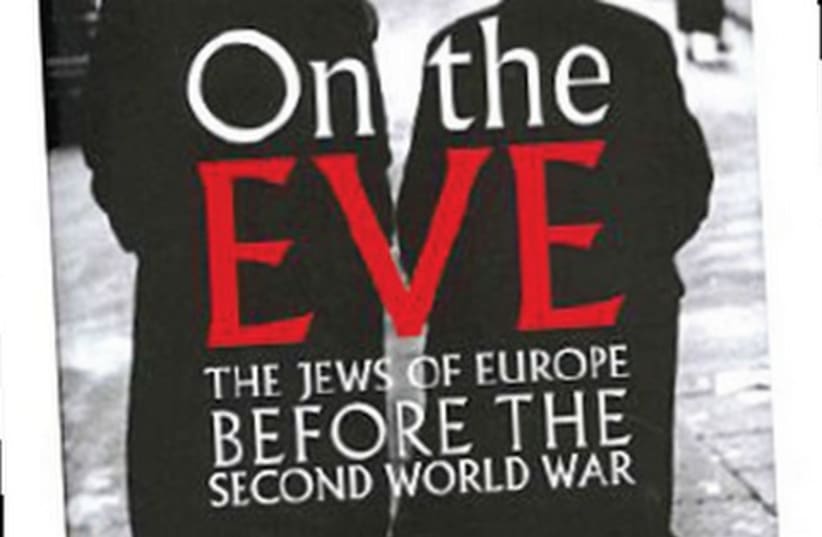
Bernard Wasserstein sheds light on Jewish life in the years leading up
to World War II, questioning conventional wisdom.
By JP O’MALLEYOn the Eve 521(photo credit: Courtesy)
As 1930s Europe moved toward the catastrophe of World War II, much of the greater part of the continent was – for Jews – being turned into a giant concentration camp. Bernard Wasserstein’s On the Eve: The Jews of Europe Before the Second World War, captures the sorrows and glories of European Jewry in the decades leading up the Nazi genocide.From the shtetls of Lithuania to the salons of Vienna, Jewish culture was on the road to extinction. Wasserstein’s book proves that, contrary to received wisdom, there was a growing awareness that Jews were approaching what the writer Joseph Roth once called “a great catastrophe.”Wasserstein was born in London and has taught at universities in Oxford, Sheffield, Jerusalem, Boston, Glasgow, and Chicago, where he is now based. He has written several books on Jewish history, including Divided Jerusalem, Israel & Palestine and Barbarism and Civilization.We meet in an old Victorian-styled tearoom in London’s Mayfair district. In conversation, Wasserstein is reserved yet retains a courteous demeanor at all times. He talks in slow, drawn-out sentences, often pausing for long periods in between questions.I begin by asking him about the central thesis that runs through his book: that Jewish culture was in decline throughout Europe even before the Nazis took power in 1933.If Jews had been more culturally unified, might they have been a stronger political force in the period before World War II? Wasserstein doesn’t seem to think so.“Jews tried everything; some of them tried assimilation, and that didn’t work. In the Soviet Union, those that embraced socialism and communism found that they were still thought of as outsiders. They tried Zionism, but that didn’t work. They attempted immigration elsewhere, but again that failed because the doors were closed everywhere. Each of these solutions was seen to address what’s called ‘the Jewish question,’ and each of them failed. Changing one of these variables would not have changed the outcome.”Writer, political activist, Nobel laureate and Holocaust survivor Elie Wiesel once described the strange paradox that haunts the Holocaust thus: “[It] is an unspeakable evil. How is it possible to speak of it at all? Yet how is one not to speak of it?” When one begins to think about genocide on an industrial scale, is it possible to find a root cause to this “unspeakable evil”?Preceding the Holocaust was a culture across European society that had an unmitigated hunger for violence. Wasserstein says that religion and politics were two prevalent forces that encouraged this.“We have to talk about the role of nationalism and the Church,” he says. “The Church was the main source of values at that time, particularly the Catholic Church in Poland, who were outspokenly anti-Semitic. It didn’t call for violence against Jews, but its underlying teaching – that the Jews were not part of the Polish nation, and were also an accursed people – certainly affected the way the majority of Poles thought about the Jews. It also affected the behavior during the war, when the question of whether to help Jews or to help the Nazis against the Jews became acute.“Part of this accepted attitude to violence in Europe at this time comes from the First World War and the horrors of famine after it,” he continues. “There was also revolutionary violence throughout much of the continent, and that brought violence out of the toothpaste tube, as it were. Then, when the Great Depression came, violence seemed a natural reaction to an extreme situation.”In his book, Wasserstein spends considerable ink discussing the role Jewish intellectuals played in Europe up until the mid-1930s in shaping public discourse.Arguments about politics and literature were debated across the pages of established liberal papers such as the Neue Freie Presse and the Frankfurter Zeitung.With historical hindsight, it’s often easier to suggest what course of action should have been taken. But given the potential power the Jewish press had, why was there not a more concerted effort implemented to resist the poisonous propaganda machine of the Nazis before it was too late? Wasserstein insists that by favoring this option, the Jewish press felt its true liberal values would have been sacrificed.“These papers felt they should not be solely serving the Jewish interest. They were hostile to Nazism and extreme nationalism, but they realized their position was precarious,” Wasserstein explains. “When the Nazis came to power, they were able to stifle these papers, in some cases close them down, in other cases take them over. The papers felt their best hope in achieving a broad interest in society was not to insist on a parochial Jewish interest but to try and show that what was being endangered by the role of extreme nationalism, and Nazism, was liberal values. And that led them to downplay these rather specific Jewish aspects of what was going on.”As Wasserstein is one of the world’s leading intellectuals in modern European Jewish history, Hitler dominates his work – perhaps a little more than he would like. For the historian, the psychology of Hitler’s mind serves little interest.“It’s less important what’s going on in Hitler’s head, but what’s more important is his ability to transfer his hatred into a collective psychopathology,” he says. “I don’t think it would have been possible to stir up the same kind of hatred that he did against the Jews with any other group, simply because there was no other group that had played such a central role in European society but who were also regarded with deep-seethed cultural contempt.”Looking back at the Holocaust, it seems strange – almost perverse – to talk about the progression of the European mind, given the barbarous acts of depravity that took place.Nevertheless, Wasserstein posits that the memory of the Nazi genocide has affected what he labels “the European consciousness” in a very profound way, particularly in Germany since the 1960s. Despite this, one need only look at the horrific events that occurred in Srebrenica, Bosnia, in 1995 to see how quickly this can change, he says.“European society has had what you might call an inoculating effect as a result of the memory of what is often called the Holocaust – a term I don’t like to use. However, I wouldn’t put too much faith in that alone as leading to decent behavior.”
if(catID != 151){
var cont = `Take Israel home with the new Jerusalem Post Store