Health Scan: Stem cell model for personalized medicine; scientists find hope for bald heads.
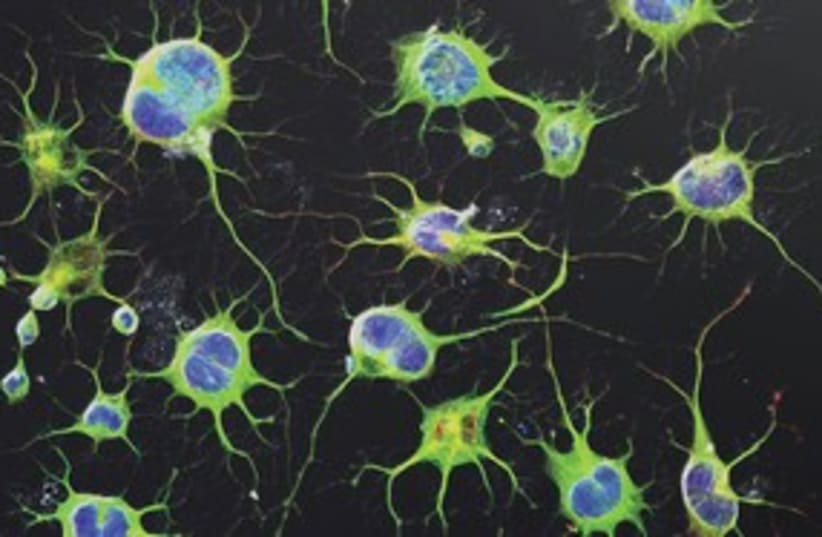
By JUDY SIEGEL-ITZKOVICHStem Cells 311(photo credit: (University of Louisville Medical School)
Antioxidants – vitamins that hunt oxygen-free radicals that trigger ageing and disease – are sold over the counter everywhere and added to food, beverages and face cream. But according to Weizmann Institute of Science Prof. Nava Dekel of the biological regulation department, scientists still lack a complete understanding of how they act.New research on rodents by Dekel and her team, recently published in the Proceedings of the [US] National Academy of Sciences, has revealed a possible unexpected side effect of antioxidants – they might cause fertility problems in females.Common antioxidants include vitamins C and E. These work by eliminating free radical molecules produced naturally in the body. Stress can cause these chemically active molecules to be overproduced; in large amounts, they damage cells indiscriminately. By neutralizing these potentially harmful substances, antioxidants can theoretically improve health and slow the aging process.But when Dekel and her research team – including her former and present doctoral students Dr. Ketty Shkolnik and Ari Tadmor – applied antioxidants to the ovaries of female mice, the results were surprising– ovulation levels dropped significantly. That is, very few eggs were released to reach the site of fertilization, compared to untreated ovaries.To understand what lies behind these initial findings, the team asked whether ovulation might rely on the very “harmful” oxygen radicals destroyed by antioxidants.Further testing in mice showed that this is, indeed, the case. In one experiment, for instance, Dekel and her team treated some ovarian follicles with luteinizing hormone, the physiological trigger for ovulation, and others with hydrogen peroxide, a reactive oxygen species. The results showed hydrogen peroxide fully mimicked the effect of the ovulation-inducing hormone. This implies that reactive oxygen species produced in response to luteinizing hormone serve, in turn, as mediators for this physiological stimulus leading to ovulation.Among other things, these results help fill in a picture that has begun to emerge of fertility and conception, in which it appears that these processes share a number of common mechanisms with inflammation. It makes sense, says Dekel, that substances that prevent inflammation in other parts of the body might also interfere with normal ovulation, thus more caution should be taken when administering such substances.Much of Dekel’s research has focused on fertility; her previous results are already helping some women become pregnant.Ironically, the new study has implications for those seeking the opposite effect. Dekel explains that “on the one hand, these findings could prove useful to women who are having trouble getting pregnant. On the other, further studies might show that certain antioxidants might be an effective means of birth control that could be safer than today’s hormone-based prevention.”Dekel and her team are now planning further studies to investigate the exact mechanics of this step in ovulation, and to examine its effect on mice when administered in food or drink. They also plan to collect data on the possible link between females being administered antioxidant supplements and having difficulty in conceiving.STEM CELL MODEL FOR PERSONALIZED MEDICINE A unique model for research into and treatment of heart diseases leading to fatal irregular heartbeat has been developed using iPSCs (induced pluripotent stem cells) by researchers at Haifa’s Rambam Medical Center and the Technion-Israel Institute of Technology. The discovery was recently reported in Nature. Ilanit Itzhaki, Leonid Maizels, Irit Huber and colleagues in Prof. Lior Gepstein’s lab turned skin cells taken from a female patient suffering from the inherited disease called congenital long QT syndrome” into unique stem cells and then used them to create a “cardiac cell laboratory.” The ability to generate patient-specific human-induced pluripotent stem cells, they wrote, offers a new paradigm for modelling human disease and individualizing the testing of potential drugs. The heart cells they created expressed the characteristic electrical disruption in the syndrome she suffered from and effects of medications that could alleviate the condition.The research “represents a promising paradigm to study disease mechanisms, optimize patient care (personalized medicine) and aid in the development of new therapies,” they wrote.HOPE FOR BALD HEADS American researchers claim to have discovered the cause of male-pattern baldness and suggest that stem cells can create new hair.University of Pennsylvania scientists say a defect in the cells causes the hair that is produced to be so thin it appears invisible to the naked eye, creating a bald spot or receding hairline, the BBC and UPI reported. They maintain that restoring the normal function of the cells could eliminate the bald appearance.The study found that although bald areas had the same number of hairmaking stem cells as normal scalp, there were fewer of a more mature type, known as progenitor cells. As a result, hair follicles in bald areas shrink, and the new hairs produced are microscopic compared to normal hair.“This implies that there is a problem in the activation of stem cells converting progenitor cells in bald scalp,” said research leader George Cotsarelis. “The fact that there are normal numbers of stem cells in bald scalp gives us hope for reactivating those stem cells,” he said.
if(catID != 151){
var cont = `Take Israel home with the new Jerusalem Post Store