New Worlds: Findings by Weizmann Institute researchers suggest that sulfur’s role may have been underestimated.
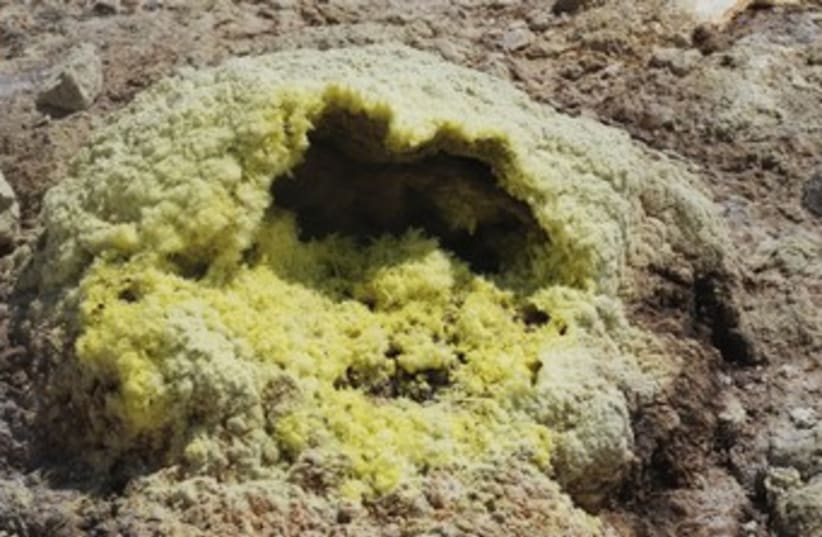
By JUDY SIEGEL-ITZKOVICHSulfur crystals 370(photo credit: Thinkstock/Imagebank)
Sulfur is an abundant, non-metallic element that was discovered in ancient times. As it cycles through the Earth’s atmosphere, oceans and soil, it undergoes chemical changes that are often linked with changes in other such elements as carbon and oxygen. Although this affects the concentration of free oxygen, sulfur has usually been portrayed as a secondary factor in regulating atmospheric oxygen, with most of the heavy lifting done by carbon. However, new findings by Weizmann Institute of Science researchers that appeared recently in the journal Science suggest that sulfur’s role may have been underestimated.Drs. Itay Halevy of the Rehovot institute’s environmental science and energy research department and US colleagues Shanan Peters of the University of Wisconsin and Woodward Fischer of the California Institute of Technology were interested in better understanding the global sulfur cycle. This cycle has been going on over the last 550 million years – roughly the period in which oxygen has been at its present atmospheric level of around 20 percent. The researchers used a database called Macrostrat, which was developed and maintained by Peters at his university and contains detailed information on thousands of rock units in North America and beyond.Using the database, the researchers traced one of the ways in which sulfur exits ocean water into the underlying sediments – the formation of so-called sulfate evaporite minerals. These sulfur-bearing minerals, such as gypsum, settle to the bottom of shallow seas as seawater evaporates. The team found that the formation and burial of sulfate evaporites were highly variable over the last 550 million years due to changes in shallow sea area, the latitude of ancient continents, and sea level. More surprising to Halevy and his colleagues was the discovery that only a relatively small fraction of the sulfur cycling through the oceans has exited seawater in this way. Their research showed that the formation and burial of a second sulfur-bearing mineral – pyrite – has apparently been much more important.Pyrite is an iron-sulfur mineral (also known as fools’ gold) that forms when microbes in seafloor sediments use the sulfur dissolved in seawater to digest organic matter. The microbes take up sulfur in the form of sulfate (bound to four oxygen atoms) and release it as sulfide (with no oxygen). Oxygen is released during this process, making it a source of oxygen in the air. Because this part of the sulfur cycle was previously thought be minor in comparison to sulfate evaporite burial – which does not release oxygen – its effect on oxygen levels was also thought to be unimportant.In testing various theoretical models of the sulfur cycle against the Macrostrat data, the team realized that the production and burial of pyrite has been much more significant than previously thought, accounting for more than 80% of all sulfur removed from the ocean (instead of the 30% to 40% in prior estimates).As opposed to the variability they saw for sulfate evaporite burial, pyrite burial has been relatively stable throughout the period. The analysis also revealed that most of the sulfur entering the ocean washed in from the weathering of pyrite exposed on land. In other words, there is a balance between pyrite formation and burial, which releases oxygen, and the weathering of pyrite on land, which consumes it. The implication of these findings is that the sulfur cycle regulates the atmospheric concentration of oxygen more strongly than previously thought.MEDITERRANEAN SEA RESEARCHThe Planning and Budgeting Committee of the Council for Higher Education recently adopted the recommendation of a special Israel Academy of Sciences committee and announced that a consortium headed by the University of Haifa has won a tender to establish a national Center for Mediterranean Sea Research. The consortium consists of eight research institutions (six of them fully fledged universities): the University of Haifa; the Technion; the Hebrew University of Jerusalem; Bar-Ilan University; Ben-Gurion University of the Negev; the Weizmann Institute of Science; the Geological Survey of Israel; and the Israel Oceanographic and Limnological Research Center. The cost of establishing the new Center for Mediterranean Sea Research is estimated at over NIS 60 million ($15 million) for its first three years of activity. It will focus on areas such as gas extraction, marine infrastructure and desalination.Heading the center will be Prof. Zvi Ben-Avraham, who is the founding director of the University of Haifa’s Charney School of Marine Sciences, which was founded five years ago. The establishment of the center, said Ben-Avraham, recognizes that Israel’s primary field of research over the coming years will be focused on the sea. Recently discovered gas and other resources in the Mediterranean Sea off the coast of Haifa and Hadera “reinforced the fact that Israel’s academia requires skillfully trained researchers and scientists in the field to understand and guide the implications of such developments,” he added.The initiative for a national center was conceived in response to a special report presented by the Academy of Sciences that revealed a worrisome academic standard in terms of Israeli marine research. The committee took action and drew up the tender that the consortium has now won.University of Haifa president Prof. Aaron Ben-Ze’ev said his institution had already recognized the Mediterranean Sea’s potential several years ago and invested extensive resources to establish its School of Marine Sciences.“The Mediterranean,” Ben-Ze’ev added, “is a strategic asset for Israel, and by developing it the country will achieve economic independence. Forming Israel’s coastline to the west, it possesses magnificent resources, a developed infrastructure, economic promise, and international trade potential. The resources hidden beneath the surface can significantly strengthen Israel’s energy economy, contribute to closing social gaps and ultimately increase Israel’s political strength at home and abroad.”
if(catID != 151){
var cont = `Take Israel home with the new Jerusalem Post Store