The Jerusalem Post
Jpost search icon google-icon iphone
  Set as Homepage
Wed, Jun 19, 2013   11 Tammuz, 5773
newspapers magazines
 
    • Breaking News
    • Diplomacy & Politics
    • Defense
    • National
    • Mideast
    • Syria
    • Iran
    • World
    • Business
    • Sports
    • Health & Science
    • Environment
  • Video
  • Opinion
    • Columnists
    • Editorials
    • Op-Eds
    • Letters
  • Jewish World
  • Lifestyle
    • Arts & Culture
    • Food & Wine
    • Travel
  • Features
    • Insights & Features
    • Week in review
    • On the Web
    • Shalva Superheroes
    • Obama in Israel
  • Blogs
    • In the news
    • Judaism
    • From the Middle East
    • Lifestyle
    • Aliya
    • Science and Technology
  • JPost Apps
    • iPhone app
    • iPad app
    • Android app
    • Twitter
    • Facebook
    • RSS feeds
    • JPost Toolbar
    • JPost Newsletter
    • JPost Alert
  • Premium Zone
    • The Jerusalem Report
    • Magazine
    • Metro
    • In Jerusalem
    • ePaper
    • Expert Opinion
    • Q&A
    • Dash
    • Christian Edition
    • Ivrit
  • French
    • Politique & Social
    • Affaires Palestiniennes
    • Diplomatie & Monde
    • Art & Culture
    • Israel
  • Green Israel
JPost Learn Hebrew  
Advertise with us  
Nefesh Guided Aliyah  
Eldan  
AFMDA  
YTA  
Isram Group  
JPost Twitter  
JPost Facebook  
Classifieds  


Breaking News
 
 
  • JPost.com
  • Health & Science
 

HU, French research: Sounds can help blind ‘see’

By JUDY SIEGEL-ITZKOVICH
11/07/2012 23:39
Tweet

Researchers use non-invasive sensory aids to provide visual information to the blind using their existing senses.

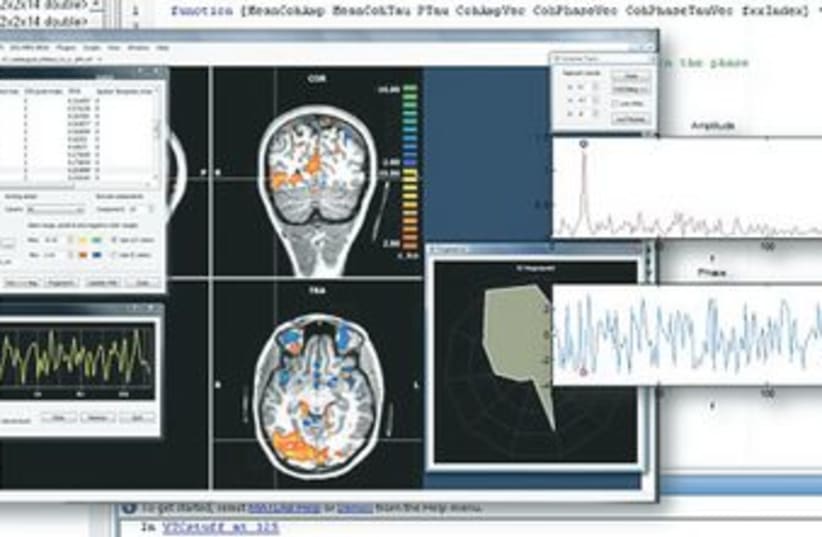
FUNCTIONAL MAGNETIC resonance imaging.
FUNCTIONAL MAGNETIC resonance imaging. Photo: HUJI.ac.il
The blind can’t see with their eyes, but they can see with their “mind’s eye” if they are able to activate it through sounds and sensory substitution devices (SSDs). Researchers at the Hebrew University of Jerusalem and colleagues in France have just published an article on this in the prestigious neuroscience journal Neuron.

Common wisdom has it that if the visual cortex in the brain is deprived of visual information in infancy, it may never develop its functional specialization properly, making sight restoration later in life almost impossible.

But researchers have found that congenitally blind people who use specialized photographic and sound equipment can actually “see” and describe objects and even identify letters and words.

The study by Prof. Amir Amedi of HU’s Edmond and Lily Safra Center for Brain Sciences and the Institute for Medical Research Israel-Canada, and doctoral candidate Ella Striem-Amit, demonstrated how this achievement is possible through the use of a unique training paradigm using SSDs.

The article, titled “Reading with Sounds: Sensory Substitution Selectively Activates the Visual Word Form Area in the Blind,” was written with help from Prof. Laurent Cohen and Prof. Stanislas Dehaene of Pierre and Marie Curie University’s faculty of medicine, INSERM and the College of France in Paris.

These are non-invasive sensory aids that provide visual information to the blind via their existing senses. For example, with a visual-to-auditory SSD in a clinical, or everyday setting, users wear a miniature camera – connected to a small computer or smartphone – and stereo headphones.

The images are converted into “soundscapes,” using a predictable algorithm, allowing the user to listen to and then interpret the visual information coming from the camera.

The blind participants using this device reach a level of visual acuity technically surpassing the criterion set by the World Health Organization for blindness – as published in a previous study by the same group.

The study shows that following – a dedicated but relatively brief – 70 hours of unique training paradigm, developed in the Amedi lab, blind people could easily use SSDs to characterize images into object categories, such as of faces, houses, body shapes, everyday objects and textures.

They could also identify even more complex everyday objects – locating people’s positions, identifying facial expressions, and even reading letters and words.

The study went on further to actually test what happens in the brain when the blind learn to see with sounds.

Specifically, the group tested the ability of this high-acuity vision to activate the supposedly dormant visual cortex of the blind, even though it was taught to process the visual images through sounds only in adulthood.

The team used functional magnetic resonance imaging to measure the neural activity of people blind from birth as they “saw” – using the SSD – high-resolution images of letters, faces, houses, everyday objects and body-shapes.

Surprisingly, not only was their visual cortex activated by the sounds, their brain showed selectivity for visual categories which characterize the normally developing, sighted brain.

A specific part of the brain, known as the Visual Word Form Area (VWFA) that was first discovered in sighted people by Cohen and Dehaene, is normally very selective.

In sighted people, it has a role in reading, and is activated by seeing and reading letters, more than by any other visual object category. Surprisingly, the same was found in this area in people deprived of sight. Their VWFA, after only dozens of hours of training in SSD use, showed more activation for letters than for any of the other visual categories tested.

In fact, the researchers found, the VWFA was so plastic to change, that it showed increased activation for SSD letters after less than two hours of training by one of the study participants.

“The adult brain is more flexible that we thought,” said Amedi. In fact, this and other recent research from various groups have demonstrated that multiple brain areas are not specific to their input sense (vision, audition or touch), but rather to the task – or computation – they perform, which may be computed with various modalities.

All of this suggests that in the blind, brain areas might potentially be “awakened” to processing visual properties and tasks even after years, or maybe even lifelong blindness, if the proper technologies and training approaches are used, said Amedi.

The findings also give hope that reintroduced input into the visual centers of the blind brain could potentially restore vision, and that SSDs might be useful for visual rehabilitation.

“SSDs might help blind or visually-impaired individuals learn to process complex images, as done in this study, or they might be used as sensory interpreters that provide high-resolution, supportive, synchronous input to a visual signal arriving from an external device such as bionic eyes,” explained Amedi.

The resulting sight, though not conventional in that it does not involve activation of the ophthalmological system of the body, is no less visual in the sense that it actually activates the visual identification network in the brain, the researchers said.

After the training program, participants could assign soundscapes to their visual categories and also determine multiple features of the stimulus (such as hairstyle in a face image, number of floors and windows in a house image, and body posture in a body-shape image), enabling them to differentiate between objects within categories.
  • Send
  • Large
  • Small
  • Print
  • Share
This article is by :
Judy Siegel-Itzkovich
Recent stories:
  • 'Dementia will be bigger world plague th...
  • Gamzu pledges more doctors and nurses in...
  • Cancer researcher lauds ruling against g...
  • German willing to consider fortification...
Most Viewed in
1
Gamzu pledges more doctors and nurses in public system
2
Food supplements fight degenerative brain disorders
3
German willing to consider fortification of foods
4
Jewish kidney donation saves Palestinian boy
JPost Community
Tweet
Hebrew University blind sounds and sensory substitution devices SSD Sensory Substitution soundscapes
Tweets about "#jpost"
Share this article
Tweet
Share
Send
Your comment must be approved by a moderator before being published on JPost.com. Disqus users can post comments automatically.

Comments must adhere to our Talkback policy. If you believe that a comment has breached the Talkback policy, please press the flag icon to bring it to the attention of our moderation team.
JPost Services
conferenceConference
newsletterNewsletter
iphoneMobile Apps
kotelcamKotel Cam
kolboJPost Alert
premiumPremium
JPost TV News  
Mobile Apps  
Bank Hapoalim  
Meir Panim  
Israel Law Center  
Inbal Hotel Jerusale  
Meier on Rothschild  
Weizmann Institute o  
JPost Premium Zone  
JPost kotel Camera  
         
 
Israel Focus
JPost TV News
Watch Now!  
Donate to Save Lives in Israel
 
Israel Law Center
The ultimate Mission to Israel, October 21 – 28, 2013 Register now!  
Nefesh B'Nefesh Guided Aliyah
Already living in Israel? Enjoy the Benefits of Aliyah!  
One year International MBA
in English, Bar-Ilan University, Israel – Open House July 9, 2013, 17:30  
Give "Freedom" this Passover
to needy Israeli families. Donate now  
YTA – A Yeshiva in Israel…
in English. Come Join Us  
War Threatens
Protect the People of Northern Israel  
Bank Hapoalim
Israeli's number one bank  
Jerusalem Post Lite
Lite Edition of the Jerusalem Post for English improvement  
Learn Hebrew with us
Get 10 minutes free personal coaching in Hebrew through phone or Skype  
JPost newspapers
Sign up for the JPost newspapers and receive one month free subscription  
Kosher English Magazine
English language weekly magazine - especially for religious people  
JReport Kindle Edition
Now you can get the Jerusalem Report directly to your Kindle  
JPost Premium Edition
The very best articles are available only in our Premium edition  
Lifestyle Magazine
 
 
Real Estate
Meier on Rothschild
Tel Aviv's Most Prestigious Address  
Don't Look For a House!
In Israel, our website will do it for you!  
 
Travel
Tourism Magazine
June 2013  
The Inbal Jerusalem Hotel
Hot summer deal, order now!  
Eldan Rent a Car
20% off all Car Rental Reservations in Israel  
Hertz Car Rental
Special Online Discounts!  
The King David Jerusalem Hotel
One of the world's truly iconic hotels, and a Jerusalem landmark  


Sites Of Interest:

Jerusalem Hotels
KKL-JNF
Poalim Online
BreitBart.com
Our Friends
Jerusalem Attractions
Jerusalem Tours
itraveljerusalem.com

JPost sites:

Learn Hebrew
The Jerusalem Report
Our Magazines
JPost Edition Francaise
Green Israel
Christian World
Jerusalem Post Lite

Services:

JPost Mobile Apps
JPost Premium
JPost Newsletter
JPost Toolbar
JPost News Ticker
JPost RSS feeds
JPost Archives
JPost Alert
JPost Kotel Cam

JPost Conferences:

NYC Conference
Diplomatic Conference

Information:

About Us
Feedback
Staff E-mails
Copyright
Sitemap
News Partners
Advertise with Us
Statistics
Ad Specs
Terms Of Service
Jpost.com, the online edition of the Jerusalem Post Newspaper - the most read and best-selling English-language newspaper in Israel. For analysis and opinion from Israel, the Jewish World and the Middle East. Jpost.com offers expert and in-depth reporting from Israel, the Jewish World and the Middle East, including diplomacy and defense, the Palestinian-Israeli conflict, the Arab Spring, the Mideast peace process, politics in Israel, life in Jerusalem, Israel's international affairs, Iran and its nuclear program, Syria and the Syrian civil war, Lebanon, the Palestinian Authority, the West Bank and Gaza Strip, Israel's world of business and finance, and Jewish life in Israel and the Diaspora.
 
About Us | Advertise with Us | Subscribe | Premium | Newsletter | RSS | Contact Us
 
All rights reserved © The Jerusalem Post 1995 - 2012