Yad Sarah communications speed-service available to all
Every Israeli can sign up for Yad Sarah’s immediate communication service for a nominal, one-time fee.
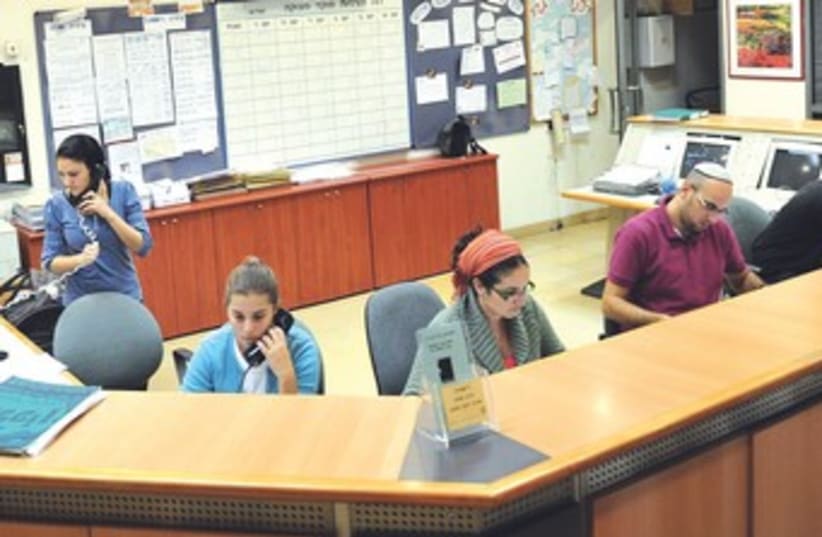
By JUDY SIEGEL-ITZKOVICHImmediate communications service center 370(photo credit: courtesy Yad Sarah)
Thanks to recent technological advances, every person in the country can sign up for Yad Sarah’s immediate communication service for a nominal, one-time fee. The voluntary organization said on Sunday that any landline or cellular phone can be used to press a digit and call Yad Sarah’s 24- hour-a-day communications service headquarters.When the phone connection is made, the subscriber’s details – including address and health condition – appear on the computer screen.The most common request – which occurs 80 percent of the time – is for help from a doctor, a relative or someone else, although cases like these are not necessarily emergencies, said Arye Kahan, the director of the service. Adult children of the subscribers also feel confidence that whenever their parents need help, there will be someone who will hear them, Kahan said.At the same time, Yad Sarah continues to offer emergency beepers to be worn on the wrist for those who want them at a minimal fee. At present, there are 18,000 such subscribers.Initially, the service was for the elderly and the disabled, but now it can be provided to anybody who feels he or she needs it. Until now, Yad Sarah volunteers had to come to the subscriber’s home and install equipment to broadcast via a Bezeq landline to the center, and this was relatively expensive.But today, it can be done without that.“We changed the system,” explained Yad Sarah spokesman David Rothner.“Now, immediately after registration, the service works.”Instead of the devices that had to be installed at home, subscribers for the wrist-worn device can purchase a special phone at Bezeq stores around the country that broadcasts to the Yad Sarah headquarters a request for help.More than 20,000 subscribers around the country are hooked up to the Jerusalem-based service, which, unlike private companies, does not charge a monthly fee or fines for subscribers who call often.The center is run by volunteers, including civilian and national service volunteers, who are trained to deal with emergencies. They also know how to listen to a subscriber and thereby to relieve the person’s loneliness, at least for a while. Non-Jews work on Shabbat and holidays.If the new technology leads to more subscribers, the organization will obtain more volunteers, Rothner said.
if(catID != 151){
var cont = `Take Israel home with the new Jerusalem Post Store