Expert on Iran tells 'Post' treaty designed to send signal to int'l community, doesn't indicate substantial developments in trade.
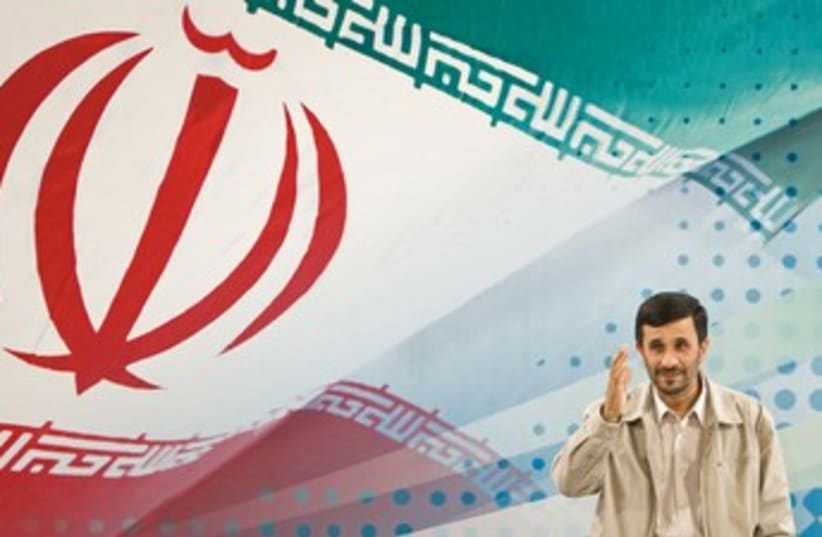
By YAAKOV LAPPINAhmadinejad behind massive Iranian flag 370(photo credit: REUTERS/Raheb Homavandi)
A recent agreement signed between Iran and North Korea is designed to send a defiant signal to the international community, but does not point to any substantial new developments in the well-established military trade between the two countries, an expert on Iran told The Jerusalem Post.According to Iranian media reports, the agreement, signed over the weekend in the presence of Iranian President Mahmoud Ahmadinejad and North Korea’s de facto head of state, Kim Yong Nam, in Tehran, will result in cooperation on technological and scientific developments, and will include delegations of scientists traveling between the two countries.“The pact is part of the dance of the diplomats in Tehran to demonstrate that Iran has friends despite Western efforts to isolate it,” said Raymond Tanter, professor emeritus at the University of Michigan, and former senior member of the National Security Council under US president Ronald Reagan.“Because North Korea already supplies Iran with advanced missiles, some of which are able to reach Western European countries, the significance is probably mainly diplomatic than military,” Tanter added. “The pact with North Korea is like the meeting in Tehran of the of the so-called Non- Aligned Movement states – little substance but a great deal of fanfare.”Tanter said actual missile shipments from North Korea to Iran are kept under wraps, adding that “Iran and North Korea tend to keep their military affairs transactions covert.”North Korea has been selling longrange missiles to the Islamic Republic for many years. Iran’s long-range projectile, the Shahab 3, which is able to strike targets in Israel, is based on North Korea’s ballistic Nodong-1 missile.Iran is also believed to have received a number of North Korean BM-25 missiles from North Korea that can hit cities in Western Europe and Russia, according to reports.The Iranians are thought to be reverse engineering the missiles in order to learn how to construct them independently.Both the Shahab and the BM-25 are capable of carrying nuclear warheads.Last year, a Reuters report said the missile purchases were continuing.“Prohibited ballistic missile-related items are suspected to have been transferred between the Democratic People’s Republic of Korea and the Islamic Republic of Iran on regular scheduled flights of Air Koryo and Iran Air,” the report said.Reuters contributed to this report.
if(catID != 151){
var cont = `Take Israel home with the new Jerusalem Post Store