Obama backs continued Egypt, PA aid despite tension
Palestinians to see only slight roll back despite unity deal with Hamas; Egypt aid to remain at 2012 level.
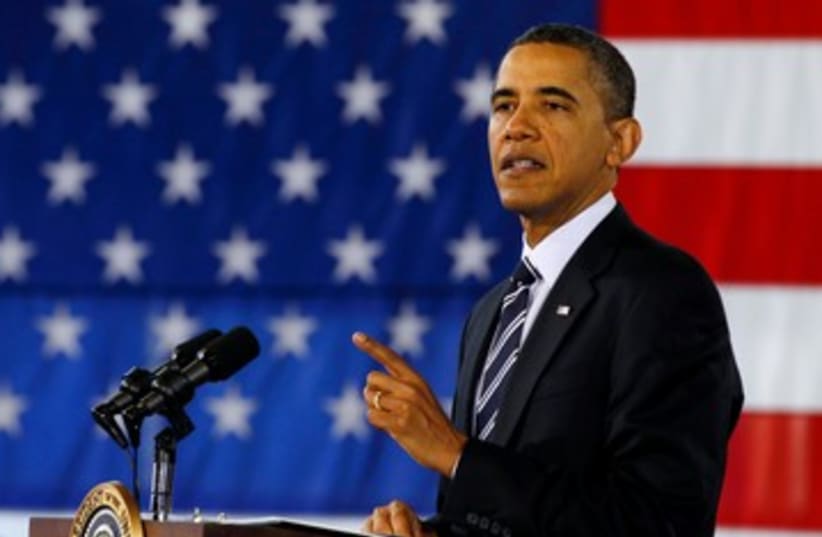
By HILARY LEILA KRIEGER, JPOST CORRESPONDENTUS President Barack Obama 390 (R)(photo credit: REUTERS/Larry Downing)
WASHINGTON – Despite recent tensions between the US and Egypt and a new Palestinian Authority government set to include Hamas, the Obama administration budget unveiled Monday maintains nearly the same level of funding for both in 2013.Egypt, which has arrested several US citizens who work for NGOs promoting democracy, is slated to receive $1.3 billion for military assistance under the plan and $250 million for economic assistance, as was also approved for 2012.“Our goal is to provide the necessary funds. It’s obviously clear to all of us that we have issues we need to work through, and we’re working very aggressively to do so,” said Deputy Secretary of State Tom Nides after the budget plan was released. “But this budget reflects our commitment and our desire to fully fund this initiative.”He said the administration would be consulting with Congress, several members of which have said the detentions could cause the US to withhold money from Cairo.The Palestinians will see a slight roll back in economic aid from $395m. in 2012 to $370m. in 2013 as well as cut back in police training from $150m. to $70m.An administration official explained the first reduction as stemming from an improved economic situation in the Palestinian territories and the second as due to the curtailment of US provision of equipment for police officers as those supplies have already been delivered.He said when it comes to the role of Hamas, a US-designated terrorist organization, and its role in the Palestinian government, the administration would revisit the issue in 2013 when the money was actually due to be allocated.“When we get to 2013 and we have to work with Congress on the allocations we have to assess where that is a year from now... and the make-up of the government,” he said.The budget plan also fully funds US military assistance to Israel as agreed under the 10-year Memorandum of Understanding signed between the two countries, and includes a $770m. “Middle East and North Africa Incentive Fund.”The allocation, of which officials said $700m. was new money, is aimed at allowing the US “to quickly respond to dramatic changes in the region and incentivize reforms,” according to a State Department budget fact sheet.“We’re in a new world. The Arab Spring has come. We need to make sure we have the tools and the flexibility to fund these initiatives,” Nides said.While much of the funding appears fluid, an administration official said it was important the money would be available to help encourage the emergence of governments in the region that worked with the United States and so that the country could rapidly respond to new challenges, for example dealing with the fallout from the volatile situation in Syria.State Department officials stressed that the $56.1 billion budget was only one percent of the overall federal budget, and the new Middle East funding was mostly off-set by cuts to regions including Europe and Asia.But the budget total still grew from 2012 and could face resistance on Capitol Hill both because of members’ concerns over the behavior of Middle East countries such as Egypt and because of policy differences with countries like Egypt but also because of Republican concern over deficits.Despite the GOP’s interest in cuts, since Republicans have gained control of the House, Israel has been able to maintain the modest growth in aid dictated by the 10-year schedule.Israel, which is due to get $3.075 billion in 2012, would get $3.1 billion in 2013 should the plan be approved.
if(catID != 151){
var cont = `Take Israel home with the new Jerusalem Post Store