Senator Mark Kirk challenges US president on statement that he might treat aspects of law as "non-binding."
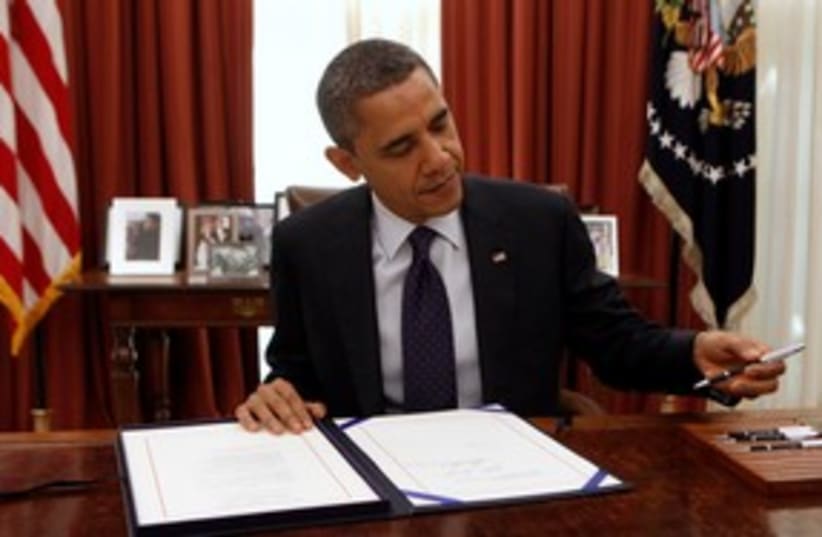
By REUTERSBarack Obama signing a bill 311 (R)(photo credit: REUTERS/Kevin Lamarque)
WASHINGTON - A Republican senator on Tuesday questioned President Barack Obama's commitment to new sanctions on Iran's central bank, noting the president had claimed the right to sidestep some of the requirements when he signed them into law last week.In a statement issued as he signed a defense bill into law on Saturday, Obama said several provisions including the sanctions that target Iran's central bank "would interfere with my constitutional authority to conduct foreign relations."RELATED:Rand Paul: My father is misunderstood on Israel, IranRepublicans talk tough on Iran before Iowa caucusThe president, a Democrat, said in his statement that if any application of these provisions conflicted with his constitutional authorities, "I will treat the provisions as non-binding."Senator Mark Kirk, one of the authors of the new sanctions on Iran, said on Tuesday that Obama was challenging the entire US Senate if he did not implement the new sanctions, because senators approved them unanimously before they were appended to the defense bill."With the Senate voting 100-0 to cripple the Central Bank of Iran, the president's signing statement hinting he will ignore parts of this law risks overwhelming opposition in the Congress," Kirk, a Republican, said through a spokesman.The new sanctions would penalize foreign financial institutions that do business with Iran's central bank, the main conduit for its oil revenues.
Obama has approved a series of sanctions on Iran and warned that no option is "off the table" in stopping Tehran from its suspected quest for a nuclear weapon.But as Congress considered the sanctions on Iran's central bank, Obama aides said that threatening US allies might not be the best way to get their cooperation in action against Iran.As Obama signed the bill last week, senior US officials said Washington was consulting with its foreign partners to ensure the measures can work without harming global energy markets.Iran threatened on Tuesday to take action if the US Navy moves an aircraft carrier into the Gulf, Tehran's most aggressive statement yet after weeks of sabre-rattling as new U.S. and European Union financial sanctions take a toll on its economyIn his signing statement last Saturday, Obama also expressed concern about the constitutionality of a number of other provisions in the defense bill that related to the treatment and transfer of detainees and said he would interpret them "to avoid constitutional conflict".Christopher Kelley, a Miami University of Ohio professor who has researched presidential signing statements, said he found at least 10 instances in Obama's statement on the defense bill when he challenged the bill's constitutionality, although there may be more."Saying things like 'I will treat it as non-binding' is a clear constitutional challenge," Kelley said in an email to Reuters.The legislation authorized US defense programs from war fighting to weapons building for 2012. Obama said he signed the bill because he wanted to ensure key services and defense programs get the financing they need.
if(catID != 151){
var cont = `Take Israel home with the new Jerusalem Post Store