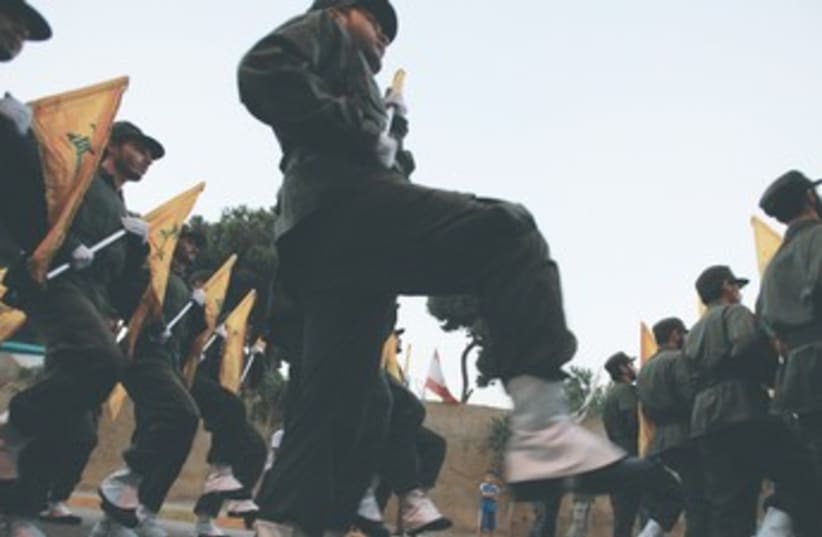
According to 'al-Seyassah' source, young recruits sent to Beirut, Syria, where they receive military training from Hezbollah operatives.
By JOANNA PARASZCZUKLebanon’s Hezbollah terrorists marching with flags 370(photo credit: Jamal Saidi/Reuters)
A senior government official in Yemen has accused Iran of recruiting more than a thousand Yemeni youths and sending them to Lebanon and Syria to receive military training from Hezbollah, according to report on Monday by Kuwaiti daily al-Seyassah.The Yemeni official, who spoke on condition of anonymity, told al-Seyassah that Iran has spent around $1 billion on supporting the separatist movement in southern Yemen, and also accused Tehran of exploiting Yemen’s deteriorating economic situation in order to recruit young people from the provinces of Aden, Taiz and Sana’a.According to al-Seyassah’s source, the young recruits are initially sent to Beirut or Syria, where they receive military training from Hezbollah operatives.They then go on to the Iranian holy city of Qom, where they receive religious indoctrination, the official said.The trained fighters are then sent back to Yemen to form subversive cells controlled by Tehran, the official added.According to al-Seyassah, the source noted that the Yemeni government is very concerned about Iran’s recruitment of large numbers of Yemeni youth, and enlisting them to carry out espionage and sabotage on behalf of Tehran.Yemen has long accused Iran of sponsoring insurgent groups in the north and south of the country.Click here for full Jpost coverage of the Iranian threatEarlier this year, Yemen’s president, Abdrabuh Mansur Hadi, said Iran was providing support to both the Southern Separatist Movement – a militant group that seeks independence for south Yemen – and the Shi’ite Houthi movement in the north, whose slogan – “God is Great, Death to America, Death to Israel, a Curse on the Jews” – indicates a shared ideology with Tehran.In October, the Yemeni news site 26 September reported that domestic security forces had captured members of an Iranian spy cell, including Iranian, Syrian and Yemeni nationals.According to that report, the Iranian members of the cell entered Yemen on the pretext of setting up a factory and had begun to transfer equipment and personnel to the southern port of Aden. However, when the Yemeni authorities inspected containers that the Iranians had imported, they found military equipment that could be used for assembling rockets and other weapons.In March, a senior American official told The New York Times that the Qods Force, the elite extraterritorial unit within Iran’s Revolutionary Guard Corps (IRGC), is engaged in sending arms shipments to Houthi rebels in Yemen, including AK-47s and rocket-propelled grenades.Both the US and Israel are concerned about Tehran’s increasing efforts to expand its influence over the Middle East, which come as its closest and largest regional ally, Syria, is increasingly under threat.By enlarging its influence in Yemen, Iran aims to gain control over the Bab al-Mandeb Strait between the Gulf of Aden and the Red Sea, a crucial part of the route Iran uses to supply arms via Sudan and Egypt to its proxy Hamas in Gaza.Iran’s presence in Yemen is also an attempt to create a proxy force, similar to Hezbollah in Lebanon, but on the border with Tehran’s rival Saudi Arabia, as part of its ongoing shadow war with that country.Earlier this year, Gen. James N. Mattis, the head of the US military’s central command, told a Senate Armed Services Committee hearing that “Iran poses the single greatest threat to US interests and to our friends and stability in the region, and poses a global threat through its worldwide proxy network.”“From active attempts to exploit the Arab Awakening, to working to undermine and subordinate the democracy in Iraq, to supporting the Assad regime in Syria, to heightening Shi’ite-Sunni tensions, to active support for Lebanese Hezbollah, Iran’s activities are motivated by its hegemonic ambitions,” Mattis said.While most of Iran’s attempts to expand its regional dominance are undertaken covertly, Tehran has recently decided to publicly announce and capitalize on its role in supporting its Gaza proxies Hamas and Islamic Jihad.Iran has mounted a large-scale and ongoing propaganda campaign both domestically and internationally in order to present the message that its military technology and expertise had propelled Gaza to a “victory” over Israel, even falsely claiming on one IRGC-run news site that Iranian technology had allowed Gazans to shoot down an Israeli fighter jet.
if(catID != 151){
var cont = `Take Israel home with the new Jerusalem Post Store