Uzi Arad says that while report not divorced from US politics, public airing of discussion adds pressure on Iran.
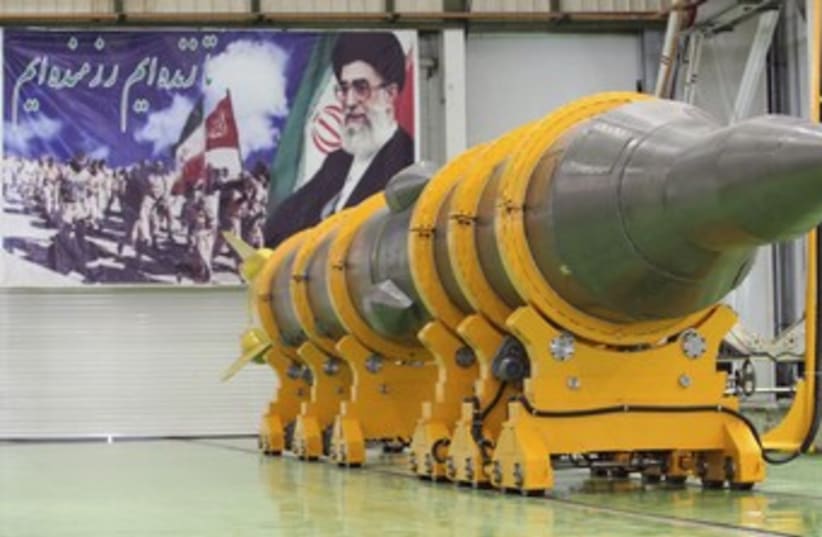
By HERB KEINONIran's Sajil 2 missile 370(photo credit: REUTERS)
Israel and the US are considering a joint surgical strike targeting Iranian uranium enrichment facilities, according to a report in Foreign Policy magazine that appeared Monday, soon after Republican candidate Mitt Romney slammed US President Barack Obama’s Iran policy.“Iran today has never been closer to a nuclear weapons capability,” Romney said in a foreign policy address delivered at the Virginia Military Institute. “And it has never acted less deterred by America.”Soon after those comments, Foreign Policy CEO and editor at large David Rothkopf – who wrote unflatteringly of Romney that this was one of the first times recently he addressed foreign policy without “tripping over his own misstatements” – reported that the White House and Israeli officials “assert that the two sides, behind the scenes, have come closer together in their views [regarding Iran] in recent days.”Rothkopf, who was an undersecretary of commerce in the Clinton administration, wrote that “while there may not be exact agreement on what constitutes a ‘red line’ – a sign of Iranian progress toward the development of nuclear weapons that would trigger military action – the military option being advocated by the Israelis is considerably more limited and lower risk than some of those that have been publicly debated.”Rothkopf quoted a “source close to the discussions” as saying that a surgical strike on the enrichment facilities “might take only ‘a couple of hours’ in the best case and only would involve a ‘day or two’ overall” and would be conducted by air, using primarily bombers and drone support.“Advocates for this approach,” he wrote, “argue that not only is it likely to be more politically palatable in the United States, but were it to be successful – meaning knocking out enrichment facilities, setting the Iranian nuclear program back many years, and doing so without civilian casualties – it would have region-wide benefits. One advocate asserts it would have a ‘transformative outcome: saving Iraq, Syria, Lebanon; reanimating the peace process; securing the Gulf; sending an unequivocal message to Russia and China; and assuring American ascendancy in the region for a decade to come.’” Such an attack could not be carried out by Israel alone, the report said.“To get to buried Iranian facilities, such as the enrichment plant at Fordow, would require bunker-busting munitions on a scale that no Israeli plane is capable of delivering,” Rothkopf wrote. “The mission, therefore, must involve the United States, whether acting alone or in concert with the Israelis and others.”The Prime Minister’s Office declined to comment on the report.Click here for full Jpost coverage of the Iranian threatUzi Arad, former national security adviser to Prime Minister Binyamin Netanyahu, said in an Israel Radio interview that regardless of whether such reports were politically motivated, the fact that there continues to be public talk about military action against Iran – be it by Israel, the US or together – increases the pressure on Iran at a time when sanctions are already having an effect.Arad, who did not deny that there may have been a political motivation behind the report, says there is also logic to it.No one who really knows will either confirm or deny the story, he said. However, he added that it made sense that the military option is on the table and that quiet, professional discussions between Israel and the US have been taking place. The fact that these discussions are being bandied about “will be felt by Iran,” and could add to the other pressures on Tehran aimed at getting it to slow down the nuclear program, he said.The political motivation behind the report may be designed to make Obama look tough on Iran in the face of Romney’s criticism.
if(catID != 151){
var cont = `Take Israel home with the new Jerusalem Post Store