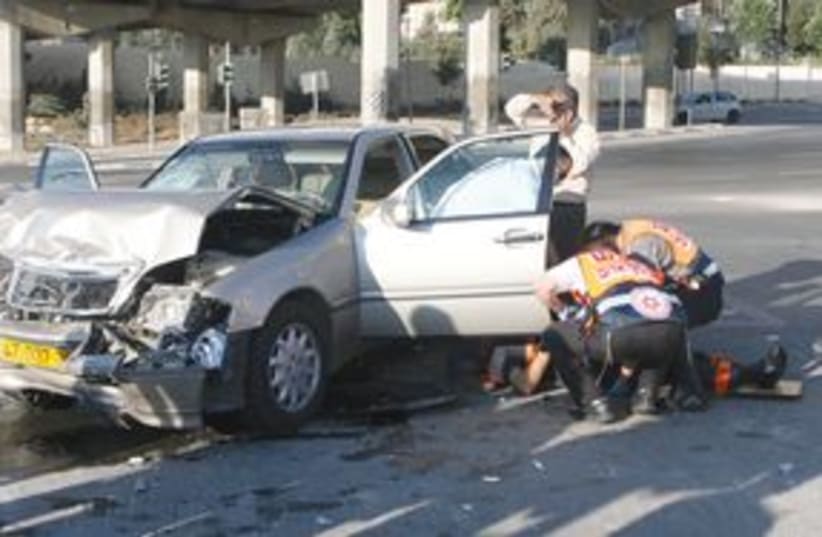
332 killed on roads so far this year; increase of 11%
Road safety advocacy group Or Yarok says nation now exceeded its maximum fatality target rate for 2010; Transportation Ministry at odds over figures.
By RON FRIEDMANCar Accident 311(photo credit: Ariel Jerozolimski)
When a 16-year-old motorcyclist crashed into a truck and died on Wednesday, it marked the 330th traffic accident casualty of 2010.Road safety advocacy group Or Yarok said on Thursday that the nation had now exceeded its maximum fatality target rate for the year, with two months left before January 1.The Transportation Ministry said in response: “We don’t deal in numbers and targets when it comes to human lives.”Deaths in traffic accidents so far this year – 332 – increased by 11 percent compared to the same period in 2009, when 298 died. This rise presents a reversal of a long-term trend of reduced accidents and fatalities.Last January, after Israel saw a remarkable 22% drop in trafficrelated fatalities in 2009 (the lowest in 43 years), Transportation Minister Yisrael Katz (Likud) spoke proudly of his ministry’s achievements in reducing casualty rates and surpassing the targets set by the government.On Thursday however, when asked to respond to Or Yarok’s statement, Transportation Ministry spokesman, Avner Ovadiah, said that the ministry doesn’t have casualty reduction targets, since it doesn’t deal in numbers and targets when it comes to human lives. “We don’t have a target of 330. That’s Or Yarok’s target, not ours,” he said.The minister’s media adviser also refused to comment on the issue, saying that the minister would address yearly summaries at the end of the year.Or Yarok said that the ministry’s refusal to acknowledge the fatality reduction target was disingenuous and that the targets were set and approved by the government in 2005, when it adopted the recommendations of the Sheinin Committee, a panel established to develop a long-term plan to battle road casualties.“The Sheinin Committee set a clear target of reducing the death rate by 30% by 2010, to below 360 deaths a year, and below 300 by 2015,” Or Yarok spokesman Elad Sasi said. “That works out to a 6% annual reduction. Six percent below last years’ rate of 350 deaths works out to 330 for 2010. The ministry can’t deny those numbers, just because they failed to reach the target.”Collecting data and setting casualty reduction targets are a common and proven method of reducing casualty figures. The European Council recently adopted a plan to reduce traffic casualties by 50% in 10 years, after a similar effort for the previous decade produced positive results in member countries. The 15 European countries that joined the original plan in 2001 showed a 42% drop in traffic deaths.“Even if the targets are not reached, having them in place gives both the government and the public incentives to try,” Sasi said.Last November, Katz participated in a Global Ministerial Conference on Road Safety, held in Moscow. The ministers resolved to “Set ambitious yet feasible national road traffic casualty reduction targets that are clearly linked to planned investments and policy initiatives and mobilize the necessary resources to enable effective and sustainable implementation to achieve targets in the framework of a safe systems approach,” and to “Improve national data collection and comparability at the international level, including by adopting the standard definition of a road death as any person killed immediately or dying within 30 days as a result of a road traffic crash.”The ministry spokesman declined to comment on the Moscow commitments.In March, MK Nitzan Horowitz (Meretz) issued a formal question to Katz in the Knesset, asking him what the casualty reductions target for 2010 was and how it was established.Katz responded then that “Every person is a world unto himself and therefore it is unworthy, in my opinion, to set targets for ‘casualty numbers’ and lists of fatalities. We are working to reduce the number of accidents and the number of casualties relative to last year and bring about constant improvement in road and vehicle safety in Israel.”According to the National Road Safety Authority monthly casualty report, out of the 332 deaths recorded in 2010, 200 were Jews and 129 were non- Jews, 140 occurred within city limits and 192 took place on inter-city roads, 113 were pedestrians, 39 were motorcyclists and 13 were cyclists.
if(catID != 151){
var cont = `Take Israel home with the new Jerusalem Post Store