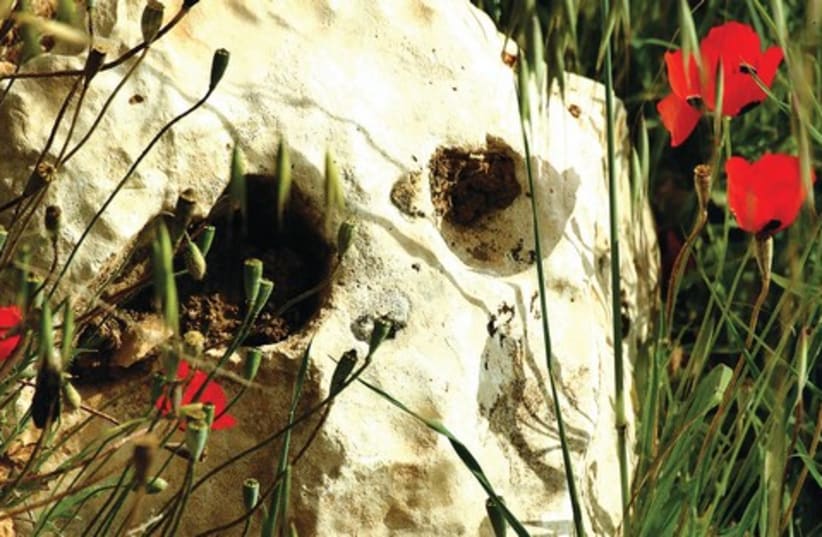
And whosoever in the open field touched one that is slain with a sword, or death body, or a bone of a man, or a grave, shall be unclean seven days’ (Hukat; Numbers 19:17.)
By SHLOMO RISKINPicture from the Parasha 521(photo credit: Israel Weiss)
“Take the staff... and speak to the rock...”– Numbers 20:8One of the most important aspects of Jewish life which characterizes our generation is the empowerment of women, in political, social and even religious spheres. Many years ago, in a lengthy private meeting (yehidut) with the revered Lubavitcher Rebbe, he told me that the greatest challenge facing Orthodox Jewry was the position of women in society – and our halachic response to what was then a newly-found acceptance of female “equality” within Western culture.The question remains whether women’s greater involvement in Torah learning and teaching will produce a different dimension, or at least a different emphasis, to the quality of Torah which is emerging. I believe the answer to this query may be found in this week’s portion of Hukat.I would like to begin this commentary with a different but connected issue in our portion: the sin and punishment of Moses. The children of Israel arrive at the wilderness of Zin, settle in Kadesh, Miriam dies and the people complain bitterly over the lack of water (Numbers 20:1, 2). Rashi immediately notes the connection: so long as Miriam was alive, a special well accompanied the Israelites on their journey. With her death, the well – and its water – were sorely missed. God instructs Moses to “take the staff... and speak to the rock.”The staff could symbolize Moses’s brand of leadership, it may even have been the staff he used earlier to smite the Egyptian taskmaster. The rock may symbolize the Jewish people, a stiff-necked nation, hard and stubborn as a rock, quick to kvetch and ripe for rebellion (so explains Rabbenu Tzadok in his Pri Tzadik commentary).Moses, however, strikes the rock, as God had bidden him to do in similar circumstances a year before (Exodus 17:1-7). In this instance, however, he is excluded from entering the Land of Israel because he strikes the rock rather than speaking to it (Numbers 20:7-13). Why the distinction, and why such a harsh punishment? The use of a rod, or a scepter, implies regal authority, domination and control. By the time of the Exodus from Egypt, the Israelites had suffered 210 years of subjugation at the hands of Pharaoh, a totalitarian tyrant.What they required was a benevolent and ethical but strong leader.After so many years of slavery, a lack of leadership would send them into the kind of panic which had pushed them into the orgies of the golden calf. Hence, just following the splitting of the Red Sea, God instructs Moses to use his leadership staff and strike the rock.Now, however, after a full year of freedom, God would have expected Moses to have rejected the power of the staff to gain the obedience of the Israelites and to have utilized instead the persuasiveness of the word to win their fealty and faithfulness. Hence God instructs Moses to speak to the rock – the stubborn Israelites – rather than to strike it.Moreover, Moses has by now received the second Tablets, which included the Oral Law (Exodus 34), the hermeneutic principles which empowered the people to become God’s partners in interpreting His words in every generation. Speech invites dialogue. God wants Moses to realize that as the Israelites matured, they required a different brand of leadership. Instead of the scepter of authority and control, they required the speech of the Oral Law. Then, the Torah, which is always compared to water, will come forth from them, from that very stubborn “rock” of a nation.After all, it’s that same stubbornness which energizes commitment, enduring commitment, even unto death, the commitment of the Israelites to the Torah in which they have become invested by means of the Oral Law.This incident of Moses’s sin and punishment is sandwiched between Miriam’s death and an account of a well this Yonatan Ben-Uziel identifies as the return of the well of Miriam: “And from there [the Israelites traveled] to the well; this is the well regarding which the Lord said to Moses, ‘Gather the nation and I shall give them water.’ Then all of Israel sang this song; concerning the well, they sang to it” (Numbers 21:16, 17).I believe the Bible is here presenting an alternative to Moses’s brand of “scepter” or “striking” leadership; it is Miriam’s brand of “singing” leadership. Words enter the mind of the other and hopefully lead to dialogue and debates; songs enter the heart and soul, leading to spirited and spiritual uplifting.The Torah, the Oral Law which includes input from Israel, is referred to as a book, but also as a “song” (Deuteronomy 31:19). A book educates the mind; a song inspires the heart. A book speaks to individuals; a song moves the masses.We met Miriam before at the splitting of the Red Sea.After Moses sang his song to God and the Israelites repeated his words (Exodus 15:1), Miriam took a drum and inspired the other women to also take drums and initiate dancing (ibid 20). Moreover, Miriam rouses them all to sing together.As the Lubavitcher Rebbe explains the prophetic verse, “Then [in the Messianic Age] there shall be heard... the sound of the groom and the sound of the bride.” The sound of the bride (the woman) shall be the sound of Torah, but it will be different from the men’s Torah; it will be a Torah of song, a Torah of heart, and a Torah which includes everyone. The writer is the founder and chancellor of Ohr Torah Stone Colleges and Graduate Programs, and chief rabbi of Efrat.
Related TagsRed Sea
if(catID != 151){
var cont = `Take Israel home with the new Jerusalem Post Store