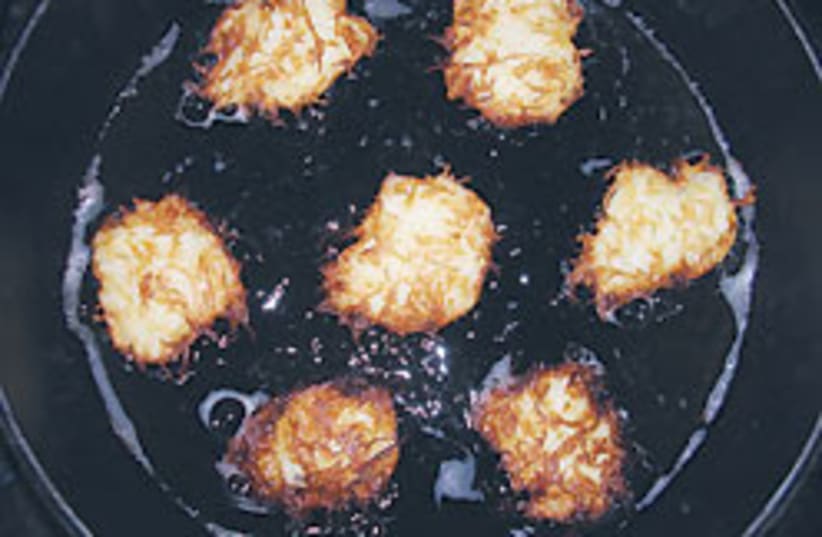
I have often wondered how sufganiyot, and not latkes, became the Israeli symbol of Hanukka.
By BARRY NEWMANlatkes 88 248(photo credit: Ilana Epstein )
Of all the seasons, autumn has always been my favorite, and with much anticipation and a warm embrace I welcome the invigoratingly cool October and November days after a particularly long and humid summer.
While elsewhere the autumn air can be brisk and biting and tease us with hints of the coming winter, in Israel the days are relatively mild and the evening winds are considerably less bracing. And what teases our senses is not the scent of pine trees, falling leaves or roasting chestnuts, but rather of frying dough.
No sooner, it seems, are the Succot poles put away for another year than the bakeries, supermarkets and outdoor stands begin aggressively hawking sufganiyot, providing a calorie-laden reminder that Hanukka is not far off. With absolutely no national or religious celebrations between Succot and the Festival of Lights, autumn and early winter in Israel have taken on something of a "shop-early-for-Hanukka" theme. Advertisements for gift baskets, toys and children's plays start long before the outdoor barbecues are covered up for another year and winter blankets brought out of storage.
And of course, by the time the first day of Hanukka arrives, it will be virtually impossible to walk two steps without bumping into a vat of bubbling oil.
Not that I'm complaining, mind you. As food motifs go, sufganiyot are certainly one of the more welcome ones. I'm not much on dairy products, so I have little enthusiasm for the quiches, lasagnas and blintzes that have come to represent Shavuot. Matza - particularly the shmura kind - I regard as something that fulfills a Pessah obligation rather than as something to enjoy. And of the horrid looking fish head that graces the Rosh Hashana dinner table... well, the less said, the better.
During my 20-some years here, though, I have often wondered how sufganiyot, and not latkes, became the Israeli symbol of Hanukka.
Avi, the owner of an industrial bake shop in the Sharon area, recently clued me in. Sort of.
"It was the Histadrut guys, you know the ones from way back, long before even [former Histadrut chairman Amir] Peretz," he explained. "They were bothered by levivot [latkes] being homemade and not something that was sold in grocery shops or kiosks, and felt that something was needed to keep workers busy - particularly during the slow months between the hagim [autumn holidays] and the time dried fruits start moving. So they began to look for an alternative, you know, something that you need oil for but also something that people - and especially kids - would spend money on. Someone real smart came up with the idea of making sufganiyot a Hanukka treat, and bingo, a star was born."
Though it sounds like one of those urban legends that get passed around from time to time on the Internet, Avi's historical account may not be as much off the mark as it sounds. The Histadrut, as we all know, wields considerable power, and just may have been the force that drove my beloved latkes onto the sidelines in this part of the world.
What I've found, however, is that sufganiyot are not as practical or as much fun as latkes. They're too messy to make at home, so you wind up having to rely on the commercially prepared ones. By the time you find a place that makes them to your liking, the fifth or sixth candle has already burned down. And with exactly the same look and feel no matter where you buy them - despite the varied fillings and toppings now available - something more boring would be hard to imagine.
I find it more than a little unsettling, moreover, that once pushed aside, latkes never again became associated with Hanukka - except, of course, by immigrants like me who stubbornly hold on to old-world customs and practices. Sufganiyot, on the other hand, are now sharing space with latkes on the Hanukka table in the Diaspora, and recipes galore are available for gourmet varieties in dozens of flavors for both the dough and the filling.
No fair. If these two holiday treats can be conjoined in Brooklyn, there's no reason they can't be similarly enjoyed here. High time, I say, to get latkes back onto the Israeli radar screen.
It won't be easy, considering the universal popularity that sufganiyot now enjoy. A bit of public relations and positive reinforcement, I think, is called for. So here are five good reasons latkes should be the shared, if not the preferred, fare for Hanukka:
1.They're much cheaper. With the oil, flour and eggs needed to make a dozen sufganiyot, you could easily make 50, maybe 60 zaftig-sized latkes.
2.They're more homey. Besides the fact that latkes are eaten warm, oil sizzling has a more relaxing, comforting sound than that of oil bubbling, which conjures up visions of persecution and torture.
3.They're more versatile. As either a main dish or on the side, latkes are part of a meal and not merely a purposeless snack made up of empty calories. And depending on which traditional topping you prefer - applesauce or sour cream - latkes are equally at home on both sides of the kitchen.
4.They're neater. No chance of cloying raspberry jam dripping down from a latke and mercilessly staining your clothes.
5.They're storable. A batch of latkes can be whipped up, put into the freezer and heated up days, even weeks, later. A day-old sufganiya tastes only a little worse than it looks.
Levana Kirschenbaum, a popular New York caterer and cooking teacher, sums it up nicely in her book Levana's Table: Kosher Cooking for Everyone: "I rarely fry anything else, but there is no Hanukka without latkes!"
And if Amir Peretz and the good ol' boys from the Histadrut don't like it, well, let them eat cake.
if(catID != 151){
var cont = `Take Israel home with the new Jerusalem Post Store