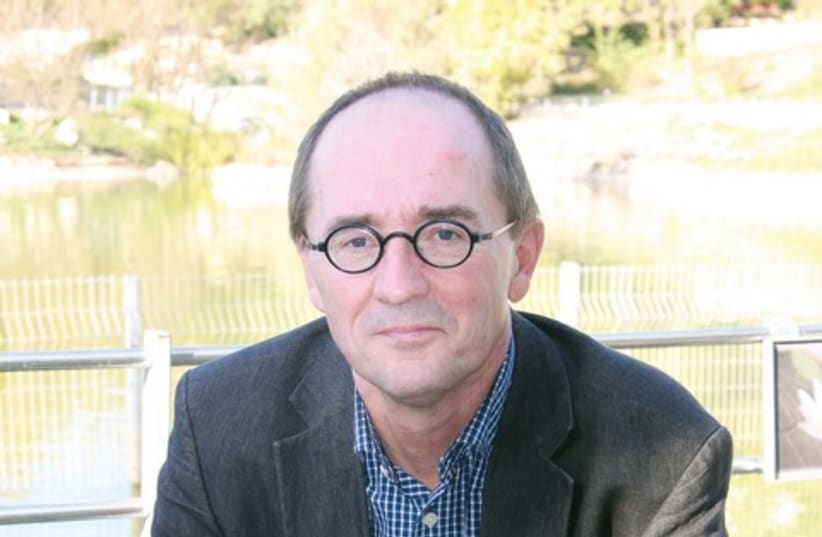
A Leiden University professor comes to Jerusalem to deliver a lecture in honor of a colleague who stood up to the Nazis 70 years ago.
By SHARON UDASINwillem otterspeer_58(photo credit: (Courtesy of Rachel Meijler/Irgoen Olei Holland))
At the end of November in 1940, 20-year-old Martijn Jakobs sat in a classroom at Holland’s Leiden University watching law faculty professor Rudolph Cleveringa deliver a speech against the Nazi decision to dismiss his esteemed Jewish colleague, Prof. Eduard Meijers. Seventy years later – on November 25 – Jakobs sat in a very different lecture hall, at the Hebrew University in Jerusalem, to witness Israel’s first participation in Cleveringa’s yearly commemorations held all over the world.“I was very excited when I heard about it,” Jakobs told In Jerusalem. “When I found out about it I knew I had to be present.”Prof. Willem Otterspeer, professor of history at Leiden University, was the keynote speaker at the Thursday evening event, responsible for delivering the “Cleveringa lecture” to a predominantly older Dutch Jewish audience that had filled the auditorium that night. A large focus of Otterspeer’s address and the other speeches of the evening was the current discrimination against Israeli professors and institutions around the world, something that defied everything Cleveringa stood for in terms of academic freedom.“Given the pressures that have befallen Israeli universities both at home in Israel and abroad, today’s lecture is very timely,” said Michiel den Hond, ambassador to Israel from the Netherlands, to the audience. “More than anything the Cleveringa lecture is a tribute to the free exchange of ideas and pursuit of academic knowledge.”Ever since Cleveringa’s original speech, Leiden University has been commemorating his courage and outspokenness by appointing a Cleveringa professor in one of the university departments annually, and the selected faculty member delivers an address in his honor each November 26. The Jerusalem lecture took place on the 25th because the 26th was a Friday. Several years ago, Leiden alumni began launching similar commemorative events in places all over the world – bringing over their professors to speak at individual events, which this year occurred in 17 cities. But this November was the first time the lecture came to Israel, after the small group of Leiden alumni in this country partnered with Irgoen Olei Holland – the organization for Dutch olim – to make it happen here.“For me as an alumnus of the University of Leiden, as an alumnus of the law faculty of Leiden, as a Jewish alumnus of the law faculty of Leiden and lawyer in Israel – to be at the first Cleveringa lecture ever in Israel, in the capital of Jerusalem, is unbelievable,” said Dave Wolf, of the Leiden University alumni group in Israel, who first attended one of these external lectures in New York.At the original speech, Cleveringa was determined to protest what he felt was an outright injustice and positively illegal measure – he simply could not tolerate the idea that the Nazis could waltz into Germany and pluck out university talent at their will, according to speakers at the Hebrew University event. Cleveringa knew that he was putting his own professorship – and perhaps even his life – in jeopardy by delivering his address, but he was determined to speak out to the university community about Meijers’s academic and personal merits, a move that inspired several other professors to do the same, and ultimately led to their imprisonment and the closure of the university.“His choice between personal safety and moral indignation was important,” said Henoch Wajsberg, chairman of Irgoen Olei Holland and largely responsible for organizing the event.But Wajsberg emphasized that Cleveringa’s behavior was hardly the norm in Holland, the western European nation with the highest percentage of Jews deported during the Holocaust.“The resistance of Cleveringa was [more] the exception than the rule.”Although some 40 of Leiden professors were imprisoned thereafter for various protests that followed Cleveringa’s monumental speech, discrimination was certainly still present at Leiden University and throughout the Netherlands, leading Otterspeer to liken Cleveringa’s actions to “a 20th-century myth.” Prior to the surge in discrimination against the Jews, the university had experienced prejudice against Catholics and socialists, according to Otterspeer.“When in the ’20s and ’30s racial theories became in fashion, the response to them was rather mixed,” he said. “Only very few people at the university believed in these theories. Many outright rejected them. Nonetheless, the theories were regarded as a legitimate subject for debate.”Interesting to Otterspeer was the fact that rather than focusing on demonizing the Nazis, Cleveringa focused on his Jewish colleague’s merits, aiming to prove that Meijers’s positive reputation was deserved – through freedom of speech, freedom of conscience and pure, unfettered research.“Cleveringa refrained from making any political statement,” Otterspeer said during his speech. “What he did do was nothing other than providing a survey of Meijers’s scientific work, and in doing so showed that the German measure was unjust.”Quite the naïve man, Cleveringa thought that the conflict with the Nazis could be solved with pure rationality, according to Otterspeer.“When questioned about his political beliefs, he answered that he never got involved in politics,” he said, referring to words Cleveringa wrote down in a diary in jail, during his second imprisonment. “He devoted his time to his studies.”Regarding his speech at Leiden, Otterspeer added, “He wrote, ‘I did hope that the Germans would accept my position.’”After telling Cleveringa’s incredible story, Otterspeer switched gears to the present day, discussing the extremism that followed 9/11 and ultimately led to radicalization in government and academia all over the globe.Academia in the Netherlands is now also undergoing radicalization, he said.On the one side, he spoke of MP Geert Wilders, a staunchly anti-Islamic Netherlands parliament member who compared the Koran to Mein Kampf and recently went on trial for inciting hatred against Islam. Meanwhile, Erasmus University of Rotterdam fired Prof. Tariq Ramadan because he hosted a function that was partially financed by the Iranian government.But most troubling, he said in his speech, is the current discrimination against Israeli educators and universities worldwide, what he calls “voices to ostracize a whole academic community” – particularly referring to the academic boycotts.“The variety and intensity of these boycotts is large enough to be alarming,” he said.“The Netherlands too are no exception,” he added, noting that although until 10 or 15 years ago his country was quite a staunch ally of Israel, current anti- Semitic acts are less suppressed than they were 40 years ago. “It is now difficult to hear something positive about Israel in the media.”“Here I think academia has an important role to play,” Otterspeer told the audience, in hopes that academia would be capable of “restoring equilibrium” as it always has. “It would be a pity indeed if precisely in a moment where a sobering voice is needed, academia abdicated,” he said.At the beginning of his speech, the audience had given Otterspeer a resounding round of applause for even showing up, given the fact that, as Wajsberg said earlier, he “has put himself in the center of an ugly anti-Israel campaign in the Netherlands.”In fact, three weeks before Otterspeer left to deliver his lecture at Hebrew University, students at Leiden University protested his decision to do so, telling the school’s administration that the professor should not be allowed to come here because the Israeli institution had expelled Richard Goldstone from its board of governors.“They said Israel is a rogue state – it doesn’t have academic freedom and everything is in military complex,” Wajsberg told IJ. “They tried to convince the director of the University of Leiden, who said, ‘We don’t do boycotts, we don’t do this.’”But Prof. Otterspeer arrived regardless, and like Cleveringa, he said he tried to avoid discussing political issues and instead focused on importance of maintaining academic freedom.“Your profession as a historian is not a tunnel vision; it is not to underline a certain political argument,” he said on the day after his speech. “And that was why I wanted to make audible sort of a position of common sense and equilibrium.”But if Cleveringa were alive to see the Israeli and Palestinian conflict going on today, Otterspeer said during a phone interview, his reaction would be “not very different from mine.”“His was a thoroughly legal mind,” he explained. “He would have rationalized along international legal lines. I think he would have emphasized the difficult legal position Israel is in having to do with the settlements. That was his protest – against the dismissal of the Jewish professor.“It was a legal protest – it was illegal what the Nazis were doing. He didn’t even mention the racial implications or causes,” Otterspeer added, noting that Cleveringa, who died in 1980 aged 86, had a necessary “utopian” way of thinking.But back at the Hebrew University auditorium that Thursday, Otterspeer emphasized how Cleveringa’s deeds were not actually heroic – rather, they were something that any decent human being would have the responsibility to do when a group of people are facing such an injustice. He viewed Cleveringa’s actions “not as the inimitable acts of a Homeric hero but something that can be expected of all of us in comparable circumstances.”Otterspeer told the audience, “In his memoirs, Cleveringa shows himself to be a very reliable, decent, ordinary man. He is not a hero; he is a professor. Rather than a legend, he is a real human being.”
if(catID != 151){
var cont = `Take Israel home with the new Jerusalem Post Store