The Jerusalem Post
Jpost search icon google-icon iphone
  Set as Homepage
Wed, Jun 19, 2013   11 Tammuz, 5773
newspapers magazines
 
    • Breaking News
    • Diplomacy & Politics
    • Defense
    • National
    • Mideast
    • Syria
    • Iran
    • World
    • Business
    • Sports
    • Health & Science
    • Environment
  • Video
  • Opinion
    • Columnists
    • Editorials
    • Op-Eds
    • Letters
  • Jewish World
  • Lifestyle
    • Arts & Culture
    • Food & Wine
    • Travel
  • Features
    • Insights & Features
    • Week in review
    • On the Web
    • Shalva Superheroes
    • Obama in Israel
  • Blogs
    • In the news
    • Judaism
    • From the Middle East
    • Lifestyle
    • Aliya
    • Science and Technology
  • JPost Apps
    • iPhone app
    • iPad app
    • Android app
    • Twitter
    • Facebook
    • RSS feeds
    • JPost Toolbar
    • JPost Newsletter
    • JPost Alert
  • Premium Zone
    • The Jerusalem Report
    • Magazine
    • Metro
    • In Jerusalem
    • ePaper
    • Expert Opinion
    • Q&A
    • Dash
    • Christian Edition
    • Ivrit
  • French
    • Politique & Social
    • Affaires Palestiniennes
    • Diplomatie & Monde
    • Art & Culture
    • Israel
  • Green Israel
JPost Learn Hebrew  
Advertise with us  
Nefesh Guided Aliyah  
Eldan  
AFMDA  
YTA  
Isram Group  
JPost Twitter  
JPost Facebook  
Classifieds  


Breaking News
 
 
  • JPost.com
  • Middle East
 

Analysis: Assad sits comfortably on his throne

By BY AMIR MIZROCH
02/05/2010 15:39
Tweet

Assad has become the pivotal player in the rapidly realigning Middle East.

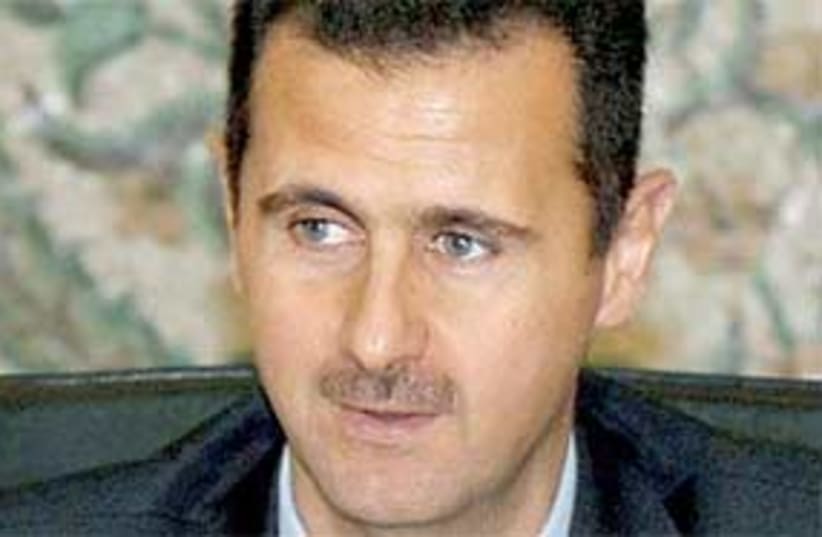
Syrian President Bashar Assad
Syrian President Bashar Assad Photo: AP
In 2008, President Bashar Assad was a worried man.

The UN probe into the assassination of Lebanese prime minister Rafik Hariri pointed at direct involvement of senior members of the Assad regime. Hariri’s long-time friend, French president Jacques Chirac, was clamoring for Assad’s head. The International Atomic Energy Agency was pursuing a probe of a Syrian nuclear facility, which, according to foreign media, had been bombed by the Israel Air Force. Damascus was being linked with Pyongyang, Assad with Kim Jong Il.

Assad was also nervously watching for any last-minute surprises by a departing George W. Bush, who hated the Syrian regime with a passion and wanted to avenge the deaths of US soldiers killed by foreign fighters who had reached Iraq via Syria’s borders. In the final stretch of the Bush presidency, about 25 percent to 30% of the Syrian army was deployed along the Iraq border in a defensive posture for this reason.

In addition, Assad was warily watching the back of departing prime minister Ehud Olmert, who had already, according to foreign reports, attacked his nuclear facility in al-Kibar and who he believed had ordered the assassination of Hizbullah’s top general, Imad Mughniyeh, in Damascus – a major embarrassment for the Syrian president.

Finally, one of Assad’s top military advisers and liaison to Iran and North Korea was killed by a sniper’s bullet.

Syria’s leader also had some serious internal headaches, which have not receded since then. Unemployment is rampant, with over one million Syrians living abroad in Lebanon and the Gulf states due to a lack of work back home. Syria’s economy, while growing steadily, is doing so at a slower rate than the Middle East as a whole. The country has a drastic water shortage, and it doesn’t have enough money or expertise to build desalination plants. There are some neighborhoods in Damascus where you can’t get water at night. Syria’s oil is also running out, and Assad still hasn’t figured out how to supplant that cash cow.

But despite all of these factors, the young Bashar Assad has not been shaken off his seat. 2009 was a much better year for the Syrian president. With the West trying to pry him away from Teheran, and the Iranian regime wooing him to stay, Assad became the pivotal player in the rapidly realigning Middle East and gradually ended his country’s isolation.

He has made good friends with former enemy Turkey; a new, more approachable American president has reinstated his ambassador in Damascus; and Assad has been welcomed with open arms by a more forgiving French president. US Middle East envoy George Mitchell has also come calling, gauging Syria’s readiness for peace talks with Israel.

Assad now has leverage over both the pragmatic camp and the radical axis. Both sides want him to come over fully. Europe sees him as part of the solution. At present, Assad is skillfully playing both sides against each other, but is not really moving in any direction, and he still has to decide where along the East-West axis he wants to position his country.

With so much to gain, Bashar Assad entered 2010 with a smile on his face. And it is precisely this smile that Foreign Minister Avigdor Lieberman is now trying to wipe off, by threatening Assad’s crowning achievement: his hold on power.

In our contemporary parlance, Lieberman put Assad on a very low couch on Thursday. But the problem is that all the signs show Assad is currently sitting on a very high stool.

He has skillfully navigated his country’s interests over the past few years. According to Western assessments, Assad does not currently want war and is unlikely to attempt a symmetrical battle with Israel. He knows his army and country are vulnerable, and he doesn’t want his regime to collapse.

With so much recent progress, Assad has much to lose. When his country runs out of oil, his regime will be dependent on the country that supplies him with his energy needs, and Iran is very willing to fill that role. Assad, however, doesn’t want to be seen as an Iranian client state, and thus be weak and isolated.

Western intelligence assessments posit that to get the Golan Heights back, Assad would pay the price of keeping the strategic plateau demilitarized. He might even allow some Israeli villages and vineyards to stay where they are under some arrangement.

As long as he takes only small steps in both directions – toward the West and toward Iran – and signals his intention to resume talks with Israel, the international community will not support an aggressive Israeli action against Bashar Assad.

Avigdor Lieberman is not nearly as welcome as Bashar Assad in many of the world’s capitals. And Thursday’s comments by the foreign minister will most likely not shake the Syrian leader’s hold on power.


To read Amir Mizroch's blog, click here.
  • Send
  • Large
  • Small
  • Print
  • Share
Most Viewed in
1
Peres: Ahmadinejad will be accountable
2
Turkey's Erdogan welcomes Hamas leaders
3
Peres supports US plan to arm Syria rebels
4
Assad warns: Europe will 'pay price' if it arms Syrian rebels
JPost Community
Tweet
syria Bashar Assad middle east avigdor lieberman israel damascus
Tweets about "#jpost"
Share this article
Tweet
Share
Send
Your comment must be approved by a moderator before being published on JPost.com. Disqus users can post comments automatically.

Comments must adhere to our Talkback policy. If you believe that a comment has breached the Talkback policy, please press the flag icon to bring it to the attention of our moderation team.
JPost Services
conferenceConference
newsletterNewsletter
iphoneMobile Apps
kotelcamKotel Cam
kolboJPost Alert
premiumPremium
JPost TV News  
Mobile Apps  
Bank Hapoalim  
Meir Panim  
Israel Law Center  
Inbal Hotel Jerusale  
Meier on Rothschild  
Weizmann Institute o  
JPost Premium Zone  
JPost kotel Camera  
         
 
Israel Focus
JPost TV News
Watch Now!  
Donate to Save Lives in Israel
 
Israel Law Center
The ultimate Mission to Israel, October 21 – 28, 2013 Register now!  
Nefesh B'Nefesh Guided Aliyah
Already living in Israel? Enjoy the Benefits of Aliyah!  
One year International MBA
in English, Bar-Ilan University, Israel – Open House July 9, 2013, 17:30  
Give "Freedom" this Passover
to needy Israeli families. Donate now  
YTA – A Yeshiva in Israel…
in English. Come Join Us  
War Threatens
Protect the People of Northern Israel  
Bank Hapoalim
Israeli's number one bank  
Jerusalem Post Lite
Lite Edition of the Jerusalem Post for English improvement  
Learn Hebrew with us
Get 10 minutes free personal coaching in Hebrew through phone or Skype  
JPost newspapers
Sign up for the JPost newspapers and receive one month free subscription  
Kosher English Magazine
English language weekly magazine - especially for religious people  
JReport Kindle Edition
Now you can get the Jerusalem Report directly to your Kindle  
JPost Premium Edition
The very best articles are available only in our Premium edition  
Lifestyle Magazine
 
 
Real Estate
Meier on Rothschild
Tel Aviv's Most Prestigious Address  
Don't Look For a House!
In Israel, our website will do it for you!  
 
Travel
Tourism Magazine
June 2013  
The Inbal Jerusalem Hotel
Hot summer deal, order now!  
Eldan Rent a Car
20% off all Car Rental Reservations in Israel  
Hertz Car Rental
Special Online Discounts!  
The King David Jerusalem Hotel
One of the world's truly iconic hotels, and a Jerusalem landmark  


Sites Of Interest:

Jerusalem Hotels
KKL-JNF
Poalim Online
BreitBart.com
Our Friends
Jerusalem Attractions
Jerusalem Tours
itraveljerusalem.com

JPost sites:

Learn Hebrew
The Jerusalem Report
Our Magazines
JPost Edition Francaise
Green Israel
Christian World
Jerusalem Post Lite

Services:

JPost Mobile Apps
JPost Premium
JPost Newsletter
JPost Toolbar
JPost News Ticker
JPost RSS feeds
JPost Archives
JPost Alert
JPost Kotel Cam

JPost Conferences:

NYC Conference
Diplomatic Conference

Information:

About Us
Feedback
Staff E-mails
Copyright
Sitemap
News Partners
Advertise with Us
Statistics
Ad Specs
Terms Of Service
Jpost.com, the online edition of the Jerusalem Post Newspaper - the most read and best-selling English-language newspaper in Israel. For analysis and opinion from Israel, the Jewish World and the Middle East. Jpost.com offers expert and in-depth reporting from Israel, the Jewish World and the Middle East, including diplomacy and defense, the Palestinian-Israeli conflict, the Arab Spring, the Mideast peace process, politics in Israel, life in Jerusalem, Israel's international affairs, Iran and its nuclear program, Syria and the Syrian civil war, Lebanon, the Palestinian Authority, the West Bank and Gaza Strip, Israel's world of business and finance, and Jewish life in Israel and the Diaspora.
 
About Us | Advertise with Us | Subscribe | Premium | Newsletter | RSS | Contact Us
 
All rights reserved © The Jerusalem Post 1995 - 2012