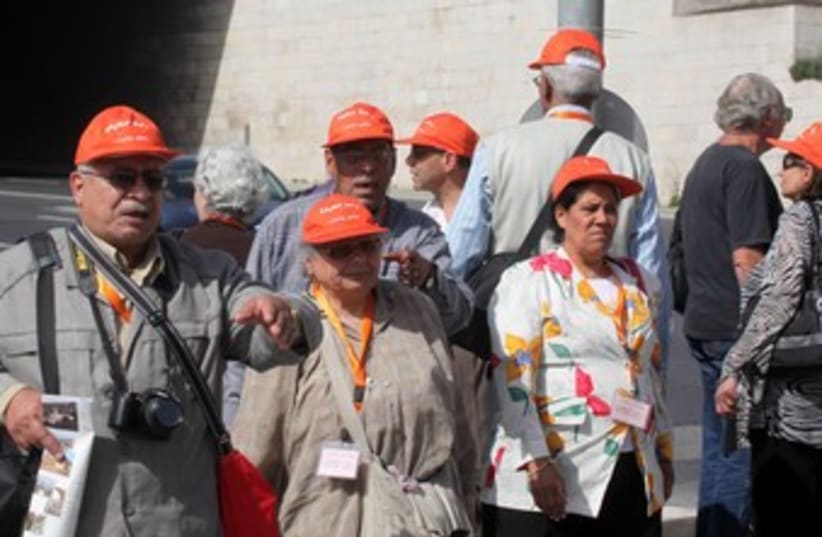
Copts tour J’lem for Easter after their pope's death
On first Easter since death of their pope, who banned pilgrimages, Egyptian Christian group's members come to J'lem.
By BEN HARTMANEgyptian Copts visit Jerusalem for Easter 370(photo credit: Marc Israel Sellem)
Dr. Kahlida Mamdouhah of Cairo waited for years before fulfilling his dream of making a pilgrimage to Jerusalem out of respect for the late Coptic pope who had banned followers from visiting Israel.But after Shenouda III died last month, there was nothing stopping him except what he called the unofficial disapproval of the government.That barrier, however, proved to be a non-issue.“I respect the pope and his wishes, but not the government,” he said, while clarifying that there is nothing political about the pilgrimage, which is of a purely spiritual nature.Mamdouhah, who was waiting for a bus to take him and his tour group to Bethlehem for the night, said that some of those in his group were on their second or third Easter pilgrimage to the Holy Land, and asserted that it is not the church that is trying to keep people away, rather the Egyptian government.Mamdouhah was one of hundreds of Coptic Christians who made their way to the Holy Land this Easter after the death of the pope, who passed away on March 20 in Cairo.The leader of the Coptic Orthodox Church in Egypt for four decades, Shenouda III was the spiritual leader of the Middle East’s largest Christian community, estimated at around 10 percent of the Egyptian population.The late pope had issued an edict banning pilgrimages to Israel as long as Jerusalem is “occupied” by Israel, but some pilgrims have still made their way to the Holy Land each Easter since Israel and Egypt signed the peace treaty in 1979, according to the Coptic Orthodox Patriarchate in Jerusalem.Though the Egyptian media reported that Coptic pilgrims were coming on the Israel pilgrimage for the first time following the pope’s ban, a representative of Air Sinai, a subsidiary of Egypt Air, told The Jerusalem Post on Sunday that while the company had increased its weekly flights to Tel Aviv from four to 13 this week to accommodate the pilgrims, their overall number does not represent a significant increase over last year.Furthermore, though the Tourism Ministry said it does not have specific numbers on the Coptic pilgrimage, each year around 500 make the trip, a small minority of the estimated 125,000 Christian pilgrims who visit Israel for Easter.The Coptic pilgrims were easy to spot in the Old City on Palm Sunday. Mainly elderly women and men, many of them wore their tour company’s bright orange baseball caps as they milled about the Old City chatting in Arabic, with the old Egyptian men in their Jalabiyas bringing a touch of Cairo to Jerusalem.A few meters from Jaffa Gate a group of around two dozen Egyptian pilgrims lazed in the afternoon shade next to the Old City walls, while steps away a booth that a group of settlers set up called on passersby to contribute to the building of a new synagogue in the Itamar settlement in memory of the murdered Fogel family.The Coptic Orthodox Patriarchate of Jerusalem presides over a handful of churches, monasteries and convents located at the Church of the Holy Sepulchre complex in the Christian quarter of the Old City, on the 9th stop of the Via Dolorosa.At the St. Anthony’s bookstore downstairs from the St. Anthony’s Coptic Orthodox Church, two monks were busy on Sunday selling assorted Christian bric-a-brac to the Coptic pilgrims crowding the stuffy, aged gift shop, whose cramped and dusty confines would make an Egyptologist feel at home.Wearing a head-to-toe black robe with gold inlay, Rev. Father El-Orshalemy greeted the faithful from a pew upstairs at the 4th century – St. Jacob’s Coptic Orthodox Church, which sits atop the Church of the Holy Sepulchre and downstairs from the Patriarchate.On a TV screen next to the door, the Coptic “St. Mark” satellite channel streamed live footage of Palm Sunday services from Cairo, where parishioners wearing black chanted in the ancient Coptic liturgy that was the language of Egypt before the Arab conquest of the Nile Delta.The general secretary of the Coptic Orthodox community in Jerusalem, 41-year-old El-Orshalemy, grew up in Cairo, where he finished law school and in his words, received a calling from God to become a monk. Fifteen years ago, he said the archbishop of the Coptic Orthodox Church sent him to Jerusalem and moved into one of the monasteries at the Sepulchre complex, taking the name “El-Orshalemy” (“The Jerusalemite”).He estimated that the community numbers around 2,500, mainly in and around Jerusalem, with a smaller community in Nazareth.El-Orshalemy dismissed reports that he had seen in recent days, which said that Coptic pilgrims were coming to Easter services in Jerusalem for the first time this year, using the death of the pope as an opportunity to skirt the ban. El-Orshalemy estimated that between 500-1,000 pilgrims are visiting the Holy Land this year and that some Copts have made the pilgrimage every year since 1979. He added that he has personally seen Coptic pilgrims in Jerusalem on Easter who defied the ruling each of the past 15 years.El-Orshalemy said the ban has never been completely effective, noting “we don’t hold the keys to Jerusalem, Israel does. People apply for a visa at the Israeli Embassy in Cairo and then they come.”Furthermore, he surmised that the reports could be from people in Egypt who are trying to make it appear as though the Coptic community is in some way working against Egyptian interests.El-Orshalemy said that contrary to reports, the church does not turn away those who come on the pilgrimage against the papal edict, rather stipulates that they are not allowed to take communion if they do come. He said that even following the pope’s death the edict remains, as it is a decision the Coptic Holy Senate in Egypt guards.In regard to what his brethren in the Coptic community in Egypt want for the future in the post-revolutionary country, he said simply “to be protected and allowed to worship freely.”When asked if the Copts, a small impoverished Christian minority in a predominately Sunni country are afraid of the rise of the Islamist parties in Egypt, he said “even the Muslims worry about the Salafis, not just us.”In an Old City alleyway outside the Church of the Holy Sepulchre, Palestinian tour guide Jamal Safi of east Jerusalem was corralling his Coptic tour group to a waiting bus, after a long day of Palm Sunday activities.Safi said that for the mainly elderly pilgrims, who for the most part live impoverished lives back in Egypt, walking in the footsteps of Jesus in Jerusalem, the Galilee and alongside the Jordan River is a once-in-a-lifetime experience that requires a lifetime of savings.Safi added that the number of pilgrims his company is hosting is no larger than last year’s and that even though “most of them are elderly peasants,” he believes they will continue to make the pilgrimage.“For them, it is a dream to come here.”
if(catID != 151){
var cont = `Take Israel home with the new Jerusalem Post Store