Analysis: Awlaki was instrumental in shaping a model for continued al-Qaida recruitment in a post-Bin Laden era.
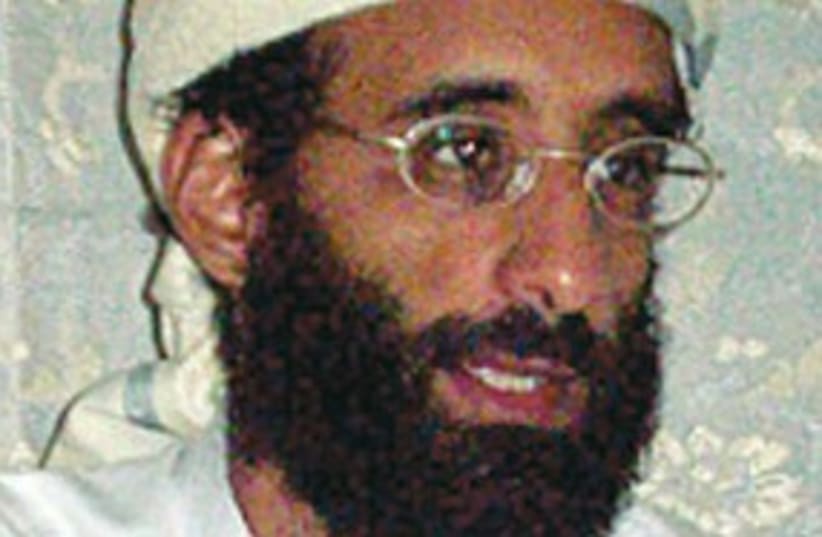
By YAAKOV LAPPINAnwar al Awlaki_311(photo credit: Courtesy)
The killing of senior al-Qaida propagandist Anwar al-Awlaki in Yemen represents a significant blow to the organization's indoctrination capabilities and media dissemination efforts, though the extensive jihadi online presence will likely continue to pose a major security risk in the near future.Awlaki, a charismatic Yemenite-American cleric who ran a mosque in Virginia before fleeing to Yemen and becoming a high-profile member of al-Qaida in the Arabian Peninsula (AQAP), was instrumental in shaping a model for continued al-Qaida recruitment and relevancy in a post-Bin Laden era.RELATED:Lappin: Inside the head of a Yemenite al-Qaida mastermind Al-Awlaki advocates killing in new video Al-Qaida in Yemen suspected of sending cargo bombs He believed that by ensuring the flow of rhetoric through the pipelines of the Internet and promoting al-Qaida's deadly narrative to the world, the jihadi network could ensure its survival for decades to come.Awlaki, who survived a similar air strike in May, founded the slickly designed English-language Inspire magazine, which is aimed at recruiting Western Muslims to al-Qaida's ranks by presenting the terror network as the only authentic Muslim movement.Inspire encouraged its readers to plan mass killings of civilians, and provided doctrines to justify the actions, as well as operational tips on creating explosives and handling weapons. It also provided instructions to readers on how to send in questions, and offered answers in subsequent online issues.It was used by US and British counter-terrorism officials to gain information on AQAP and its plans to strike Western cities.Awlaki's message, as well as that of al-Qaida in general, often compared al-Qaida's global attacks with battles fought by Islam's prophet, Muhammad, against Arab pagans in seventh century Arabia.The message is predicated on presenting the US as a fundamentally anti-Muslim global power, and labeling Arab-Muslim governments as American stooges.This week, days before Awlaki's assassination, Inspire released its seventh issue, made available by the Washington DC-based Middle East Media Research Institute, which included past comments by Alwaki regarding the "duty of killing those who insult our Prophet Muhammad." The latest issue of Inspire also contained an article by US-born jihadi Samir Khan - who was killed alongside Awlaki, according to reports - on the importance of the "media conflict." In it, Khan boasted of the global jihadi movement's propaganda efforts, writing, "Something that was produced thousands of feet above in the mountains of Afghanistan was found distributed in the streets of London and California. Ideas that disseminated from the lips of the mujahidin's leaders were carried out Madrid and Times Square."After fleeing the US in 2002, Awlaki flew to Britain from Yemen, where he gave firebrand pro-jihad sermons to followers, who proceeded to record the talks and distribute them on the Internet.Awlaki returned to Yemen in 2004, and became involved in operational planning of attacks, according to counter-terrorism officials. He has been linked to at least three international terror plots: The failed 2009 'underwear bomber' attempt to blow up an airliner over Detroit (Awlaki helped recruit the Nigerian bomber, Umar Farouk AbdulMutallab), the 2009 Fort Hood shooting (Alwaki was in email communications with the gunman, Nidal Hassan) and the 2010 cargo flight explosives plot.Awlaki's assassination is the latest in a series of devastating strikes against al-Qaida that have severely weakened the network.The coming months and years will reveal how successful the assassinations will be in preventing al-Qaida from poisoning minds and disrupting future attacks.Yaakov Lappin is the author ofVirtual Caliphate; Exposing the Islamist State on the Internet.
if(catID != 151){
var cont = `Take Israel home with the new Jerusalem Post Store