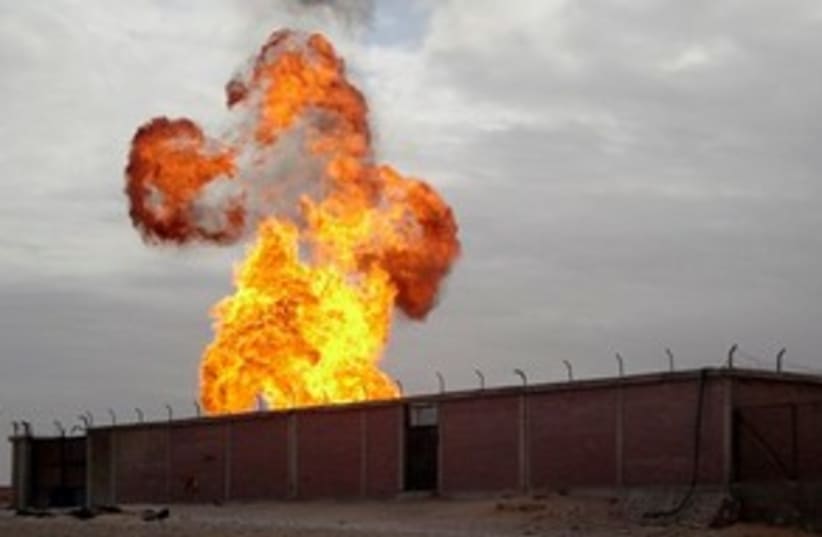
Gas firm blames Sinai pipeline blast on leak, not sabotage
Landau: Flow of gas to Israel won’t be disrupted; El-Arish blast causes shut off of natural gas flow to Israel and Jordan.
By OREN KESSLER, ASSOCIATED PRESSGas Pipeline Blast 311(photo credit: Associated Press)
An explosion shook a gas terminal in Egypt’s northern Sinai Peninsula on Saturday – setting off a massive blaze that was contained by shutting off the flow of gas to neighboring Jordan and Israel, officials and witnesses said.Egypt’s natural gas company said the fire was caused by a gas leak – but a local security official said an explosive device was detonated inside the terminal. The regional governor said he suspected sabotage.RELATED:Editor's Notes: The reversal of a generation’s momentumColumn One: Israel and Arab democracyMubarak: I'd resign, but Egypt would descend into chaosThe blast and fire at the gas terminal in the Sinai town of El-Arish did not cause casualties.Infrastructure Minister Uzi Landau said in a statement Saturday that Israel is prepared for unexpected disruptions in the supply of natural gas from Egypt, and that a drill was held last June when an exact scenario was simulated.Landau added that his ministry is conducting consultations with Prime Minister Binyamin Netanyahu and security authorities as events unfold.“No disruption of the electricity supply is expected,” Landau said, adding that Israel has the capacity to immediately switch to alternative energy sources.A Ministry spokesperson declined to respond to questions from The Jerusalem Post over reports that the blast had been caused by an explosion in the terminal.Army Radio reported Saturday that the gas pipeline is only expected to begin servicing Israel in about a week, once repairs are made.The explosion sent a pillar of flames leaping into the sky, but was a safe distance from the nearest homes, said regional governor Abdel Wahab Mabrouk. He added the fire was brought under control by mid-morning, after valves controlling the flow of gas were closed.The terminal is part of a pipeline system that transports gas from Egypt’s Port Said, on the Mediterranean Sea, to Israel, Syria and Jordan. The Sinai Peninsula, home to Beduin tribesmen, has been the scene of clashes between residents and security forces.The head of Egypt’s natural gas company, Magdy Toufik, said in a statement that the fire broke out in the terminal “as a result of a small amount of gas leaking.”However, a senior security official, who spoke on condition of anonymity because he was not authorized to discuss the issue with reporters, said an explosive device was detonated in the terminal.The Prime Minister’s Office said it’s not clear whether damage was caused to the pipeline leading to Israel.“But as a security precaution, Israel temporarily stopped – by its own initiative – the transfer of gas as procedure dictates,” Netanyahu’s office said.Late last week, the AP reported that the turmoil in Egypt has spurred an unexpected boom in Israel’s nascent energy sector – as investors bet that demand for locally produced natural gas will surge because of doubts about the stability of supplies from Egypt.Small investors are buying stock in small companies that could boom – or bust – a development that is worrying professionals.“At the moment, there is the fear that there will be problems with incoming gas from Egypt,” said Liat Glazer, an analyst at the Excellence- Nessuah investment house.Israeli officials say the flow of Egyptian gas has not been disrupted, but the deal with Israelis unpopular in Egypt. Speculators are trading on concerns that the contract might not survive the turmoil there.Israel’s long energy shortfall began to turn around in recent years with discovery of offshore gas deposits.Two years ago, Noble Energy, the US-based company leading the exploration, announced deep-water finds that dwarfed earlier offshore discoveries.In December, it announced it had uncovered the world’s largest deepwater discovery in the past decade.In all, Noble and its Israeli partners claim to be sitting on some 25 trillion cubic meters of deep-water gas – enough to keep Israel energy self-sufficient for decades. Gas could start flowing from one of the fields by late 2012, experts say.The scope of the finds fueled a gas rush on the Tel Aviv Stock Exchange – even before the new fears about the Egyptian gas supply arose – bringing in retail investors for the first time since a mid-1990s bubble burst.The local energy market is relatively new, providing an element of the gold rush atmosphere.Six years ago, all of Israel’s electricity was generated by imported coal and oil. Today, roughly half of the fuel Israel uses comes from natural gas – drawn in equal parts from Israeli and Egyptian sources – which started pumping to Israel in 2008 under a 15- year contract for 1.7 billion cubic meters per year.Amit Mor, an energy analyst, forecasts that by 2020, as much as 70 percent of Israel’s electricity could be powered by natural gas.The Sinai gas pipelines have come under attack in the past. Beduin tribesmen attempted to blow up the pipeline last July as tensions intensified between them and the Egyptian government, which they accuse of discrimination and ignoring their plight.Egypt has potential natural gas reserves of 1.7 trillion cubic meters, the 18th largest in the world.The deal with Israel has raised controversy at home, with some in the Egyptian opposition saying the gas was being sold at below-market rates.Others resent their neighbor’s treatment of Palestinians, and say Egypt shouldn’t supply energy to Israel.“The deal [to sell gas] was a blow to the pride of Egyptians and a betrayal,” former diplomat Ibrahim Yousri said Saturday.Yousri led a high court challenge to try to halt Egypt’s sale of gas to Israel.Although the high court ruled in his favor in February 2010, the ruling was widely ignored by the government.
if(catID != 151){
var cont = `Take Israel home with the new Jerusalem Post Store