Morsy seeking 'balance,' reassures Israel on peace
In 1st interview with int'l news organization Egypt's leader urges Assad's allies to coax him out, hints at new approach on Iran.
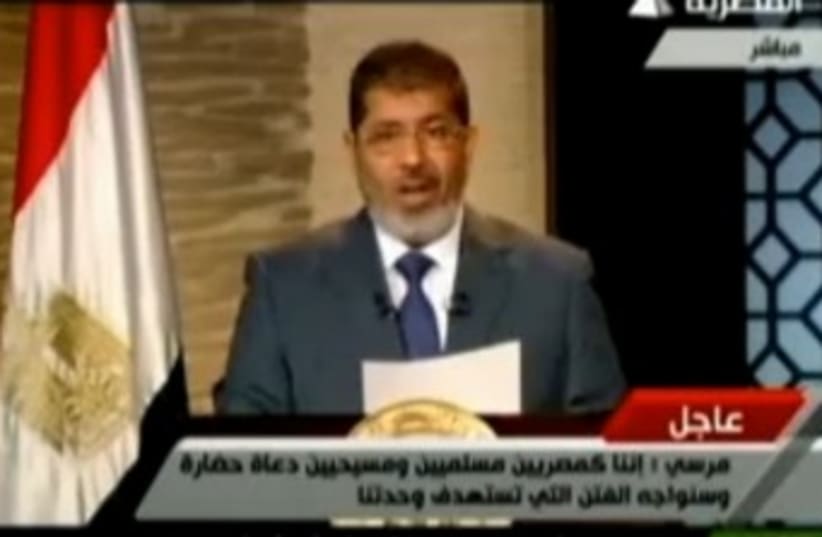
By REUTERSMorsy victory speech 370(photo credit: REUTERS)
CAIRO - Egypt's new Islamist president said on Monday he would pursue a "balanced" foreign policy, reassuring Israel its peace treaty was safe, hinting at a new approach to Iran and calling on Syrian Bashar Assad's allies to help lever the Syrian leader out.Mohamed Morsy, who was elected in June and consolidated his power this month by dismissing top military leaders, is seeking to introduce himself to a wider world ahead of a trip to Iran - the first by an Egyptian leader in three decades - and China."Egypt is now a civilian state ... a national, democratic, constitutional, modern state," he told Reuters in his first interview with an international news organization since taking office as the candidate of the once-banned Muslim Brotherhood."International relations between all states are open and the basis for all relations is balance. We are not against anyone but we are for achieving our interests," said the US-educated engineer, appearing confident and assertive in the marble-lined presidential palace.The first leader Egyptians have elected in a 5,000-year history dating back to the pharaohs, he spoke in a room for visiting dignitaries surrounded by monarchy-era furniture, oil paintings and a grand tapestry on the wall.Morsy, 61, came to power after the fall of Hosni Mubarak, who served for decades as a loyal US ally and the guarantor of Egypt's status as the first Arab country to make peace with Israel.His emphasis on balance suggests he is seeking a less explicitly pro-American role in the region, but he has also been at pains to reassure traditional allies.Morsy's Brotherhood describes Israel as a racist and expansionist state, but he resigned from it on taking power and has avoided inflammatory language. He repeated his position that Egypt will continue to abide by international treaties, including its 1979 peace deal.Without mentioning Israel by name, he indicated Egypt's neighbor had nothing to fear from a new military campaign in the Sinai Peninsula, which he ordered after gunmen attacked an Egyptian border post, killed 16 guards and tried to burst across the frontier into Israel. "Egypt is practicing its very normal role on its soil and does not threaten anyone and there should not be any kind of international or regional concerns at all from the presence of Egyptian security forces," he said, referring to the extra police, army and other forces moved to the area.The military campaign was in "full respect to international treaties", he said. The Egypt-Israel peace deal includes limits on Egyptian military deployment in Sinai.Officials in Israel, already concerned that Egypt's Islamists will support the Brotherhood-offshoot Hamas in Gaza, have voiced worries about Egypt's build-up of heavy armor in Sinai to quash militants.Morsy would not say if he would meet Israeli officials. Mubarak regularly received top officials although only went to Israel once for a funeral.In an effort to increase Egypt's role in regional affairs, Morsy has called for dialogue between Egypt, Saudi Arabia, Turkey and Iran to find a way to stop the bloodshed in Syria. Notably, the initiative has been welcomed by Iran, the only country in the group that supports Assad.During his interview, Morsy gave a particularly strong call for Assad to be removed from power, suggesting that he is comfortable taking a high profile role in regional affairs. It is a message he will take on his trip to Iran and China, which, along with Russia, are the main countries backing Assad."Now is the time to stop this bloodshed and for the Syrian people to regain their full rights and for this regime that kills its people to disappear from the scene," Morsy said."There is no room to talk about reform, but the discussion is about change," Morsy said, adding Egypt had repeated that "the friends of the Syrian people in China and Russia and other states" need to back ordinary Syrians. However, Morsy said he opposed foreign military action in Syria "in any form."
if(catID != 151){
var cont = `Take Israel home with the new Jerusalem Post Store