Hamas rejects Cairo's claims that it wanted to frame Egyptian groups.
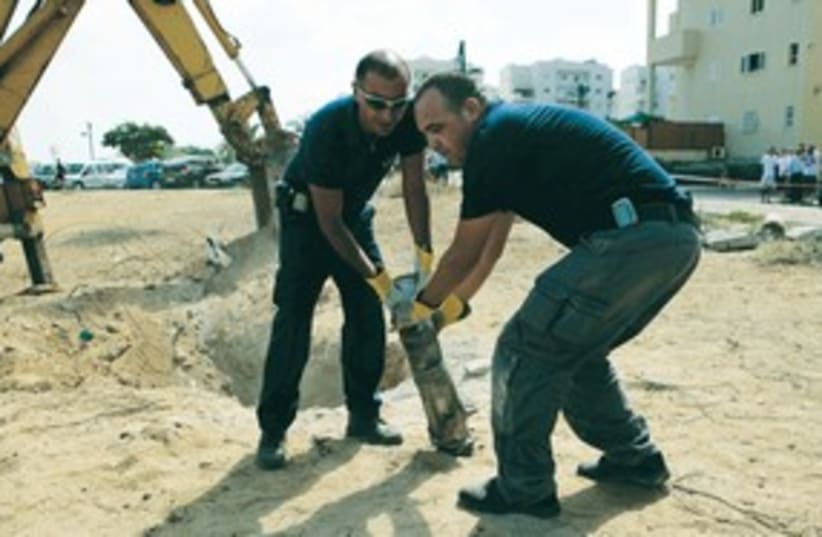
By KHALED ABU TOAMEH, TOVAH LAZAROFFKatyusha 311(photo credit: Associated Press)
Evidence shows that Hamas’s military wing twice fired Katyusha rockets at Eilat and Aqaba – once in April and a second time on Monday, Prime Minister Binyamin Netanyahu charged in a statement released to the press on Wednesday night.“We investigated these two incidents. It is clear to us beyond any doubt that in both incidents a cell of Hamas’s military wing in Gaza surreptitiously fired the missiles,” Netanyahu said. “I want to be clear: Using the territory of a third country — a peaceful one — in order to launch missiles against Israel won’t help Hamas escape responsibility.”RELATED:Hamas: No connection to Eilat-Aqaba rocket attackEilat tourism sector unfazed by attack'Terrorists want to thwart peace'The statement went on by saying that Israel viewed the attacks “with great severity” and described them as an attempt to “harm Israel’s relationship with Egypt and Jordan.”On April 22, a Katyusha rocket fired from Sinai hit a warehouse in Aqaba, but Israel believed the intended target had been Eilat. On Monday morning, six Katyusha rockets were fired from Sinai. One came to earth in the Sinai; another fell in a field near Eilat, while two more landed in the Red Sea. The remaining two rockets struck near the Intercontinental Hotel in Aqaba, killing one person and wounding four.Cairo initially denied that this week’s missiles had been fired from Sinai. By Wednesday, however, it had changed it tune, and Egyptian security authorities were blaming armed groups in the Gaza Strip.Egypt’s announcement triggered a strong response from Hamas and other groups in Gaza. Their spokesmen denied any involvement.A Hamas official in the Gaza Strip said his movement did not rule out the possibility that Islamic Jihad and al-Qaida elements in Sinai had been behind the attacks. Islamic Jihad leaders, however, denied any involvement.The official Egyptian news agency Ashraq Al-Awsat quoted an Egyptian security source as saying that “preliminary information” indicated that Palestinian groups in the Gaza Strip had been behind Monday’s rockets.“Egypt would not agree, under any circumstances, that any party use its territories to harm Egyptian interests,” the source cautioned.The Egyptian source did not hold Hamas responsible. Nevertheless, the announcement was seen as a warning to Hamas against allowing armed groups to use the Gaza Strip as a launching pad for terrorist attacks.The Egyptians said that at least seven Grad rockets had been fired at Eilat and Aqaba from Sinai.However, the Egyptian magazine Al-Yom Al-Sabe quoted an Egyptian security official as saying that Hamas had indeed been involved in the attacks. The official added that Hamas men had infiltrated Sinai through tunnels before firing the rockets, and that Sinai had been chosen to “arouse suspicion” about Egypt’s role.The official quoted in the magazine added that the Hamas cell responsible for the attack had been aided by local Beduin.Hamas reiterated on Wednesday that the allegations had been “fabricated” by Israel and Egypt. Hamas spokesman Sami Abu Zuhri said Cairo’s accusations were “unprofessional, contradictory and unreliable.” He added that the Egyptian charges were “politically motivated” and aimed at inciting against the Gaza Strip,“to justify the continued siege and aggression.”Hamas remained opposed to “exporting” the fight against Israel outside the Palestinian territories, Abu Zuhri said.Salah Bardaweel, another Hamas spokesman, accused the Egyptians of issuing “contradictory” statements on the incident.He said the new allegations against Hamas “provide Israel with an excuse to strike at Egypt and the Gaza Strip.”
if(catID != 151){
var cont = `Take Israel home with the new Jerusalem Post Store