Kuwaiti daily cites Iraqi source as saying Assad officials might ask Iran’s Qods Force to deploy chemical weapons.
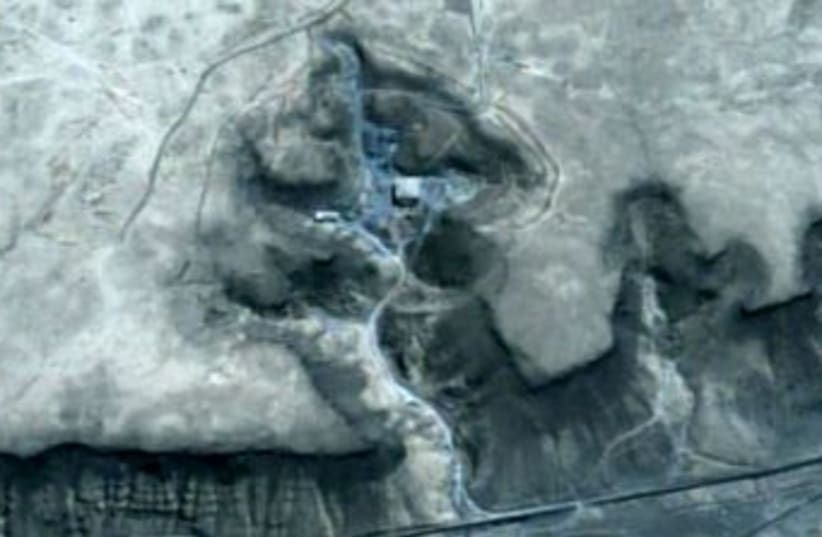
By JOANNA PARASZCZUKSatellite images of suspect sites in Syria 370 (R)(photo credit: Reuters / Handout)
Sources in Iraq say Syrian President Bashar Assad’s inner circle is engaged in “intensive debate” between those who advocate using chemical weapons as a last resort and those who warn of the dangers of such a step, Kuwaiti daily Al-Seyassah reported on Thursday.The debate comes amid growing Western fears that a desperate Assad could turn to chemical weapons as rebels close in on Damascus.Al-Seyassah said its reporters spoke to a “prominent figure in Iraq’s Islamist Sadrist movement” in Baghdad. The movement, led by popular Shi’ite cleric Muqtada al-Sadr, is supportive of Assad but has previously denied reports it has sent fighters to Syria to help put down the uprising.Assad’s security and intelligence chiefs believe the rebels’ convergence on the capital provides a unique “opportunity to exterminate them,” the source said.The Iraqi Sadrist leader said the Syrian regime’s political military and security factions have become more desperate as rebel forces converge on Damascus, and therefore the regime won’t hesitate to use “any weapon” against the opposition, Al-Seyassah reported.This faction, led by Gen. Ali Mamlouk, Assad’s special security adviser and former head of the General Security Directorate (GID); his deputy Gen. Abdel-Fateh Qudsiya; current GID chief Maj.-Gen. Mohammed Dib Zaitoun; military intelligence chief Maj.-Gen. Rafiq Shahada; and Gen. Rustum Ghazali, the head of the Political Security Directorate, believe such a move could help quash the uprising once and for all.The majority of Syria’s military leaders and the Defense Ministry have warned, however, that if the army itself resorts to chemical weapons against the rebels, that move may result to the armed forces’ “complete disintegration,” since while the army does not really oppose the use of such weapons, it does not want to be directly involved in using them against the Syrian opposition, the source told Al-Seyassah.Mamlouk, Qudsiya and Zaitoun have proposed that special units of Iran’s Revolutionary Guard Corps, rather than the Syrian Army, be asked to carry out security leaders’ orders to use chemical weapons, the source said.Click for full JPost coverageThe report comes after US officials said last week they have intelligence that Syria may be making preparations to use chemical weapons against opposition forces. On Monday, The Washington Post reported comments by a senior American defense official that the US is concerned about “indications of preparation” for a possible use of chemical weapons.US intelligence officials have also intercepted one communication within the last six months they believe was from the Revolutionary Guard Corps’s elite extraterritorial unit, the Qods Force, according to the Washington Post. That communication reportedly urged Syrian regime members to use its supplies of Sarin nerve gas against rebels and the civilians supporting them in Homs.Syria has one of the world’s largest chemical weapons arsenals, according to Leonard Spector, executive director of the James Martin Center for Nonproliferation Studies based in Washington. Syria’s arms cache includes “traditional chemical agents, such as mustard, and more modern nerve agents, such as sarin, and possibly persistent nerve agents, such as VX,” he told the BBC on Tuesday.While Damascus has never confirmed that it has chemical weapons, it has insisted that it would never use them against its own people.Deputy Foreign Minister Faisal Mekdad reiterated this position on Thursday, telling Hezbollah’s Al-Manar TV that “Syria would never use chemical weapons, even if it had them, against its own people.”Mekdad said the West’s “theatrical talk” of chemical weapons was merely a ploy to justify military intervention against Syria.According to Al-Seyassah, its Iraqi source said that Iran has discussed the use of chemical weapons with Moscow, and Tehran supports their use “widely and extensively.”Moscow believes the Syrian regime could resort to limited use of chemical weapons as a deterrence if it were forced to act to stop Damascus from falling into the hands of the armed opposition, especially in the suburbs of Douma, Moadamiyeh, Zamalka and Kafr Batna, where intelligence shows there are more armed groups including those affiliated with the Al-Nusra Front (Jabhat al-Nusra), the source said.The Al-Nusra Front is an al-Qaida-affiliated Sunni jihadist paramilitary group, which has claimed responsibility for several suicide bombings including in Damascus and Aleppo. The US is moving to designate the group as a foreign terrorist organization because of its links to al-Qaida.According to Al-Seyassah, its source said Assad’s inner circle could well decide to use chemical weapons only in a limited initial operation, but that use could be expanded depending on the circumstances and results.Syria’s security and intelligence chiefs are “not indifferent,” however, to the international community’s response as it prepares its plans, first to carry out chemical weapons strikes and second to direct its air defense system to counter Western fighter jets that may intervene to strike Assad’s forces and strategic sites, including chemical weapons stores, according to Al-Seyassah.The US warned Syria last week not to use chemical weapons, saying that would be a “red line” for Washington.US Secretary of State Hillary Clinton told reporters in Prague on Monday that Washington was “certainly planning to take action if that eventuality were to occur,” but has not said what form that action might take. Washington has also not said what it might do should Syria’s chemical weapons cache fall into the hands of opposition forces.Al-Seyassah also quoted its source as saying that the decision whether or not to use chemical weapons was “not in the hands of President Assad.”Assad would “not sign any document proving that he is resorting to this weapon to attack the rebels, and therefore the decision will likely be taken by Mamlouk, Qudsiya and Zaitoun and the IRGC leadership,” the paper quoted the source as saying.Tehran, which has much to lose if Assad falls, has been accused by the US last week of continuing to ship arms to the Syrian regime via Iraqi airspace. The Syrian opposition have also accused the Revolutionary Guard Corps of providing military assistance to Assad.In May, an Iranian news report that was quickly removed quoted Qods Force deputy commander Esmail Gha’ani as admitting that the Revolutionary Guard Corps’s elite extraterritorial unit was aiding Syria. In September, Revolutionary Guard Corps commander Brig.-Gen. Mohammad Ali Jafari said that while Qods Force agents were in Syria, Iran did not have a military presence there.
if(catID != 151){
var cont = `Take Israel home with the new Jerusalem Post Store