Mubarak remains in power, passes some authority to Suleiman
Protesters disheartened as Egyptian president vows to remain in office until September elections, fails to resign immediately as had been rumored.
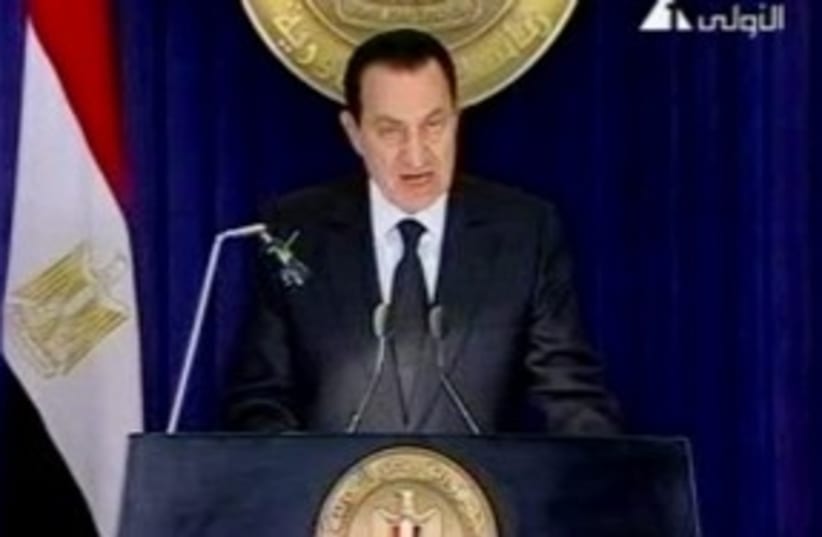
By O. KESSLER, H. KEINON, G. HOFFMAN, H. L. KRIEGEEgyptian President Hosni Mubarak 311 AP(photo credit: AP / Egypt TV)
Millions of protesters across Egypt erupted in fury late on Thursday night as Hosni Mubarak defied hours of rumors that he would step down by vowing, in a televised speech, to stay in office and oversee a reform of the constitution en route to September’s presidential elections.“Get out, get out!” the crowds shouted and some protesters marched toward his presidential palace and the offices of state TV.RELATED:Dangerously underestimating the Muslim BrotherhoodReporter's Notebook: Laying low, shredding passportsFormer CIA head on Egypt: US response ‘uncertain'Washington: Basic citizens' demands unmet by EgyptMubarak said he would delegate further powers to Vice President Omar Suleiman, but would also ignore “diktats from abroad.” Instead, he said, he would “carry on and protect the constitution and the people, and transfer power to whoever is elected next September in free and transparent elections.” The embattled president reiterated that he would not run as a candidate.Mubarak also said he would lift the country’s reviled stateof- emergency laws once the situation had stabilized.But he added, defiantly, “I have confronted death... I have never succumbed to international pressure. I have preserved my dignity. I have preserved peace for Egypt and worked hard for its renaissance.”Protesters in Cairo’s vast Tahrir Square responded to the speech with indignation, waving their shoes at the leader, who has ruled the Arab world’s largest state with an iron fist for nearly three decades. Later Thursday, there were reports of protesters marching toward his presidential palace.CIA director Leon Panetta had said Mubarak appeared poised to hand over his powers to Suleiman.And in anticipation of Mubarak’s speech, protesters who had packed into the square broke into chants of “We’re almost there, we’re almost there” and waved V-forvictory signs.But the euphoria that stemmed from the belief that they were nearing their goal of Mubarak’s fall was tempered with worries that a military takeover could scuttle wider demands for true democracy.The developments created confusion over who was calling the shots in Egypt and whether Mubarak and the military were united on the next steps.Ahead of Mubarak’s speech, a member of the Muslim Brotherhood said he feared the army was staging a coup, but later said any official comment from Egypt’s biggest opposition group would depend on the final outcome.“It looks like a military coup... I feel worry and anxiety.The problem is not with the president, it is with the regime,” Essam al-Erian, a senior member of the Brotherhood, told Reuters before adding, “We will not comment until the situation clears.”Neither the Prime Minister’s Office nor the Foreign Ministry had any formal comment on Thursday night on the developments in Egypt, a continuation of the policy put in place at the beginning of the crisis to keep a low Israeli profile on the events unfolding in Cairo. One diplomatic source said this position was both noted and appreciated by the Egyptian authorities.Diplomatic sources in Jerusalem seemed to be surprised by the rapidly changing events in Cairo, having said as late as Wednesday that the situation in Egypt seemed to be stabilizing, and that the country was settling down to a state of “abnormal normality.”The widespread assessments in Israel are that the Egyptian military recognizes the strategic importance of the peace treaty with Israel, and will continue to uphold it. The army leadership of the two countries have a good working relationship, and communications have continued at senior levels throughout the crisis.Israel has a strong working relationship with Suleiman, and a recently released WikiLeaks cable dated August 2008 from the US Embassy in Tel Aviv said that should Mubarak die or become incapacitated, “there is no question that Israel is most comfortable with the prospect of Omar Suleiman.”While contact between the Egyptian and Israeli militaries has continued unabated, there is believed to be little to no contact between Israeli authorities and members of the amorphous Egyptian opposition.This disconnect stems from two causes: much of the opposition – including the Muslim Brotherhood – does not want to talk to Israel, and the current Egyptian leadership would look unfavorably on any such contact.Click here for full Jpost coverage of unrest inEgyptPresident Barack Obama pledged US support for an “orderly and genuine transition to democracy in Egypt,” and spoke of “witnessing history unfold” in Cairo.Obama, appearing at a previously scheduled speech on the economy in Michigan, described the hundreds of thousands of people gathered in Cairo as a new generation of people “calling for change.“We want all Egyptians to know America will continue to do everything that we can to support an orderly and genuine transition to democracy in Egypt,” he said.Hours earlier, Deputy Secretary of State James Steinberg told members of Congress that whatever new government emerges in Egypt, the US will work to make sure it isn’t overtaken by extremists who would threaten Israel’s security.“By working for orderly transitions, we believe we can help ensure Israel’s long-term security, and we will be vigilant against attempts to hijack a legitimate impetus for domestic reform to advance extremism,” he said at a hearing called to assess administration policy on the Egypt crisis.“One constant in a changing region is our unwavering support for Israel’s security.”He said that the US has also been communicating a very clear message that its expects the 1979 Egyptian-Israel peace treaty will be upheld regardless of who comes to power.“The peace treaty between Israel and Egypt isn’t just in the interest of Israel, but in the interest of Egypt and the region,” he said, “and therefore we would expect any government to honor its international commitments, to honor a treaty that was signed by that government, and to remain committed to it not just in letter but in spirit.”Steinberg was also questioned repeatedly about America’s stance toward the Muslim Brotherhood and what the US was doing to prevent the Islamist group from taking over a new government.“We want to make sure that the process is not hijacked by extremists, or those who do not equally believe in the open and tolerant and democratic process that we want,” he told lawmakers on the House Foreign Affairs Committee. “The process itself is one for the Egyptian people to decide, but as we engage with whatever government emerges there we will be guided by those principles.”Opening the hearing, Rep. Ileana Ros-Lehtinen, chairwoman of the House Foreign Affairs Committee, declared, “Engaging the Muslim Brotherhood must not be on the table.”
Related TagsSuez Canal
if(catID != 151){
var cont = `Take Israel home with the new Jerusalem Post Store