"We pray and dance all night," says Tel Aviv upholsterer.
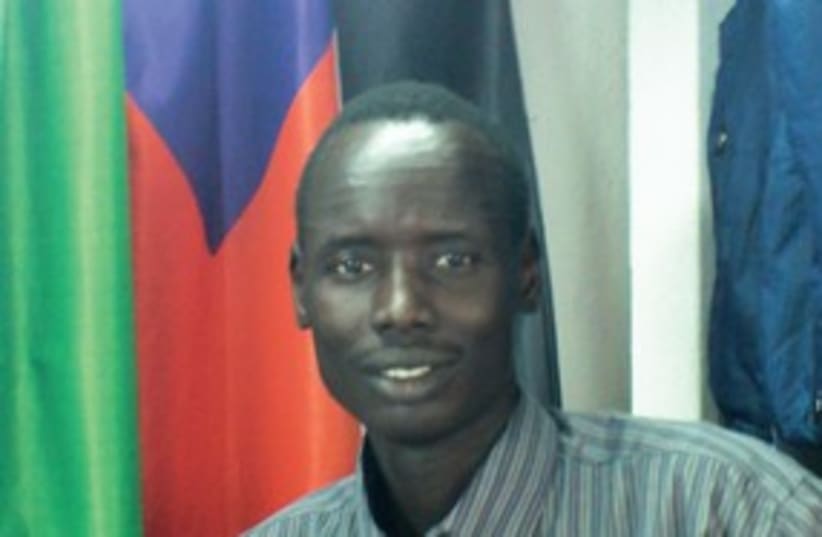
By BEN HARTMANSIMON KOANG GAI_311(photo credit: Ben Hartman)
Simon Koang Gai would love to slaughter a cow for the traditional South Sudanese Christmas feast, but pulling off such a holiday treat would be far too expensive in Israel.“It cost very much money to buy a cow in Israel,” Gai said.RELATED:Christmas fervor hits Jerusalem The 39-year-old South Sudan native owns the appropriately named “Holy Land” upholstery store on Chelnov Street in south Tel Aviv, where he refurbishes motorcycle seats and furniture and repairs satellite dishes.On Wednesday, he spoke excitedly about the upcoming Christmas celebrations his community was planning at their church in south Tel Aviv, in particular the late-night praying and dancing extravaganza that is Christmas Eve for South Sudanese.“We pray and dance all night, but it’s not dancing for us, it’s dancing for the lord,” Gai said.The day after the all-night festival at the church on Levanda street in Tel Aviv and at the community’s church in Arad, those who can will make their way to Bethlehem on Sunday.Gai said on Christmas, South Sudanese travel far and wide to reunite with their families in their home villages, traveling back home from Khartoum and beyond, often at great risk.In addition, Gai said they travel from house to house bringing good tidings to their neighbors, and that massive communal barbecues are held.When asked if they decorate Christmas trees, he replied matter-of-factly, “no, we don’t have those trees in South Sudan.”Gai moved to Israel three years ago after spending four years in Egypt, where he arrived after fleeing South Sudan. Owing to his fervent evangelical faith, Gai keeps a bible on hand and highlights his points with scripture. Thumbing through the book of Isaiah, he comes to chapter 18 verses 1-7, which describe (King James 2000) “a people tall and smooth of skin” who come from a land “the rivers divide” and make their way to Mount Zion.He rolls up his sleeve to reveal what is indeed a hairless forearm, which along with his well over 6-foot frame would suggest a resemblance to the description given in the book of Isaiah.
Gai said the Christian population in the South Sudanese community in Israel – estimated to number around 3,000 – is mainly Evangelical with some Catholics, mostly in the community in the Negev city of Arad. As opposed to Sudan, South Sudan is predominantly Christian and Animist, with a Muslim minority. The Christianity practiced in the country has been heavily influenced by local traditions and has customs quite different than those practiced in the West.A few blocks away, at a hair salon outside the new central bus station, Johannes Aforki, a 28-year-old Eritrean of Ethiopian extract chewed khat leaves and spoke of Christmas traditions in his Orthodox Christian homeland as the mild narcotic stimulant seeped into his veins.“There’s no work on Christmas, it’s a holiday. We go to church and pray, and you buy new clothes for Christmas and wear them.”“I haven’t seen my family in 10 years, but I’ll call them and talk to them on the phone,” Aforki said, adding that he’ll probably cry speaking to them as another holiday passes without them.
if(catID != 151){
var cont = `Take Israel home with the new Jerusalem Post Store