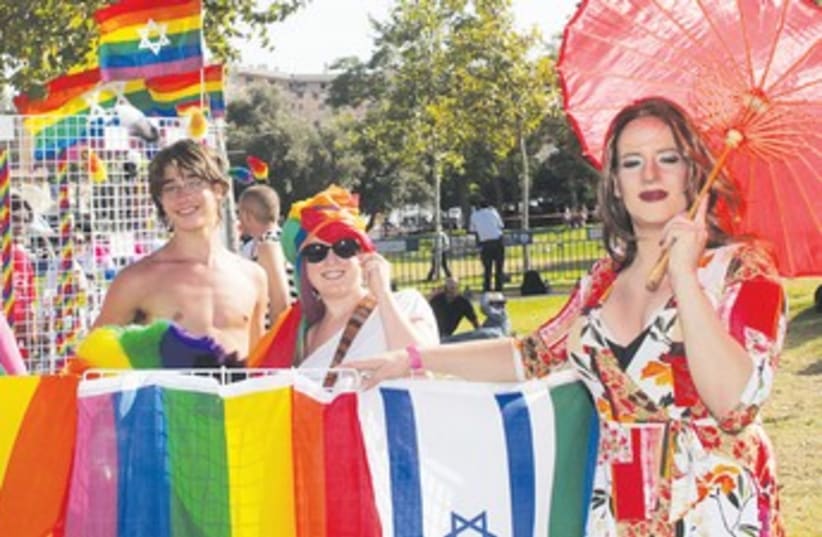
10th Gay Pride Parade set to kick off in Jerusalem
Right-wing activists vow to bring live donkeys to protest the "bestiality" of parade; 5,000 expected to attend.
By MELANIE LIDMANJerusalem Gay Pride Parade (370)(photo credit: Marc Israel Sellem/The Jerusalem Post)
The 10th annual Jerusalem Gay Pride Parade will return to its original route through the city center on Thursday, passing by the point where three participants were stabbed in 2005 by a haredi extremist.Ahead of the parade, right-wing activists lead by Baruch Marzel said they planned on bringing eight live donkeys to the parade to protest the “bestiality” of the Pride and Tolerance parade. Marzel told The Jerusalem Post he plans on bringing the donkeys from settlements in the West Bank to march along the participants, although the police “is currently giving us problems.”Elinor Sidi, the director of Jerusalem’s Open House, the lesbian, gay, bisexual, and transgender (LGBT) community center, said that Marzel tries to bring donkeys to the parade every year. “This is animal abuse, and we really hope the Agricultural Ministry will get involved to stop this,” she said.On Thursday morning, police discovered the white “Welcome to Jerusalem” sign had been covered with rainbow paint, most likely in support of the Pride and Tolerance Parade. Police opened an investigation into the incident, and the sign was immediately cleaned.Sidi said that the Open House is against all forms of violence, including vandalism of public property. On Wednesday, activists opened a center in Tel Aviv to deal with abuse against the gay and lesbian community.Approximately 5,000 people are expected to take place in Thursday’s march. Haredim have requested a permit to hold a counter-protest in Shabbat Square, and in the past few years there have been small groups of haredim protesting along the route, though there have been no major disturbances in the past five years. Sidi said the gay community does not oppose the Shabbat Square protest because they support freedom of expression.American philanthropist Lynn Schusterman, an early supporter of Open House, is one of the main speakers at the event.Adam Russo, who was 18 when he was stabbed during the 2005 march, will also address the crowd.Sidi added that the parade’s biggest victory in the past 10 years is that the march is now a regular part of the city’s calendar.“We’re marking a decade of advancement in this city,” she said. “In the first years of the parade there was terrible violence against participants, but now it has become part of the status quo of this city.“Our goal for the next 10 years is not just to be seen during the one day a year of the day on the parade, but on the other 364 days per year as well.”The parade, which will march from Independence Park to the Liberty Bell Park down King George Street, is traditionally much more subdued than the week-long colorful beach party of Tel Aviv’s gay pride events.King George Street will be closed to traffic during the parade, from approximately 6 to 7 p.m. Thursday’s march also takes place on the third anniversary of the shooting at the Bar Noar center for LGBT teenagers in Tel Aviv, when 26-year-old volunteer counselor Nir Katz and 16-year-old Liz Trubeshi were killed and 15 were wounded.No one was arrested for the murder and the gay community has not recovered its sense of security, said Sidi.“At the Open House, the door used to be physically open. Now, not only is it closed, it is locked, we have guards and a key. We want to be able to give our community self-confidence, we want to keep the door open,” she said.Sidi said activists refused to give up hope that the murderer will eventually be caught.
if(catID != 151){
var cont = `Take Israel home with the new Jerusalem Post Store