Egypt’s transformation
By JPOST EDITORIAL
08/21/2012 22:49
Neither the US nor the Saudis seem willing or able to confront Egypt’s Islamists.
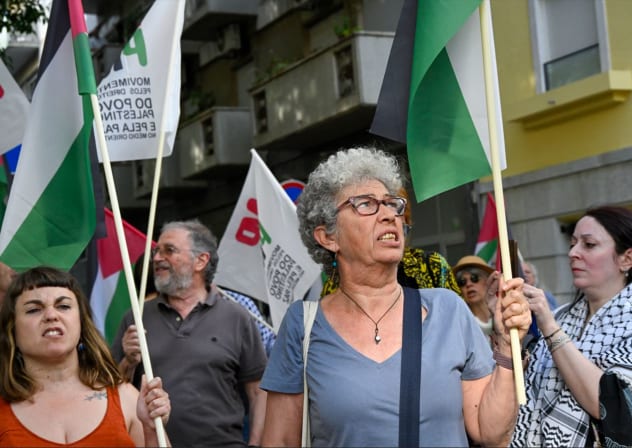
Protesters chant against Clinton's visit to Cairo Photo: REUTERS
Shortly after Egypt signed the 1979 peace treaty with Israel, Tehran’s newly
installed Ayatollah regime broke off diplomatic ties with Cairo. For three
decades Egypt was one of the few Arab countries – if not the only one – without
an embassy in Iran.
But relations are warming between the most populous
Arab state in the Middle East and the Islamic Republic. In April of last year
Iran appointed an ambassador to Egypt for the first time in over 30 years as a
gesture designed to express Tehran’s desire for improved relations in the wake
of Hosni Mubarak’s ouster.
Now Egyptian President Mohamed Morsy has
announced that he will be attending the Non-Aligned Movement’s conference,
taking place in Tehran at the end of the month. It will be the first visit to
Iran by an Egyptian president since Egypt’s recognition of Israel.
It
appears there is very little the US or “moderate” Arab states like Saudi Arabia
can do to persuade Morsy from pursuing a foreign policy that puts Egypt on a
course of confrontation with the West.
Internally, Morsy has succeeded in
consolidating the Muslim Brotherhood’s control over Egyptian
leadership.
In the latest and most dramatic shakeup of the country’s
political system since the Tahrir Square demonstrations, Morsy sacked Defense
Minister Mohamed Hussein Tantawi, forced out Army Chief of Staff Sami Enan and
other top military officials, and scrapped amendments to the constitution that
would have limited his power.
The Supreme Council of the Armed Forces,
headed by Tantawi, was supposed to restrain the Muslim Brotherhood and ensure
the continued enforcement of the Egypt-Israel peace treaty. Now Morsy faces no
major internal challengers. Egypt’s decision to move tanks and aircraft into the
Sinai Peninsula without notifying Israel for the first time since the Yom Kippur
War – in an apparent violation of the peace accords – appears to be the direct
result of an unrestrained Muslim Brotherhood leadership.
Morsy knows that
the vast majority of Egyptians are opposed to the peace treaty with Israel. The
Islamic Republic has garnered a tremendous amount of popularity among Arabs
across the region for refusing to back down to the West’s demand to halt its
nuclear program.
At the upcoming NAM conference, during which Egypt will
hand over the chairmanship to Iran, Iranian President Mahmoud Ahmadinejad is
expected to push an agenda advocating the right of developing countries –
including Egypt – to pursue programs of uranium enrichment and nuclear
capabilities.
Both Iran and Egypt are interested in creating alliances
with Islamist movements in Arab states that were empowered by the Arab Spring.
As a Sunni state Egypt is much better positioned to do so. There are burgeoning
Muslim Brotherhood-affiliated movements in Jordan, Syria, Tunisia and Libya. If
Tehran can improve relations with Cairo, the Shi’ite regime could capitalize on
what has been a Sunni uprising.
True, Morsy has no interest in hurting
his relations with Saudi Arabia, which is at odds with the Islamic Republic for
stoking a Shi’ite uprising in Bahrain.
Indeed, Riyadh was the first city
Morsy visited after winning the presidential elections. With dwindling economic
support from abroad and a severely troubled economy, Morsy cannot afford to
alienate his Gulf State patrons. Egypt also desperately needs the $1.3 billion
in annual aid it receives from Washington.
But neither the US nor the
Saudis appear to be willing to confront Egypt.
When Morsy confirmed his
participation in the NAM conference, US State Department spokeswoman Victoria
Nuland issued a lukewarm response. She essentially admitted there would be no
repercussions and expressed hope that “those who choose to go will take the
opportunity of any meetings that they have with Iran’s leaders to press them to
come back into compliance... to come clean about their nuclear
program.”
It is abundantly evident that Egyptian foreign policy under the
Muslim Brotherhood has deviated radically and dangerously since Mubarak’s ouster
and neither the US nor the Saudis seem willing or able to confront Egypt’s
Islamists. None of this bodes well for Israel.