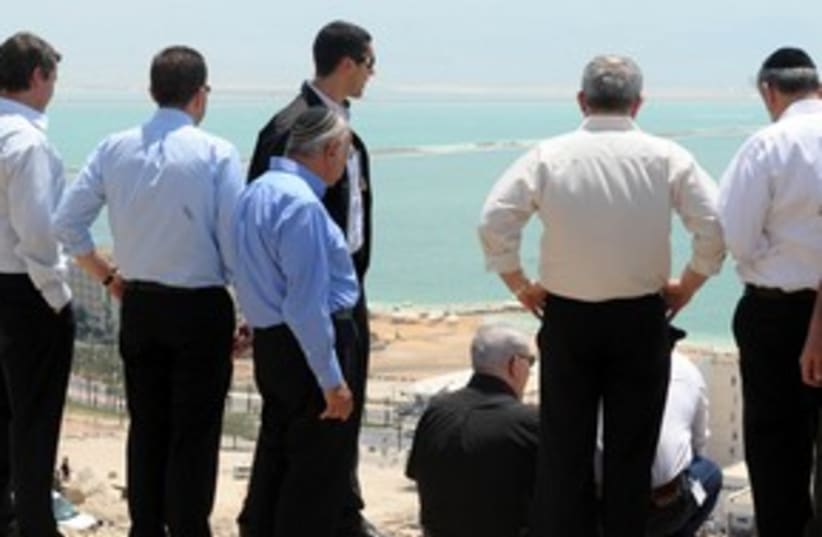
PM tours Dead Sea to find solution for water levels
Netanyahu evaluates flooding problem that may threaten hotels; green groups praise PM support for harvesting 20m. tons of sea salt.
By SHARON UDASINNetanyahu Dead Sea 311(photo credit: Moshe Milner/GPO)
Prime Minister Binyamin Netanyahu toured the Dead Sea region on Monday morning in order to evaluate first-hand the impact of the flooding problem that could potentially threaten the hotels and infrastructure in the southern section, as a continuation of discussions he has held over the past few weeks, his office announced in the afternoon.The flooding would be caused by a rising water level of about 200 millimeters per year in the southern Pool #5, as the Dead Sea Works company has been perpetually pumping in water in order to maintain operational efficiency as it harvests minerals from its evaporation ponds, Prof. Alon Tal of Ben-Gurion University of the Negev’s Jacob Blaustein Institutes for Desert Research had explained to The Jerusalem Post in mid-May.RELATED:Editorial: Keeping the Dead Sea aliveTourism, environment ministers urge Dead Sea salt harvestAt the end of that month – and after the publication of a report co-authored by Tal – the Tourism and Environmental Protection Ministries had announced that they would recommend harvesting the 20 million tons of salt in the southern sea as the solution to the dangerously high water levels there.In response, Netanyahu organized a team, chaired by Finance Ministry Budget Director Udi Nisan and Accountant General Michal Abadi, to review different methods of financing this preferred solution within the next 21 days, the Prime Minister’s Office said.“The Government has come to save the Dead Sea and it is also obligated to save its tourism industry and scenic beauty as well,” Netanyahu said in a statement following the tour.“Previous governments talked about this but my government is doing something.We will try to reach a solution through dialogue with the Dead Sea Works, but if not, we will act with all the means – including legal – at our disposal.”Joining Netanyahu on the Dead Sea tour were Tourism Minister Stas Meseznikov, Environmental Protection Minister Gilad Erdan, Finance Minister Yuval Steinitz, Interior Minister Eli Yishai and Justice Minister Yaakov Neeman.The Prime Minister said that he hoped it would be possible to begin work on the salt extraction within a few weeks, in an effort “to save this global natural resource,” according to his media adviser. Netanyahu had originally been presented with three alternative solutions – harvesting the salt, creating a lagoon for the hotels or relocated the businesses to another region.Environmental groups praised Netanyahu’s visit to the Dead Sea as well as his probable support for the salt harvesting solution but expressed some additional requests to the prime minister.“The Dead Sea harvest is only a partial solution to the environmental damage caused by the Dead Sea Works plants,” said Amit Bracha, executive director of the Israel Union for Environmental Defense (Adam Teva v’Din) in a statement.Bracha emphasized that the Dead Sea Works company must bear the brunt of the costs and the harvest must not harm the nearby Tze’elim Stream, and also stressed that private companies also must be prohibited from establishing an additional evaporation pond – Pool #6 – in the northern Dead Sea.The Society for the Protection of Nature called the salt harvesting option “the only possibility that will allow for a balance” among Dead Sea Works operations, hotels and nature, while cross border environmental organization Friends of the Earth Middle East also lauded the prime minister’s support.“This is the only solution that is sustainable and that will preserve the hotels in the long run. Now it rests upon the Treasury to stand against the false campaign of Dead Sea Works and not give in to the pressure of the property owners, who are trying to evade responsibility for the damage they caused,” said Gidon Bromberg, Israel director of the group, in a statement.“Therefore, and according to the ‘polluter pays’ principle, it is necessary to charge the full cost of the salt harvest to the plants.”During his tour, the prime minister also encouraged Israelis to vote for the Dead Sea in the finals of the New 7 Wonders of Nature Competition, which concludes in November 2011 and pits the sea against 27 other sites across the world, his office said in a second statement.In addition to logging on to www.new7wonders.com, voters can cast their ballots by sending an SMS to 224 with the words “Dead Sea” in Hebrew, English or Arabic, according to the statement.
if(catID != 151){
var cont = `Take Israel home with the new Jerusalem Post Store