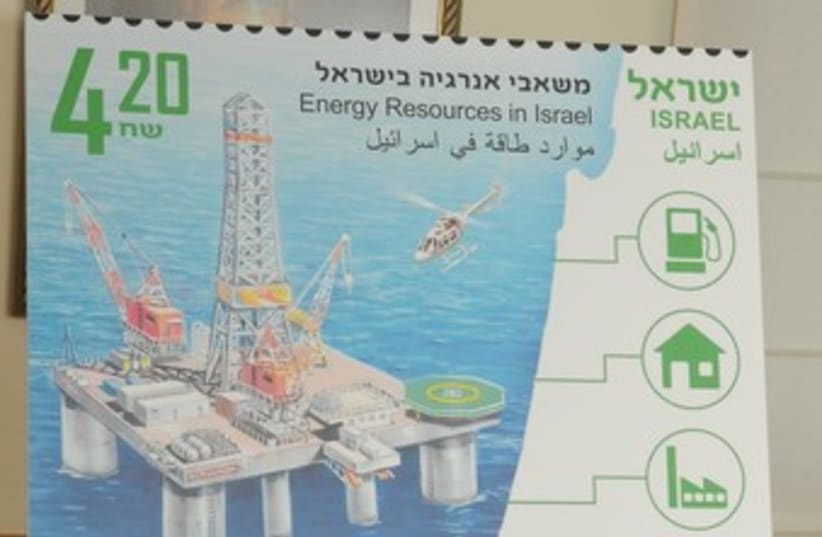
In honor of Israel's 26th Philately Day, ministry produces NIS 4.20 stamp featuring a drilling rig at sea.
By SHARON UDASINNatural gas stamp 370(photo credit: Courtesy)
In honor of Israel’s 26th Philately Day – the day celebrating the collection and study of postage stamps – the Energy and Water Ministry launched on Wednesday a stamp featuring a drilling rig at sea, to commemorate the large reserves of natural gas found off the coast in recent years.The NIS 4.20 stamp, produced by the Israel Philatelic Service in conjunction with The Association of Oil and Gas Industries in Israel, was designed by Ronen Goldberg and Tuvia Kurtz and is available on a sheet of 15 stamps. On the stamp is a colorful illustration of a drilling rig at sea and a service copter flying overhead, as well as a black-and-white photograph of on-shore drilling from the Central Zionist Archives.The stamp stresses the importance of Israel’s expanding energy economy and its new-found capability to emerge in the global energy industry as well as provide a secure electricity supply at home, the ministry said.“One of the ways in which the state record a seminal event in history and ascribes to it importance is by means of issuing a stamp,” said Energy and Water Minister Uzi Landau. “The discoveries of Israeli natural gas are certainly such an event for the State of Israel.”Landau stressed that due to the large amounts of natural gas available, the country’s electricity supply will be able to undergo a complete “makeover,” with reduced air pollution and increased energy independence.“Our job is to see to it that all Israelis can enjoy and benefit from the advantages of this gas,” Landau added.Launching the stamp along with Landau were Communications Minister Moshe Kahlon, Israel Postal Company Board of Directors chairman Sasi Shilo, Israel Postal Company CEO Haim Elmoznino, Philatelic Services director Yaron Ratzon and Association of Oil and Gas Industries chairman Uri Aldubi.Noting the importance of using blue-and-white energy resources at home as well as allowing for exports, Aldubi said that the natural gas finds will contribute greatly to the economic development as well as the energy stability and security of the country for years to come.“The State of Israel’s achievements in the field of natural gas, oil and energy put the country in a position of honor in the international energy market,” Shilo added.“These achievements certainly deserve to be commemorated in a stamp.”
Related Tagskahlon
if(catID != 151){
var cont = `Take Israel home with the new Jerusalem Post Store