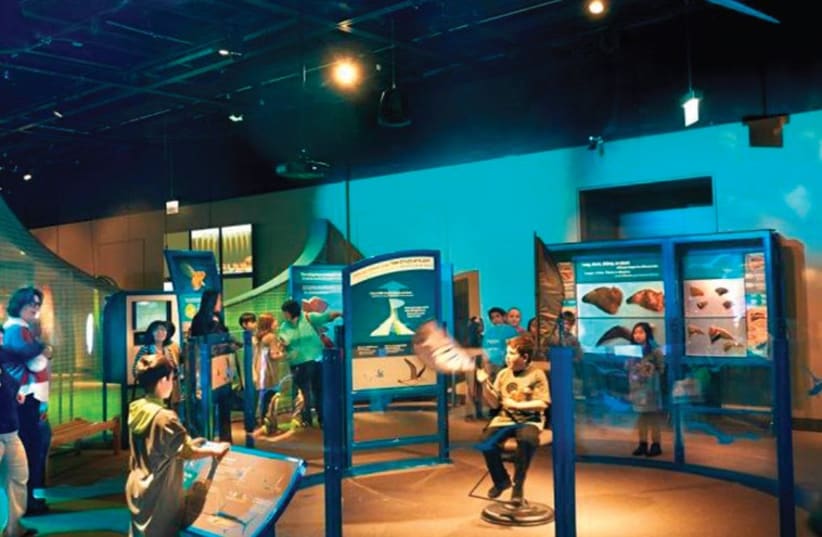
The famed Field Museum in Chicago has sent its biomechanics exhibition to Jerusalem’s Bloomfield Science Museum.
By JUDY SIEGEL-ITZKOVICHJerusalem’s Bloomfield Science Museum(photo credit: Courtesy)
All living things are from their inception engaged in a struggle to survive. Every moment of their existence, they are under attack. Wind, water, gravity and predators are working to tear both animals and plants apart. Fortunately, however, Nature has responded by providing these biological machines with an arsenal of materials and structures to defend them – and these ingenious biomechanical designs can inspire us to copy them for our own uses.This continuous contest is chronicled in The Machine Inside: Biomechanics, a major exhibition that has been imported by Jerusalem’s Bloomfield Science Museum from the famed Field Museum in Chicago. Four years in the making at Field, it was ensconced in a huge prefab structure constructed and installed within two months at the edge of the Bloomfield campus and will be open, for a separate entrance fee, until after Succot. It was the first time Field had taken the exhibition outside the US; from Israel, it will tour various cities in Europe.Bloomfield director Maya Halevy and deputy director Dea Brockman said at the opening on July 9 that it was a major achievement to persuade the Field Museum – established in 1893 and designated as a museum of natural history in 1905 – to lend the exhibition.The explanatory text for the exhibition was translated from English into both Hebrew and Arabic.Hebrew University president Prof. Menahem Ben-Sasson, whose institution of higher learning was a partner in establishing Bloomfield in 1992, said: “When you ask a child to look in the mirror, he takes it for granted.When you ask a question, you are in process of discovery. If not, you lose a lot.”Jerusalem Foundation president Mark Sofer, whose institution was the other founder of the Bloomfield, added: “It [the museum] always has new things to show the public, especially children. This is not just another exhibition.”Shelley Reisman Paine of the Chicago museum, an expert in the conservation of artistic and historic works, said that the concept of the exhibition began in 2008. A number of museum people were brought together to think about what would be the “next big thing” in science museums.“All agreed it would be biomechanics.Everything is a machine, including humans, from the sprinting of the cheetah to the acute hearing of the owl to the bite of a mosquito.We hope that from now on, we will carry out more joint projects with Bloomfield,” she said.YOUNG CHILDREN will have a ball at the exhibition, from flapping giant bat wings, pressing the simulated hand of a monkey to measure his strength or pressing the neck of giraffe to discover how the arteries pump its blood to its head. But to really appreciate the new exhibition, older children, teens and adults should spend some time there, experiment and read, read, read about the mysteries of these living machines.To withstand compression, for example, Nature uses stony materials like calcium in structures such as skeletons and seashells. To be able to bend, there are substances such as collagen, cellulose and keratin inside bones, wood and feathers. To withstand tensile stress, nature uses stretchy materials such as cellulose and various proteins for things like stems and spider webs. To temporarily change shape, nature uses elastic materials like cartilage so that spinal discs and other structures bounce back. To allow things to slide, there are natural slippery materials such as mucus and synovial fluid that reduce friction in noses, knees and joints. The dome shape found throughout nature protects objects from chicken eggs and turtle shells to the human skull from massive pressure.Compare muscles and motors, legs and springs, claws and clamps and many more mechanisms to learn how all living things have evolved the right tools for the job of survival. Using surprising tactics, creatures endure the planet’s extreme temperatures, find food in the face of fierce competition, and – without metal, motors or electricity – circulate their own life-sustaining fluids.Video footage and interactive displays help you experience how living creatures cope with the never-ending race to remain alive.You’ll be amazed by the variety of pumps, pipes, insulation, motors, springs and sensors with which creatures are equipped.How do fleas that live on dogs and other mammals jump so high – up to 35 centimeters in length and 20 centimeters in height, which is proportionately a much greater distance than an Olympic athlete? They have a mix of strong leg muscles and pads of a rubber-like protein called resilin behind their hind legs. When the parasite prepares to jump, it crouches, causing the resilin to be squeezed and storing energy that can be suddenly released.The giraffe has such a long neck it can munch on tender leaves up to six meters high. Why doesn’t it get dizzy when it lowers its head to drink? It has a complex series of mechanisms that constantly monitor the pressure in the blood vessels and make any adjustments needed to ensure that the proper pressure is maintained at all times. Even if the animal lifts its head up suddenly in the middle of a drink, proper blood supply to the brain is maintained. Giraffes have big hearts, weighing up to 26 pounds. Weighing 10 kilos and pumping about 60 liters of blood some 170 times a minute, the giraffe’s heart is pushed to the limits of its capacity. The animal’s blood pressure is twice that of a human, with human hearts of about 350 grams pumping about five liters of blood around 60 times per minute. In addition, the arteries in the giraffe’s neck are supported by ringed muscles that push blood to the brain.The valves in the jugular vein fight gravity by preventing the rapid descent of blood into the brain when the head is lowered, and they direct flow toward the heart.How did the cheetah get to be the world’s fastest land animal? It has an aerodynamic nose, a long, thin tail for balance, claws that never retract, for extra traction, and a spine that curls like a loaded spring help create the animal’s extra reach. At the Bloomfield exhibition, you can experiment with a video of the feline to slow down its gait and witness another secret to its speed: being fully in the air twice in each stride – something few other animals can do.The exhibition also reports on an extinct fish with a stronger bite than both the Tyrannosaurus rex dinosaur and today’s alligators.Called Dunkleosteus terrelli, it could bite a shark in two. Living some 400 million years ago, it weighed up to four tons. Its teeth were like sharp blades, and the creature’s bite pressure was an amazing 36,000 kg. per 6.l5 square centimeters. It could open its mouth in just one-fiftieth of a second, creating strong suction that pulled its prey into its mouth before it knew what was happening.How do sea turtles find their way around? Their brains contains magnetite, which acts as a natural compass and helps the animal to navigate accurately over huge distances.THERE ARE even plants that attack living things. The carnivorous Venus flytrap captures curious insects that get too close. But how can a plant – which lacks muscles or nerves – move to catch and capture its prey? The amazing plant is a “power plant” that generates electrical signals and secretes sweet sap to attract victims. The double-lobed leaf has a hinge in the middle. The rims of each lobe flair out in a curved row of spikes that interlock when the traps shut to prevent prey from escaping. When a trap is open, each lobe is convex in shape, its red belly bulging outwards. When something triggers the hairs of the trap, the lobes flip to a concave arrangement in less than a tenth of a second, forming a sealed stomach.How does the red, black and white woodpecker manage constantly to bore holes into trees to catch insects without getting a massive headache? It turns out that it has a very long tongue that not only lengthens the bird’s reach for bugs but also wraps around the entire skull to act like a shock absorber.The omnipresent Velcro fastener that replaced shoelaces and other closing devices was in fact inspired by a natural phenomenon.Swiss engineer George de Mestral got the idea when he went out in the Alps to hunt with his dog. When he returned, he looked at the burrs (seed pods) stuck to the dog’s fur and his own clothing. Managing to extricate the burrs and examining them under a microscope, he saw they had hundreds of “hooks” that caught onto anything with a loop. Thus was born Velcro, which has hooks on one side and loops on the other – one of the early examples of bio-inspired technology.ENTRANCE TO the exhibition doesn’t come cheap, as entrance is in addition to regular museum admission – but it’s worth it. While children under five get in free, children over five through adults pay NIS 79 each, with a relatively cheaper family ticket and lower prices for students, police, soldiers, disabled persons and those who have Yerushalmi cards.But admittance also provides entrance to workshops on “building” animals without motors or springs; a study of animals’ sensing mechanisms; and lessons on bio-inspired technology. Bloomfield also created a new production called The Race to the Ark, combining modern dance, theater and animation, which integrates reality and the Bible.
Related TagsAdli Mansour
if(catID != 151){
var cont = `Take Israel home with the new Jerusalem Post Store