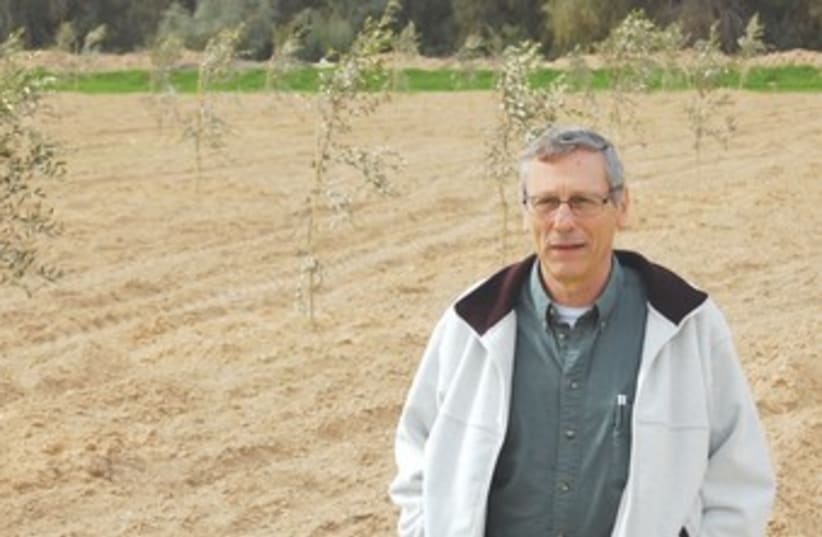
New funding initiative by Ben Gurion University will provide for the growth of an olive tree fores.
By SHARON UDASINBGU PROFESSOR Pedro Berliner 370(photo credit: Courtesy Ben-Gurion University of the Negev)
American Associates of Ben Gurion University of the Negev (AABGU) have launched a new funding initiative that will provide for the growth of an olive tree forest at a university agricultural research farm.The project, called “Plant a Tree to Seed Desert Research,” will take place at the Wadi Mashash research farm, located about 32 km. south of Beersheba.Contributing to a BGU mission of “making the desert bloom,” the initiative will also allow donors to dedicate individual trees to the person of their choice.Wadi Mashash, the area where the olive grove will crop up, is the only site in Israel where agricultural production is based solely on the collection of the desert’s rare flood-waters, according to the AABGU. Tactics developed at this specific farm have already been used to promote sustainable development projects in other drylands – particularly tree growth projects in African nations, the organization reported.“The olive tree is a symbol of Israel, a reminder of our extraordinary heritage in our biblical homeland and a prized example of the remarkable agricultural and energy potential of drylands around the world,” said Doron Krakow, AABGU executive vice president, in a statement released by his office. “The research done at Wadi Mashash will bring knowledge to the world – knowledge that will help produce food, cash crops and more sustainable farming practices.”Planting, managing and researching at the olive grove is being carried out by students at the Albert Katz International School for Desert Studies, from BGU’s Blaustein Institutes for Desert Research based in Sde Boker.The first phase of planting – about 240 olive trees – has already been completed, as the Wadi Mashash area had “good luck” with receiving rainwater this winter, according to Prof.Pedro Berliner, director of the Blaustein Institutes and head of the olive grove project.“Our irrigation is ancient Nabatean type in which we collect runoff,” he told The Jerusalem Post on Wednesday. “Our plot was flooded. The moment our plot was flooded we planted our trees.”Two more successive plots will follow, in which the researchers are aiming to plant 600 to 700 additional trees, Berliner said.Olive trees, a staple food provider for the region, were the ideal new crop choice for the research farm, according to Berliner.“Olive trees are originally from this area,” he said. “Any research we carry out here is relevant to the whole area.”Meanwhile, he explained, olive trees are not customarily irrigated – they rely on rainwater only – so in areas where precipitation is highly variable, an ample supply of runoff can be a great advantage for tree survival.While at one point crops thrived on runoff water in both Shivta National Park and in Avdat National Park, the Wadi Mashash research farm is now the only place in the country where this watering method is being actively used in agriculture, Berliner confirmed.The researchers are planting the groves using an “intercrop system,” in which a row of grain grows between each row of olive trees. Because of the wide breadth of their roots and branches, trees cannot be planted that close to each other, and a lot of water loss therefore occurs in the top portion of the soil, according to Berliner.“Instead of letting that happen we developed a system in which we put plants in between the rows of trees,” he said. “These plants take up the water that would be lost to the atmosphere.”If the olive tree branches eventually become overgrown and provide too much shade over the grain plants in between them, the researchers will then need to do some selective pruning to ensure that enough radiation is reaching the other plants, Berliner explained. The researchers already began developing this “runoff agroforestry system” by intercropping grain plants between trees used for firewood and fodder only. But in this scenario, pruning was much simpler, as there were no olives to worry about.Now, the researchers have the slightly more complicated challenge of determining the best ways to simultaneously grow olives and grains, using runoff as the sole source of irrigation, and analyzing economic return per unit area, Berliner explained. Only then will they be able to transfer their techniques to farmers in the region, he said.A single olive tree costs $180, three cost $500, 10 cost $1,600 and 18 cost $3,000, according to AABGU. The university will specially acknowledge donors of 36 trees, which costs $5,000, by permanently recognizing their names on the BGU Sde Boker campus.
if(catID != 151){
var cont = `Take Israel home with the new Jerusalem Post Store